





O ego (lite) é só um navegador, o ego é o teu agente pessoal em todos os dispositivos.
Junta-te à lista de espera
ego lite vs Browser Use

The Best Browser Use Alternative

Browser Use is a Python agent framework: you supply an LLM API key, and it launches its own browser, calling the model again at every step to plan the next move.

ego lite needs no framework: the coding agent you already run drives your real, logged-in browser directly, batching actions instead of narrating them one at a time, 3 to 4x faster than Browser Use.

Trusted by developers from
GoogleAmazonShopifyTikTokHarvardStanfordUSCUCLA

Why ego lite is better than Browser Use

With Browser Use, the browser agent is something you build: a Python project, an LLM API key, a loop that calls the model every step. With ego lite, it's something you already have. Run /ego-browser inside Claude Code, Codex, or Cursor and your agent gets your actual browser, logins and all.

3 to 4x faster on real tasks

Browser Use's agent loop calls the LLM at every step: read the page, decide the next batch of actions, wait, repeat. Teams running it at volume report the token bill climbing fast, since each call re-sends a serialized snapshot just to plan the next few clicks.

In ego lite, every page reaches your agent as a compressed Snapshot it can act on immediately, no separate model loop deciding a step at a time, finishing whole tasks 3 to 4x faster than Browser Use.

Time to finish a task, shorter is better
81.8 sego lite
282.9 sagent browser
Data source - Task: scrape the main posts from the X account from the last 7 days
Parallel multitasking, execute faster

Browser Use's own docs mark parallel runs experimental: developers note agents can conflict when they share resources, and real isolation means standing up a separate browser instance per task yourself.

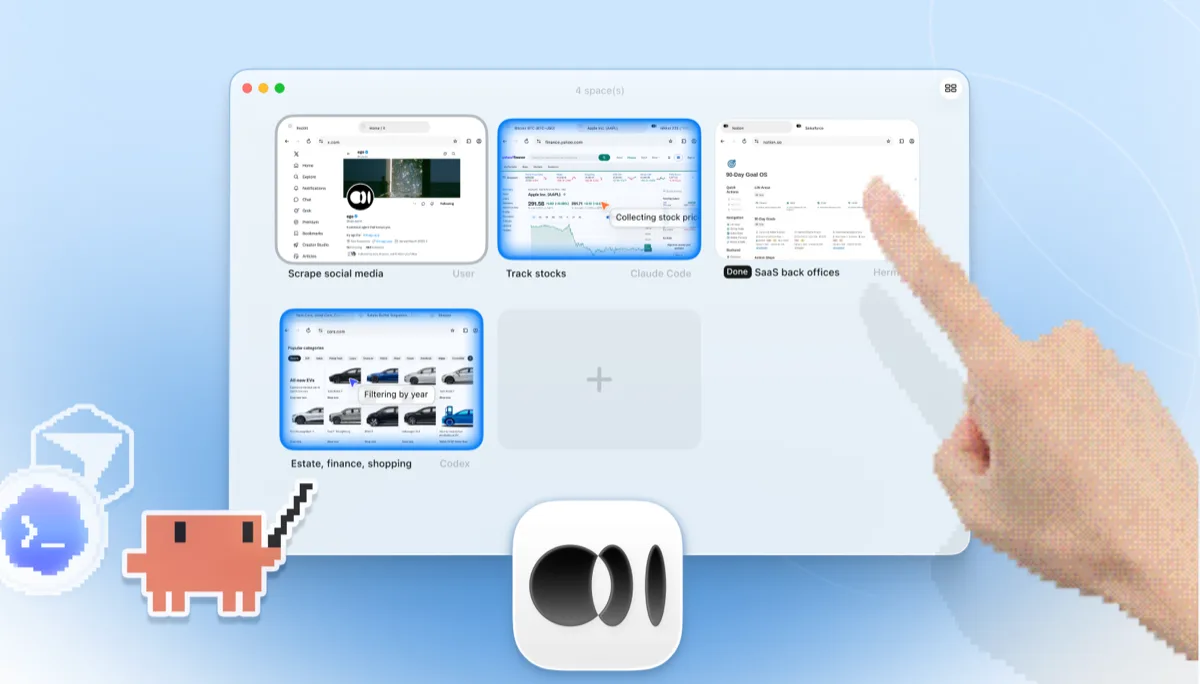
In ego lite there's no cap on Spaces: each runs its own task at once, on its own imported Chrome profile. None of them steal your tab, and you can watch or take over any Space anytime.

No more back and forth Cost fewer tokens

Browser Use's loop calls the model at every step and carries the page state along, and on longer tasks that cost compounds fast enough that users ask maintainers how to avoid burning tokens on a task that runs the same way every time.

Your agent in ego lite batches several actions in a few lines of JavaScript per turn instead of waiting on a fresh model call to keep going. Stacked with Snapshot input, the same task completes on far fewer tokens overall.

Claude Code · ego lite
>/ego-browser Add the first product to the cart, then check checkout loads
Bash(
ego-browser nodejs <<'EOF' await openOrReuseTab('localhost:3000') await click('.product-card') await click('.add-to-cart') await click('a[href="/checkout"]') cliLog('checkout loaded') EOF
)
Output:
[t=4480ms] checkout loaded
Done. Both steps work.
─── 1 tool call · 1.1k tokens ───
Browser Use · agent.run()
>$ python run_task.py 🎯 Task: Add the first product to the cart, then check checkout loads
📍 Step 1:
👍 Eval: Page loaded successfully
🧠 Memory: On demo store homepage, need to find a product
🎯 Next goal: Open first product and add it to cart
📍 Step 1: Ran 3 actions in 2.1s: ✅ 3
3.4k tokens sent so far
📍 Step 2:
👍 Eval: Product added to cart
🧠 Memory: Item in cart, now check checkout
🎯 Next goal: Navigate to checkout and confirm it loads
📍 Step 2: Ran 2 actions in 1.9s: ✅ 2
7.1k tokens sent so far
📍 Step 3:
👍 Eval: Checkout page did not load on first click
🧠 Memory: Link required a second click, retrying
🎯 Next goal: Retry the checkout link and wait for the form
📍 Step 3: Ran 1 action in 2.3s: ✅ 1
10.8k tokens sent so far
📍 Step 4:
👍 Eval: Payment form is present
🧠 Memory: Task complete
🎯 Next goal: done
📍 Step 4: Ran 1 action in 1.4s: ✅ 1
13.6k tokens sent so far
─── 4 model calls · 13.6k tokens ───
The same task, the same model. Left: one batched JavaScript call in ego lite, 1.1k tokens total. Right: Browser Use's agent loop, a fresh model call per step, tokens climb to 13.6k.

Same Chrome, agent-native

Browser Use launches its own Chromium over the DevTools protocol, and its GitHub issues are full of developers hitting profile-lock errors pointing it at their real Chrome: the --profile flag copies the live profile into a temp directory, and on Windows that copy fails outright while Chrome holds the file locks.

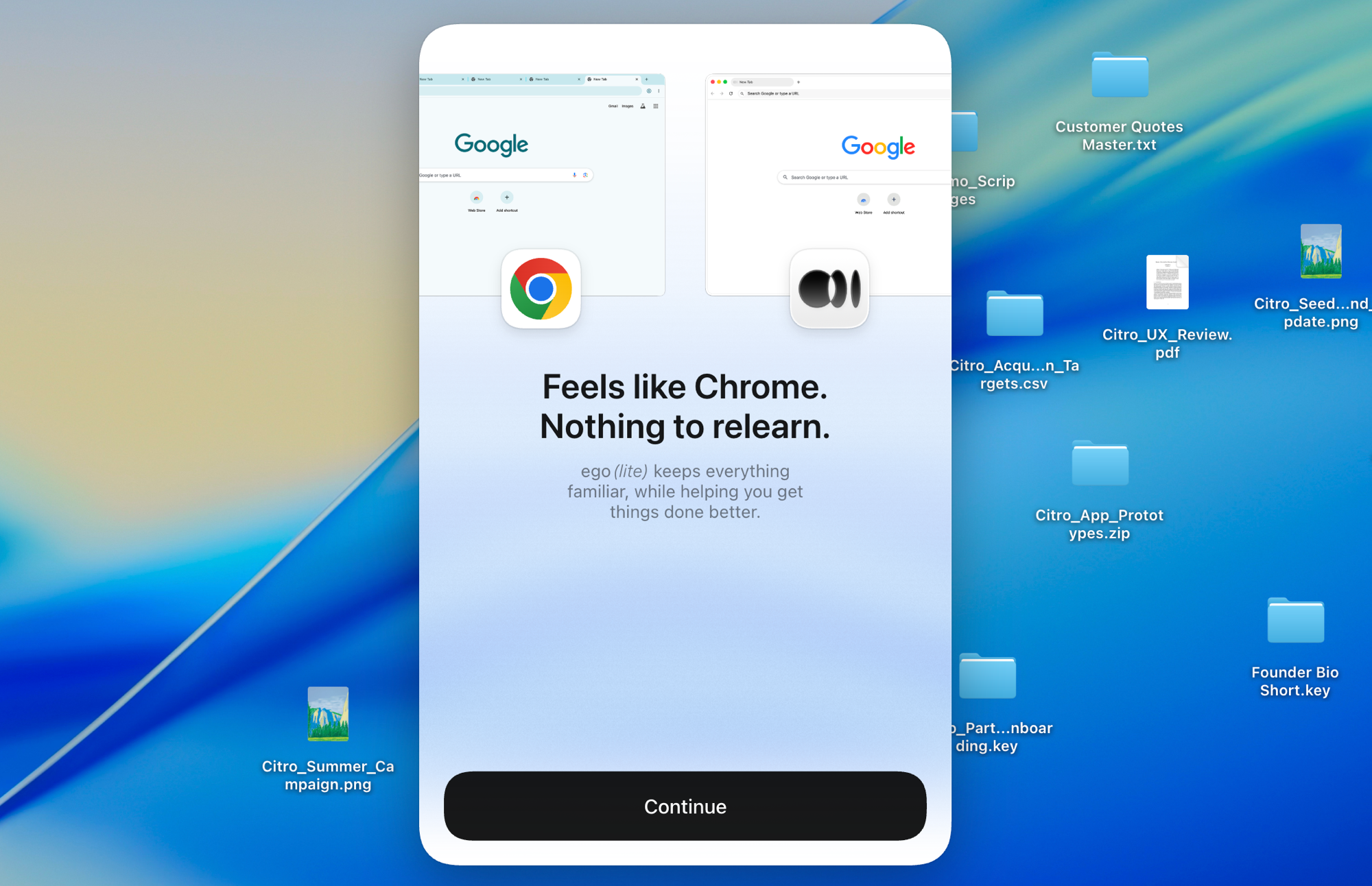
Built on Chromium, ego lite imports your entire Chrome setup in one click, live, with nothing to close first. Your agents inherit real logins without ever getting stuck.

ego lite Chrome profile import: one-click setup with all your logins

ego lite vs Browser Use

Feature comparison between ego lite and Browser Use.
Featureego liteBrowser Use
Who supplies the modelYour coding agent (Claude Code, Codex, Cursor)You, bring an LLM API key and pay per token
SetupInstall the app, run /ego-browser in your agentPython project, pip install, model config, task code
Logged-in sites (SSO, 2FA)One-click Chrome profile import, signed in by defaultLaunched Chromium; profile reuse is manual, with caveats
How actions executeSeveral actions batched per turn in JavaScriptAgent loop calls the model every step
Token cost per taskLower: Snapshot input plus batched actions, measured per taskHigher: every step re-sends page state through the model
Parallel tasksSpaces isolate tasks inside one visible browserExperimental; multiple agent instances, or the paid cloud
Doubles as your daily browserYes, you browse in your Space, agents work in theirsNo, an automation library and hosted browsers
Reusable skills (coming soon)Distills successful runs into reusable skills; up to 5x faster on complex tasks as the agent repeats them (limited beta)No built-in equivalent
PriceFree, no subscriptionOpen source free; cloud and LLM usage are paid
Last updated Jul 28, 2026

Make it a seamless transition

If you set up Browser Use to automate your own browsing (research, form filling, logged-in chores) rather than to ship a product, the switch removes the whole project layer.

  1. Download ego (lite)

    Download ego lite and import your Chrome profile in one click. The logins you were configuring Browser Use to reach come along automatically.

  2. Run your first task with /ego-browser

    Paste into your agent

    /ego-browser Open ego.app and join the waitlist

    Run /ego-browser in Claude Code, Codex, or Cursor. No Python environment, no model selection, no API key.

  3. Watch it work
    ego lite Spaces overview with four browser tasks running side by side: Claude Code tracking Apple stock on Yahoo Finance, Codex filtering cars by year on cars.com, Hermes finishing a SaaS back-office task, a user scraping X, and a hand tapping + to open another Space

    The task runs in its own Space, not a headless Chromium instance you can only guess at from logs. Watch it live or take over anytime, and the result lands back in your agent's CLI.

Keep Browser Use where it belongs: inside Python products and pipelines you're building for others. ego lite covers the agent browsing you do yourself.

When to use each tool

Choose ego (lite) when

  • You want an agent doing your own browser work (research, forms, logged-in chores) without building anything in Python.
  • You already run Claude Code, Codex, or Cursor and don't want a second agent loop with its own API-key bill.
  • The tasks need your real logins: one-click profile import beats manual Chromium profile configuration.
  • You want tasks running in parallel Spaces, in a headful browser you can watch or take over.

Choose Browser Use when

  • You're building a custom automation product or pipeline in Python. Browser Use is a library designed to be embedded.
  • You want to own the agent loop in your own code: pick the model, shape the prompts, control each step.
  • You need automations deployed to the cloud, running on hosted browsers when your laptop is closed.
  • You're shipping browser automation to others. ego lite is an end-user browser, not an SDK.

Give your agent a real browser

Free, runs on your Mac, imports your Chrome profile in one click. Works with Claude Code, Codex, Cursor, and any CLI agent that writes code.

Still weighing your options? See how Browser Use compares with the other tools in the same space.

FAQ

Browser Use is one of the most popular open-source AI browser agents: an MIT-licensed Python library that lets an LLM control a browser, launching its own Chromium over the DevTools protocol and deciding actions step by step against the page state. You bring your own model API key, and a paid cloud offering adds hosted browsers with stealth and captcha-solving features for production use. For developers building custom automation products and pipelines in Python, it's a strong, actively developed foundation. Browser Use vs Playwright and Browser Use vs Browserbase are the comparisons developers search most, since all three show up in most LLM-driven browsing stacks.

If you want an agent to do browser work for you, yes. ego lite plugs your existing coding agent into your real logged-in browser with no Python project and no API-key billing. If you're building a browser-automation product or pipeline in Python, Browser Use is the better fit: it's a library designed to be embedded, and ego lite isn't an SDK.

Yes, with manual configuration, and it's a common source of friction. The --profile flag copies your live Chrome profile into a temp directory, and on Windows that copy fails outright while Chrome is running and holding file locks, so the workaround is closing Chrome first. Connecting to an already-running Chrome over CDP works too, but Chrome 136 and later blocks CDP on your default profile, so most setups end up on a separate, non-default one. In ego lite, the real profile is the starting point: one-click import of logins, cookies, sessions, and extensions, shared safely with your own browsing through separate Spaces.

No. There's no separate model loop to fund. The intelligence comes from the coding agent you already run, whether that's Claude Code, Codex, Cursor, Gemini CLI, or Opencode. ego lite itself is free with no subscription.

Both are open-source tools for LLM-driven browsing, but Browser Use is a Python agent framework built around an autonomous loop, while Stagehand is Browserbase's TypeScript-first SDK with act/extract/observe primitives for hybrid code-plus-AI automation. Both are code-first: you scaffold a project and supply model access. See our ego lite vs Stagehand page for that side of the comparison.

They solve different layers. Browser Use is the agent framework; Browserbase is cloud browser infrastructure that frameworks run on. Teams often combine an agent library with hosted browsers for production scale, and that's a real win for cloud fleets. ego lite sits at neither layer: it's a local, headful browser for the agent work you do on your own machine, with your own accounts.

Its agent loop calls the model at every step, and each call carries a fresh serialized snapshot of the page just to plan the next batch of clicks. Users running recurring or long-horizon tasks have asked the maintainers how to cut that cost, since the same task run the same way still pays full model price every time. ego lite reduces the round trips themselves: the agent batches several actions in one JavaScript execution and reads pages as compressed Snapshots, so the savings compound over a whole task.

The ego-browser shell that connects agents to the browser is MIT-licensed open source. The ego lite browser itself is a free app for macOS, no subscription, and your data stays local.