





ego (lite) 只是一款浏览器;ego 才是你跨设备的个人 Agent。
加入候补名单
ego lite 对比 Codex browser

最好用的 Codex browser 替代品

Codex browser is @Browser in the ChatGPT desktop app: a local Chromium panel Codex can drive, with its own state separate from your Chrome. The Codex CLI has no browser at all.

Run /ego-browser and Codex controls ego lite, the browser you already use, in the CLI and on desktop. Import your Chrome profile and finish whole tasks 3 to 4x faster than Codex browser.

开发者用户来自
GoogleAmazonShopifyTikTokHarvardStanfordUSCUCLA

为什么 ego lite 比 Codex browser 更好

You keep Codex. ego lite is which browser it reaches for: your imported Chrome profile with sessions already in place, not a second Chromium you sign into site by site. It works from the CLI where @Browser cannot run, and it beats @Browser on speed, parallelism, tokens, and logins where it can.

真实任务中快 3 到 4 倍

In the Codex CLI there is no browser at all: the skill may appear, then report unavailable, and you verify changes yourself. On desktop, @Browser re-reads the page through domSnapshot() at every step, and the panel sits idle while Codex thinks.

Run /ego-browser and Codex controls ego lite directly. Every page arrives as a Snapshot: a compressed accessibility tree with stable @N refs Codex can act on instantly. Codex spends its time on the task, not waiting on snapshots or handoffs, finishing whole tasks 3 to 4x faster than Codex browser.

Time to finish a task, shorter is better
81.8 sego lite
282.9 sagent browser
Data source - Task: scrape the main posts from the X account from the last 7 days
并行多任务,执行更快

The CLI cannot run browser tasks in parallel because it has no browser. On desktop, @Browser is one panel on one task, and browser work draws from the same usage allowance as your coding work.

In ego lite there's no cap on how many Spaces you open inside the same browser: each one runs its own task at the same time, controlled by Codex or another coding agent via /ego-browser on its own imported Chrome profile. None of them ever steals the tab you're using, and you can watch or take over any Space anytime.

不再反复来回 消耗更少 Token

On desktop, every @Browser action is its own round trip through the model: domSnapshot(), click, domSnapshot() again. Each result comes back before the next move is chosen, and that spend comes out of the same allowance as your coding work. In the CLI there is no @Browser, so you never get this loop built in.

Run /ego-browser and Codex batches several actions in a few lines of JavaScript per turn to control ego lite. Stacked with Snapshot input, the same task completes on far fewer tokens overall.

Claude Code · ego lite
>/ego-browser Add the first product to the cart, then check checkout loads
Bash(
ego-browser nodejs <<'EOF' await openOrReuseTab('localhost:3000') await click('.product-card') await click('.add-to-cart') await click('a[href="/checkout"]') cliLog('checkout loaded') EOF
)
Output:
[t=4480ms] checkout loaded
Done. Both steps work.
─── 1 tool call · 1.1k tokens ───
Codex · @Browser
>Add the first product to the cart, then check checkout loads
browser.tabs.new() (@Browser)
Tab
Tab created (about:blank)
1.6k tokens sent so far
Approve localhost for this site, then navigate.
tab.goto (@Browser)("http://localhost:3000")
Result
Navigated to http://localhost:3000
2.8k tokens sent so far
Page is up. Reading the DOM before choosing a target.
tab.playwright.domSnapshot() (@Browser)
DOM snapshot
… +187 lines (ctrl+o to expand)
4.6k tokens sent so far
First product card is .product-card. Clicking it.
tab.playwright.locator(".product-card").click() (@Browser)
Result
Clicked .product-card
6.3k tokens sent so far
Product page rendered. Snapshot again: prior refs are stale.
tab.playwright.domSnapshot() (@Browser)
DOM snapshot
… +203 lines (ctrl+o to expand)
8.4k tokens sent so far
Add to cart is .add-to-cart.
tab.playwright.locator(".add-to-cart").click() (@Browser)
Result
Clicked .add-to-cart
10.2k tokens sent so far
Added. Opening checkout, then confirming the form with a snapshot.
tab.playwright.locator("a[href='/checkout']").click() (@Browser)
Result
Clicked a[href='/checkout']
tab.playwright.domSnapshot() → payment form present
13.6k tokens sent so far
─── 7 tool calls · 13.6k tokens ───
同样的任务,同样的模型。 左边:ego lite 里一次打包的 JavaScript 调用,总共 1.1k tokens。 右边:Codex 内置浏览器,7 次往返,token 涨到 13.6k。

同一个 Chrome,为 Agent 而生

In the CLI, Codex never sees your Chrome logins because there is no browser. On desktop, @Browser uses separate state: OpenAI's help center says it does not use your Chrome profile, cookies, tabs, or extensions. You sign into a second browser by hand, one site at a time.

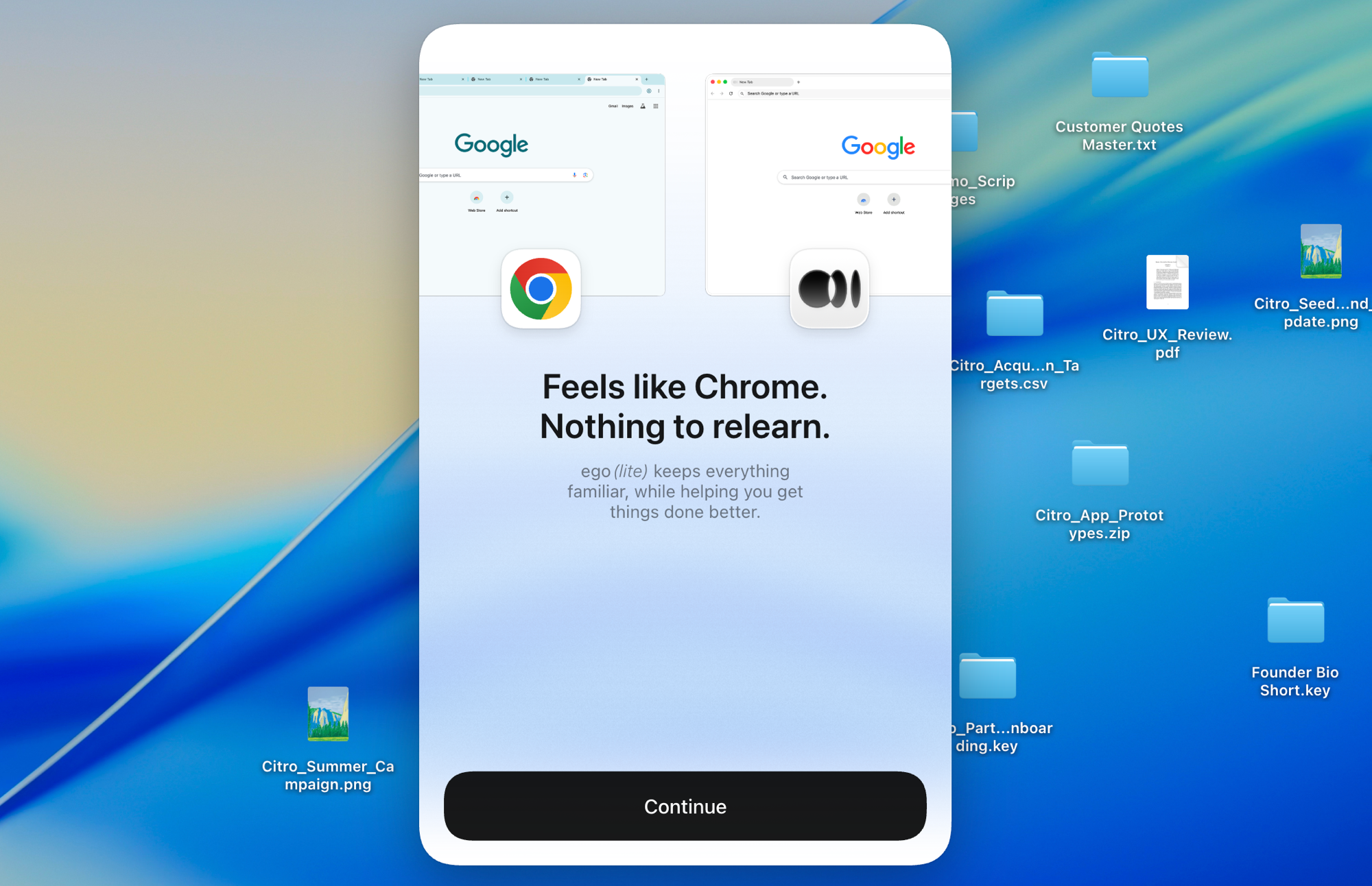
Built on Chromium, ego lite imports your entire Chrome setup in one click. When Codex runs /ego-browser, it controls ego lite with your real sessions already in place, including the 2FA trust you already have, so it doesn't stall on login walls you passed months ago.

ego lite 的 Chrome 浏览器配置文件导入:一键设置,保留所有登录状态

ego lite 对比 Codex browser

ego lite 与 Codex browser 的功能对比。
功能ego liteCodex browser
可在 Codex CLI 中使用Yes. Run /ego-browser and the coding agent controls ego liteNo. Only the desktop app has @Browser
复用你真实的 Chrome 登录状态Yes, one-click Chrome profile importNo. Separate browser state, signed in by hand per site
跨源 iframe 与 passkeySnapshot reaches into cross-origin iframes and shadow DOMOpen issues: cross-origin iframe input unsupported; passkeys incomplete
AI Agent 如何操作页面Coding agent batches multiple actions in JavaScript per turn via /ego-browserOne tool call per action, result read back each time
每个任务的 Token 消耗Lower: Snapshot plus batched actions, measured per task更高:每一步都要把上下文带回模型
工作按什么计费不需要额外东西。浏览器免费且在本地The same coding allowance as the rest of your Codex work (5-hour window plus a weekly cap)
并行任务隔离Unlimited Spaces in one browser, bounded by your machine每个会话一个内置浏览器面板
同时也是你的日常浏览器可以。你在自己的 Space 里浏览,Agent 在它们自己的 Space 里工作No. A separate panel with separate state
与真实账号隔离No. The coding agent controls ego lite inside your loginsYes, by design: separate state, no path to personal accounts
可复用技能(即将上线)将成功的运行过程提炼为可复用技能;Agent 重复执行复杂任务时最高可快 5 倍(限量测试中)没有内置的浏览器任务等价物
价格与可用性Free, no subscription. macOS, Chromium onlyIncluded with ChatGPT plans; Computer Use is region-limited
最近更新 2026年7月30日

让切换无缝衔接

You are not switching away from Codex. Run /ego-browser so Codex controls ego lite, a Chromium browser that already holds your sessions, from the CLI or alongside @Browser on desktop.

  1. 下载 ego (lite)

    下载 ego lite,一键导入你的 Chrome 浏览器配置文件,登录状态、Cookie 和扩展程序全部一起带过来。

  2. 用 /ego-browser 运行你的第一个任务

    粘贴到你的 Agent 里

    /ego-browser 打开 ego.app 加入等候名单

    Run /ego-browser in Codex and paste one sentence. Works in the CLI; no MCP config, no per-site approval step first.

  3. 看它开始工作
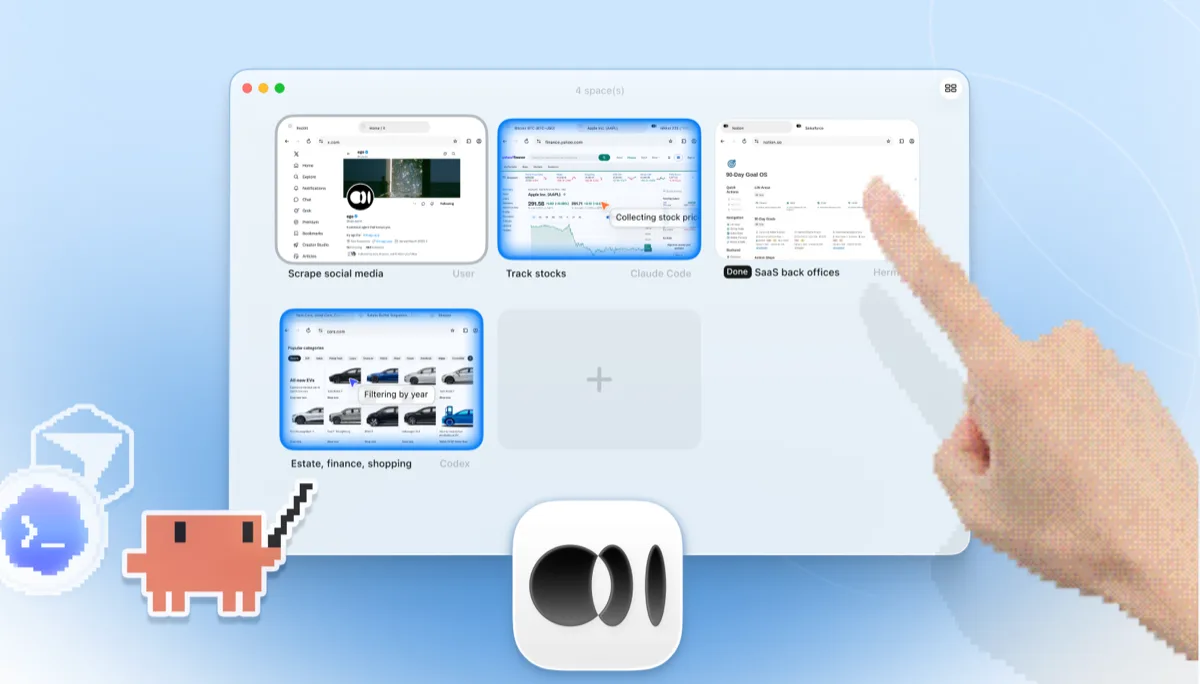
    ego lite 的 Space 概览,四个浏览器任务并排运行:Claude Code 在 Yahoo Finance 上追踪苹果股价,Codex 在 cars.com 上按年份筛选车型,Hermes 在完成一项 SaaS 后台任务,一位用户在抓取 X 上的数据,还有一只手正在点击 + 打开另一个 Space

    The task runs in its own Space, so your tabs stay untouched. Take over anytime. Results land back in the Codex CLI.

Keep @Browser on desktop for localhost previews and the annotation loop: select an element, comment, fix exactly that.

各工具的适用场景

以下情况选择 ego (lite)

  • You want browser work from the Codex CLI, where @Browser does not run.
  • Logged-in tasks should start in your real Chrome, not a second browser you authenticate site by site.
  • Even on desktop, whole tasks behind SSO feel slow in @Browser's one-panel, one-action loop.
  • You want parallel Spaces without spending Codex allowance on routine @Browser clicking.

以下情况选择 Codex browser

  • You want zero setup: @Browser is already in a ChatGPT plan you pay for.
  • You're debugging your own frontend on localhost and want CDP access from inside the agent.
  • You want the annotation loop: select an element, comment, fix exactly that.
  • You want the agent to have no path to your real accounts. Separate state is a deliberate safety tradeoff.

为你的 Agent 配备真实浏览器

免费使用,运行在你的 Mac 上,一键导入 Chrome 浏览器配置文件。支持 Claude Code、Codex、Cursor,以及任何能写代码的 CLI Agent。

还在权衡?看看 Codex browser 和同赛道其他工具怎么比。

常见问题

Codex browser is OpenAI's built-in browser for Codex, reached with @Browser in the ChatGPT desktop app. It is a local Chromium panel you can watch and take over, with DOM and accessibility-tree reading plus CDP access in Developer mode. For localhost frontend work it is genuinely good, and it is included in ChatGPT plans. It does not use your Chrome profile, and it is not available in the Codex CLI. The Codex Chrome extension is a separate surface covered on its own compare page.

Yes, for both surfaces. In the Codex CLI, ego lite is the Chromium browser Codex lacks. On desktop, it beats @Browser on speed, parallelism, tokens, and logins because Codex controls ego lite with batched JavaScript instead of one domSnapshot round trip per click. Keep @Browser for localhost previews and the annotation loop.

Codex browser use is OpenAI's @Browser feature in the ChatGPT desktop app: Codex can open pages, click, and inspect them in a local Chromium panel. The Codex CLI has no browser. Run /ego-browser and Codex controls ego lite, a Chromium browser with your imported Chrome profile, from the CLI and beats @Browser on whole logged-in tasks.

OpenAI Codex browser is the built-in Chromium panel reached with @Browser in the ChatGPT desktop app. It is local, not cloud, and separate from your Chrome profile. ego lite is not a replacement for Codex itself. It is the Chromium browser Codex controls when you run /ego-browser from the CLI or want your real Chrome sessions on desktop.

In the ChatGPT desktop app, yes, via @Browser for codex web browser tasks. In the Codex CLI, no: only web search snippets, no page control. Codex cloud blocks internet by default in the agent phase. Run /ego-browser so Codex controls ego lite, a Chromium browser, from the CLI.

No. The browser skill may still appear, then report unavailable. Run /ego-browser so Codex controls ego lite, a Chromium browser on your Mac, from the same terminal. On desktop, @Browser exists but uses separate state and a slower one-action loop; ego lite still wins for logged-in whole tasks.

On desktop, invoke @Browser and Codex drives its built-in panel one action at a time: tab.goto, domSnapshot, locator click. From the CLI, install ego lite, import your Chrome profile, and run /ego-browser so Codex controls ego lite against your real sessions with batched JavaScript instead of seven round trips per task.

Yes, into its own browser state, not your Chrome profile. OpenAI's help center points to the Codex Chrome extension when you need existing cookies or sessions. ego lite imports your profile once, so Codex starts inside the logins and 2FA trust you already have.

No. @Browser is an embedded Chromium panel in the desktop app on your machine. ChatGPT's separate cloud browser is a different surface. ego lite is also a local Chromium browser on your Mac: free, no subscription.

Yes. @Browser draws on the same coding allowance as the rest of your Codex work. ego lite adds no meter of its own; you only pay model tokens your agent already spends, and batched JavaScript keeps per-task totals lower than @Browser's one-action loop.

Playwright MCP works in the CLI but needs MCP config and one tool call per action against a blank profile. ego lite needs no MCP: run /ego-browser against your real Chrome profile from Codex, Claude Code, or Cursor. See ego lite vs Playwright MCP.