






ego (lite) is just a browser, ego is your personal agent across devices.
Join waitlist
ego lite vs Kimi Chrome extension

The Best Kimi Chrome extension Alternative

Kimi's Chrome extensions bring the agent to the browser you already have open. WebBridge lets CLI agents operate your live Chrome window. ego lite is a browser built for agents: they work in their own Spaces, in parallel, with your logins imported, while your tabs stay yours.

Trusted by developers from
GoogleAmazonShopifyTikTokHarvardStanfordUSCUCLA

Why ego lite is better than Kimi Chrome extension

Moonshot's WebBridge and ego lite agree on the important things: agents should run locally, work with your real logged-in sessions, and not be locked to one vendor's agent. The disagreement is architectural: whether the agent shares the window you're using, or gets a workspace of its own.

The agent never fights you for your browser again

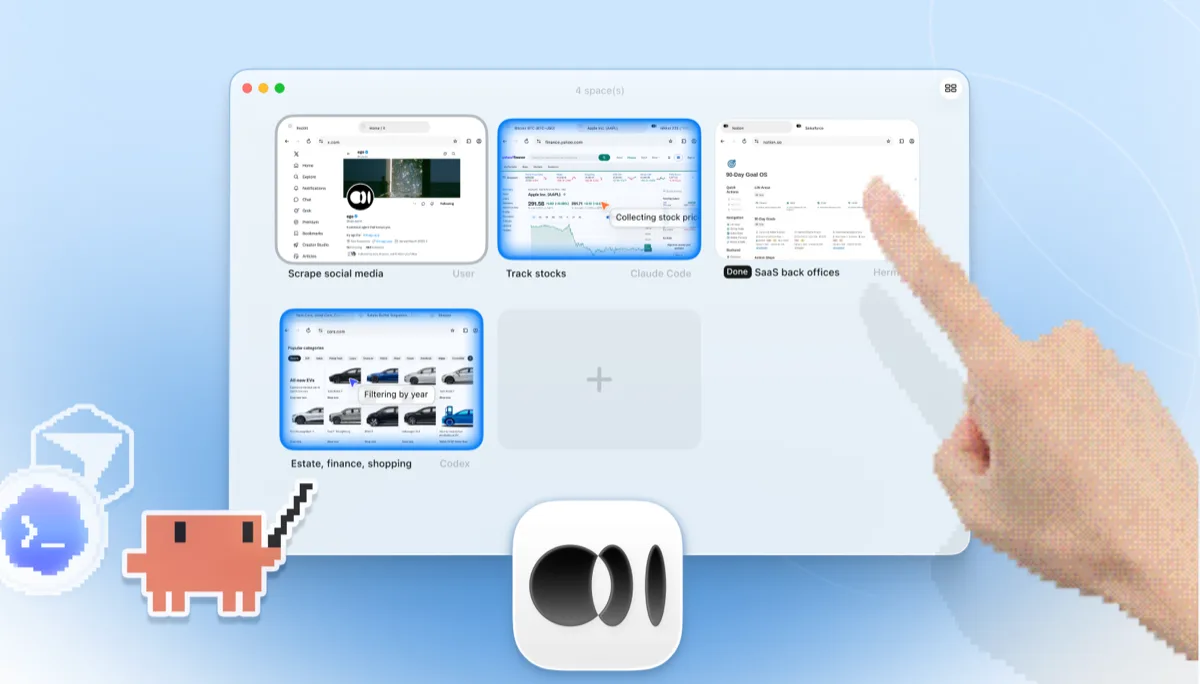
Because every task gets its own Space (a separate workspace inside the same browser), agents can run in parallel without ever touching the tabs you're using, and everything stays visible while it works.

WebBridge works the opposite way: the agent operates inside the same Chrome or Edge window you already have open (the very window you're trying to use), so you and the agent end up sharing one browser.
Faster on both tasks, measured against Kimi WebBridge

WebBridge's agent (even running Kimi's own K3 model at high reasoning effort) works through Chrome DevTools Protocol tool calls: one click, one read, one keystroke at a time. On two real tasks, ranking OpenAI's X posts took WebBridge 4 minutes 57 seconds, and the Expedia flight-booking task took 15 minutes 26 seconds.

ego lite reads the page as a compressed Snapshot and batches several actions into a few lines of JavaScript per turn. On the same two tasks, ego lite finished in 87 seconds and 166 seconds: 3.41x faster and roughly 5.6x faster.

Time to finish the same tasks, shorter is better
Task 1: Rank OpenAI's X posts from the last 7 days
87 sego lite
297 sKimi WebBridge (K3 high)
Task 2: Expedia: search, filter, and fill a flight booking
166 sego lite
926 sKimi WebBridge (K3 high)

Both keep things local and open: ego lite adds parallel tasks

Credit where it's due: WebBridge is free, keeps everything running locally, and works with agents beyond Kimi's own, including Claude Code, Cursor, and Codex. But it's still one browser window shared between you and the agent, one task at a time.

ego lite keeps that same local, open approach and adds parallel Spaces on top, so several tasks can run at once, using whatever agent you already have.

One app instead of a three-piece bridge that can fall out of sync

WebBridge really is a bridge: Chrome, the WebBridge extension, and the Kimi desktop app's local service all have to be running and correctly paired before an agent can control a page. Moonshot's own FAQ documents this as a common problem: the extension shows as disconnected if the local service isn't running yet, and actions like snapshot or click can fail if another extension conflicts with WebBridge.

ego lite collapses all of that into a single install, because ego lite is the browser. Import your Chrome profile, run /ego-browser, and there's no separate service to pair and nothing else that can conflict with it.

ego lite Chrome profile import: one install, no pairing step, nothing to fall out of sync

ego lite vs Kimi Chrome extension

Feature comparison between ego lite and Kimi Chrome extension.
Featureego liteKimi Chrome extension
What it isA Chromium browser built for you and your agentsExtensions for the Chrome you already use
Where the agent worksIn its own Space: never the tabs you're usingIn your live Chrome/Edge window and session
Parallel tasksYes: multiple Spaces run side by sideOne shared window between you and the agent
SetupInstall one app, run /ego-browser in your agentChrome + WebBridge extension + Kimi desktop app, paired
Agents supportedClaude Code, Codex, Cursor, Gemini CLI, any code-writing CLI agentKimi Code CLI, Claude Code, Cursor, Codex, also agent-agnostic
How the agent reads and acts on pagesCompressed Snapshot with @N refs; batched JavaScript per turnBrowser actions exposed over CDP; agent calls them step by step
Logged-in sites (SSO, 2FA)Yes: one-click Chrome profile importYes: it drives your already-signed-in browser
ReliabilityOne install, no pairing step, nothing else to conflict withMoonshot's own FAQ documents disconnects when the local service isn't running and action failures from conflicts with other extensions
Speed on a real task87s vs WebBridge's 4:57 on the same X-research task; 166s vs WebBridge's 15:26 on the same Expedia flight taskReasons and calls a tool for every click and keystroke: slower on both real tasks tested
Data localityLocal: data stored on your machineLocal: execution and page content stay on device
PriceFree, no subscriptionFree extensions; Kimi's own agent has its own pricing
Last updated Aug 04, 2026

Make it a seamless transition

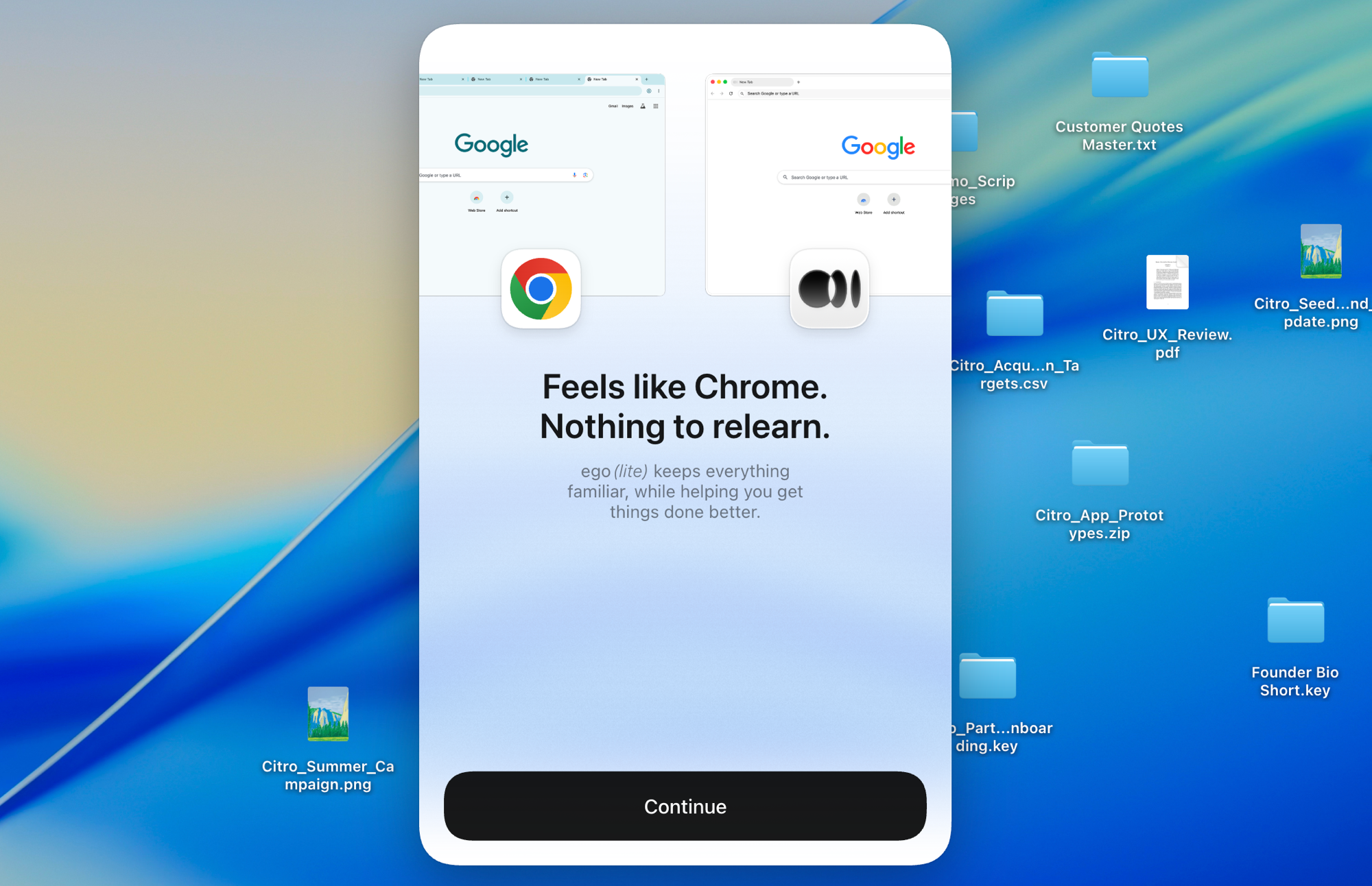
If WebBridge already connects your CLI agent to a browser, you know the workflow. ego lite keeps it and removes the sharing and the pairing.

  1. Download ego (lite)

    Download ego lite and import your Chrome profile in one click. The logged-in sessions WebBridge borrows from your window come along as real profile state.

  2. Run your first task with /ego-browser

    Paste into your agent

    /ego-browser Open ego.app and join the waitlist

    Run /ego-browser inside Claude Code, Codex, Cursor, or the CLI agent you were pointing at WebBridge. No extension, no desktop-app pairing.

  3. Watch it work
    ego lite Spaces overview with four browser tasks running side by side: Claude Code tracking Apple stock on Yahoo Finance, Codex filtering cars by year on cars.com, Hermes finishing a SaaS back-office task, a user scraping X, and a hand tapping + to open another Space

    Re-run your last WebBridge task and keep using your own browser while it executes: the agent works in its Space, you work in yours.

Keep Kimi Explorer if you like its summarize-and-ask reading workflow; ego lite replaces the agent-drives-the-browser layer, not the page assistant.

When to use each tool

Choose ego (lite) when

  • You want agents in their own Spaces, running tasks in parallel, while the tabs you're using stay yours.
  • You want one install instead of three pieces: no extension, no desktop-app pairing to fall out of sync. Import your profile and run /ego-browser.
  • You care about per-task speed: compressed Snapshots plus batched multi-action JavaScript beat WebBridge's step-by-step CDP tool calls: 87s vs 4:57 on the same X-research task, 166s vs 15:26 on the same Expedia flight task.
  • Your logins matter and should be real profile state, imported once, not borrowed from whatever window is open.

Choose Kimi Chrome extension when

  • You're already in the Kimi ecosystem (Kimi Code CLI and the desktop app), and WebBridge is the native fit.
  • You specifically want agents driving the exact Chrome or Edge you already have open, unchanged, with its live sessions.
  • You want to stay in your current browser entirely: no new browser to install or switch to, just an extension in the one you use.

Give your agent a real browser

Free, runs on your Mac, imports your Chrome profile in one click. Works with Claude Code, Codex, Cursor, and any CLI agent that writes code.

Still weighing your options? See how Kimi Chrome extension compares with the other tools in the same space.

FAQ

Moonshot AI ships two Chrome extensions under the Kimi name. Kimi Explorer is a reading assistant: summarize the page you're on, ask questions about it, get writing help without switching tabs. Kimi WebBridge, released in May 2026, is the agent one; it pairs with the Kimi desktop app to let CLI agents (Kimi Code CLI, Claude Code, Cursor, Codex) operate your existing Chrome or Edge window locally, with cookies and logins intact and page content staying on your device. WebBridge's local-first, agent-agnostic design is genuinely good, and philosophically the closest thing to ego lite in the extension world.

Kimi Explorer is a page assistant: summarize the article you're reading, ask questions about it, draft text. Kimi WebBridge is agent infrastructure: paired with the Kimi desktop app, it lets CLI agents operate your Chrome or Edge window locally. If you're comparing against ego lite, WebBridge is the relevant one.

Yes, if you want the same local, agent-agnostic approach without sharing your window or the three-piece pairing. ego lite runs agents in their own Spaces in parallel, imports your Chrome profile so logins persist, and needs one app instead of an extension-plus-desktop-app pair. WebBridge wins if you specifically want agents driving the exact browser you already have installed, unchanged.

Moonshot's own help center documents two common failure modes worth knowing before you rely on it: the extension shows disconnected when the local Kimi service isn't running yet, and actions like snapshot or click can fail when another installed extension (scraping tools, AI assistants) conflicts with WebBridge, which the FAQ suggests troubleshooting by disabling other extensions one at a time. ego lite has no local service to keep running and no extension it can conflict with, since it is the browser.

Any CLI agent that writes code can plug in through the open-source, MIT-licensed ego-browser shell. That includes custom agents. Claude Code, Codex, Cursor, Gemini CLI, and Opencode are the documented entry points; a code-writing CLI agent like Kimi's connects the same way.

In ego lite, yes: agents run tasks in their own Spaces and never take the tabs you're using, and you can watch or take over any Space. With WebBridge, the agent operates the window you have open, so an active task and active browsing compete for the same session.

Yes: free, no subscription, data stored locally, and the ego-browser shell is MIT-licensed open source. You bring your own agent and pay only whatever that agent already costs you.