






ego (lite) es solo un navegador, ego es su agente personal en todos sus dispositivos.
Únanse a la lista de espera
ego lite vs extensión de Codex para Chrome

La mejor alternativa a la extensión de Codex para Chrome

OpenAI's Codex Chrome extension lets Codex take over tabs in the signed-in Chrome you're using, one browser shared between you and the agent. ego lite gives Codex its own Spaces in a separate browser that inherited your logins, so it works in parallel while your tabs stay yours.

Con la confianza de desarrolladores de
GoogleAmazonShopifyTikTokHarvardStanfordUSCUCLA

Por qué ego lite es mejor que la extensión de Codex para Chrome

Both exist for the same reason: Codex needs logged-in browser context to be useful on real sites. The extension borrows yours. ego lite imports your Chrome profile once and gives Codex a browser of its own. Run /ego-browser inside Codex and it's connected.

The agent never fights you for your browser again

Because every task gets its own Space (a separate workspace inside one browser), Codex can run several tasks in parallel without ever touching the tabs you're using, and there's no permission prompt each time it opens a new site.

The Codex Chrome extension works differently: it takes over your existing Chrome tabs and acts inside the session you're already using, one task at a time. Because the agent is acting inside your live, logged-in browser, OpenAI has Codex ask for approval before touching each new website, so real tasks pause for permission clicks.

6.48x faster, and it finished the task the extension couldn't

Codex Chrome extension acts one click, one keystroke, one tool call at a time, and on real tasks that adds up: ranking OpenAI's X posts took it 9 minutes 24 seconds. On the Expedia flight-booking task, it never finished at all. A safety review blocked it after 15 minutes.

ego lite reads the page as a compressed Snapshot and batches several actions into a few lines of JavaScript per turn. Same two tasks: 87 seconds, and 166 seconds to completion. That's 6.48x faster on the first, and the only one of the two that finished.

Time to finish the same tasks, shorter is better
Task 1: Rank OpenAI's X posts from the last 7 days
87 sego (lite)
564 sCodex Chrome extension
Task 2: Expedia: search, filter, and fill a flight booking
166 sego (lite)
BlockedCodex Chrome extension, after 900 s

Works with Codex, and with everything else, in parallel

The extension only works with Codex, only in official Chrome (not Arc, Brave, or Edge), and it needs the Codex desktop app running and paired before anything works at all.

ego lite works with any code-writing CLI agent (Codex, Claude Code, Cursor, Gemini CLI) and runs several of their tasks in parallel. Switch agents later, and the browser side stays exactly the same.

Works from Codex's terminal: the plugin doesn't

The Codex Chrome extension only works through the Codex desktop app. OpenAI's own GitHub issues confirm that a terminal-only Codex CLI session can't reach the extension at all. The request fails immediately with the error "Browser is not available: extension."

ego lite works the same whether Codex is running in a terminal or as a desktop app: run /ego-browser, and the agent gets a real browser of its own either way.

ego lite Chrome profile import: the same setup whether Codex runs in a terminal or as a desktop app

ego lite vs extensión de Codex para Chrome

Feature comparison between ego lite and Codex Chrome extension.
Funciónego liteCodex Chrome extension
Dónde trabaja el agenteIn its own Space: never the tabs you're usingEn tu Chrome con sesión iniciada, tomando pestañas existentes
Seguir trabajando mientras correYes: parallel Spaces, you browse in yoursNot really: it's driving the browser you're in
Agentes compatiblesCodex, Claude Code, Cursor, Gemini CLI, cualquier agente de CLI que escriba códigoSolo Codex
Navegador requeridoNone: ego lite is the browser (Chromium, macOS)Solo Chrome oficial; sin Arc, Brave ni Edge
ConfiguraciónInstala la app, corre /ego-browser dentro de CodexApp de escritorio de Codex, luego instala la extensión desde su menú Plugins
Sitios con sesión iniciada (SSO, 2FA)Yes: one-click Chrome profile importYes: it acts in your already-signed-in Chrome
Modelo de permisosOtorga el estado de sesión una vez vía importación de perfil; observa o toma el control de cualquier SpaceAvisos de aprobación por sitio web, lista de dominios permitidos/bloqueados
Extension reliabilityN/A: no native-messaging pairing between an extension and a desktop appOpenAI's own GitHub issues show a recurring pattern of the extension and desktop app disagreeing on connection state, plus native-host registration and handshake timeouts on Windows
Cómo actúa el agente en las páginasSnapshot input plus batched JavaScript: several actions per turnAcciones de navegador paso a paso en tus pestañas
Speed on a real task87s vs Codex's 9:24 on the same X-research task; 166s on the same Expedia flight task9:24 on the X-research task; blocked by a safety review after 15 minutes on the Expedia flight task, never finished
PrecioGratis, sin suscripciónIncluded with Codex: requires a ChatGPT plan with Codex access
Works from Codex's terminalYes: /ego-browser works the same in a terminal or a desktop appNo: the CLI can't reach the extension backend at all ("Browser is not available: extension")
Última actualización 04 ago 2026

Hacé de esto una transición sin fricciones

Already running the Codex Chrome extension? You keep Codex and change what it drives. The switch is a few minutes, and nothing has to be uninstalled.

  1. Descargar ego (lite)

    Download ego lite and import your Chrome profile in one click. The signed-in context the extension borrows from Chrome becomes real profile state in a browser Codex can call its own.

  2. Ejecuta tu primera tarea con /ego-browser

    Pega esto en tu agente

    /ego-browser Open ego.app and join the waitlist

    Corre /ego-browser dentro de Codex. Sin plugin de app de escritorio, sin emparejar extensiones.

  3. Míralo en acción
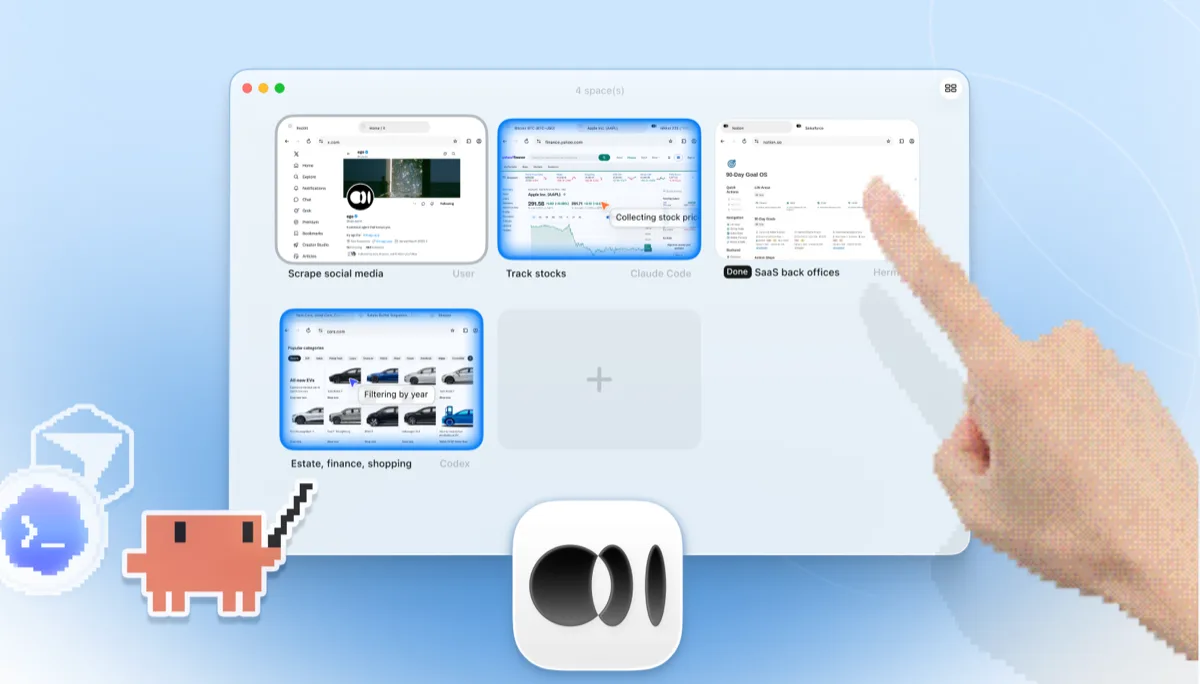
    Vista general de Spaces en ego lite con cuatro tareas de navegador corriendo en paralelo: Claude Code siguiendo la acción de Apple en Yahoo Finance, Codex filtrando autos por año en cars.com, Hermes terminando una tarea de back-office de SaaS, un usuario haciendo scraping en X, y una mano tocando + para abrir otro Space

    Re-run a task you'd normally hand the extension (a dashboard read, a form workflow, a multi-tab test) and keep using your own browser while it executes in its Space.

Conserva la extensión si algunos flujos están conectados a ella; ego lite corre junto a Chrome, así que nada se rompe mientras comparas.

Cuándo usar cada herramienta

Elegí ego (lite) cuando

  • You run Codex from a terminal, where the extension's backend isn't reachable from CLI sessions at all. Run /ego-browser and the agent gets a browser regardless.
  • You want Codex running longer, multi-step tasks in its own Spaces, in parallel, while your tabs stay yours.
  • Prefieres otorgar el estado de sesión una vez vía importación de perfil que hacer clic en avisos de aprobación por sitio a mitad de la tarea.
  • You use other agents too: the same /ego-browser setup works with Claude Code, Cursor, and Gemini CLI, not just Codex.

Elige la extensión de Codex para Chrome cuando

  • You're already running the Codex desktop app, and the extension is right there in its Plugins menu, with no extra install.
  • You want a quick action on a page you already have open: handing Codex your live Chrome session is the shortest path.
  • Valoras las salvaguardas oficiales de OpenAI: avisos de aprobación por sitio web y listas de dominios permitidos envolviendo cada acción.

Dale a tu agente un navegador real

Gratis, funciona en tu Mac e importa tu perfil de Chrome con un clic. Funciona con Claude Code, Codex, Cursor y cualquier agente de CLI que escriba código.

Still weighing your options? See how Codex Chrome extension compares with the other tools in the same space.

Preguntas frecuentes

The Codex Chrome extension is OpenAI's official way to give Codex a browser, launched in May 2026 and installed through the Codex desktop app's Plugins menu. It lets Codex act in your signed-in Chrome for tasks that need logged-in context (reading dashboards, filling forms, testing sites across tabs) with a genuinely careful permission model: Codex asks before touching each new website, and you manage domain allowlists and blocklists. If you're all-in on Codex and official Chrome, it's a polished, well-scoped tool.

Sí. OpenAI la lanzó en mayo de 2026 como parte del sistema de plugins de la app de escritorio de Codex, y llegó al EEE, el Reino Unido y Suiza en junio de 2026. Deja que Codex actúe en tu Chrome con sesión iniciada para tareas que necesitan contexto autenticado, con avisos de permiso por sitio.

Si quieres que Codex haga trabajo de navegador sin ocupar el navegador que estás usando, sí. ego lite le da a Codex sus propios Spaces con tus sesiones importadas, corre tareas en paralelo y es gratis. La extensión gana si quieres específicamente la vía oficial de un solo proveedor dentro de Chrome, con las salvaguardas de avisos de aprobación de OpenAI.

Install ego lite, import your Chrome profile, then run /ego-browser inside Codex. The agent reads pages as compressed Snapshots and executes batched JavaScript in the browser. No extension, no MCP server, no plugin configuration.

No. As of mid-2026 it supports official Chrome only. ego lite sidesteps the question: it is its own Chromium-based browser on macOS, and your existing Chrome profile imports into it in one click.

No. It's bound to the Codex desktop app. OpenAI's own GitHub issues confirm a terminal-only Codex CLI session can't acquire the extension backend at all, failing with "Browser is not available: extension." ego lite doesn't make that distinction: install ego lite and run /ego-browser inside Codex, terminal or desktop app, and the agent gets a real browser either way.

You're not alone. OpenAI's own GitHub issue tracker has a recurring thread of reports where the extension and the Codex desktop app disagree on whether they're connected, plus native-host registration and handshake timeouts, mostly on Windows. That's the tradeoff of pairing a browser extension to a separate desktop app over native messaging. ego lite doesn't have that pairing step: it is the browser Codex drives directly.

Yes. They don't conflict: the extension lives in Chrome, ego lite is a separate browser. A common split: the extension for quick actions in a page you already have open, ego lite for longer parallel tasks you don't want running in your active window.