





ego (lite) es solo un navegador, ego es tu agente personal en todos tus dispositivos.
Únete a la lista de espera
ego lite vs Selenium

La mejor alternativa a Selenium

Selenium is the W3C WebDriver standard for cross-browser tests: you write the script, tune the waits, and run it against a fresh browser with no logins.

ego lite is a Selenium alternative for AI agents. There is no script, no driver, and no Grid. Run /ego-browser and your coding agent controls ego lite, reading each page as a Snapshot and writing its own JavaScript, finishing whole tasks 3 to 4x faster than Selenium.

Con la confianza de desarrolladores de
GoogleAmazonShopifyTikTokHarvardStanfordUSCUCLA

Por qué ego lite es mejor que Selenium

Selenium still owns cross-browser regression in CI. Agent work inside the browser you already live in is a different job. Run /ego-browser in Claude Code, Codex, or Cursor and describe what you want.

De 3 a 4 veces más rápido en tareas reales

Selenium's timing pain is familiar: waits you keep tuning, elements that go stale mid-click, retries baked into the starter config, and "Element is not clickable at point" forever on Stack Overflow.

Run /ego-browser and your coding agent controls ego lite, reading each page as a Snapshot with stable @N refs, acting on what's on the page, and reading again only if the page moved, finishing whole tasks 3 to 4x faster than Selenium.

Time to finish a task, shorter is better
81.8 sego lite
282.9 sagent browser
Data source - Task: scrape the main posts from the X account from the last 7 days

Multitarea en paralelo, ejecución más rápida

Running two browser chores at once in Selenium means either juggling parallel driver sessions yourself or standing up Grid. That is the right machinery for a nightly cross-browser matrix, and far too much for three things you want done before lunch.

In ego lite there's no cap on how many Spaces you open inside the same browser: each one runs its own task at the same time, controlled by a coding agent via /ego-browser on its own imported Chrome profile. None of them ever steals the tab you're using, and you can watch or take over any Space anytime.

No más idas y vueltas Menos tokens

Raw Selenium scripts spend no tokens because there is no model in the loop. Wrap WebDriver for an agent and the bill shows up fast: Selenium still has no official MCP server, and community servers often dump a heavy DOM tree into the model's context.

Run /ego-browser and your coding agent batches several actions in a few lines of JavaScript per turn to control ego lite, reading pages as Snapshots of roughly 200 to 400 tokens. Stacked together, the same task completes on far fewer tokens overall.

Claude Code · ego lite
>/ego-browser Add the first product to the cart, then check checkout loads
Bash(
ego-browser nodejs <<'EOF' await openOrReuseTab('localhost:3000') await click('.product-card') await click('.add-to-cart') await click('a[href="/checkout"]') cliLog('checkout loaded') EOF
)
Output:
[t=4480ms] checkout loaded
Done. Both steps work.
─── 1 tool call · 1.1k tokens ───
Claude Code · mcp-selenium
>Add the first product to the cart, then check checkout loads
selenium - start_browser (MCP)(browser: "chrome")
Result
Browser started with session_id 4f1c…
1.6k tokens sent so far
Fresh Chrome, no cookies and no logins. Loading the storefront.
selenium - navigate (MCP)(url: "localhost:3000")
Result
Navigated to localhost:3000
3.1k tokens sent so far
Nothing came back about the page itself. Reading the accessibility resource to find the first product.
selenium - accessibility://current
Accessibility tree
… +214 lines (ctrl+o to expand)
4.9k tokens sent so far
First product card is .product-card. Clicking it.
selenium - interact (MCP)(action: "click", by: "css", value: ".product-card")
Result
Clicked element
6.8k tokens sent so far
Product page is up, so everything I just read is out of date. Reading the tree again.
selenium - accessibility://current
Accessibility tree
… +206 lines (ctrl+o to expand)
9.2k tokens sent so far
Add to cart is .add-to-cart.
selenium - interact (MCP)(action: "click", by: "css", value: ".add-to-cart")
Result
Clicked element
11.2k tokens sent so far
Added. Opening checkout, then I still have to confirm it loaded.
selenium - interact (MCP)(action: "click", by: "css", value: "a[href='/checkout']")
Result
Clicked element
13.6k tokens sent so far
─── 7 tool calls · 13.6k tokens ───
La misma tarea, el mismo modelo. Izquierda: una llamada de JavaScript en lote en ego lite, 1,1k tokens en total. Derecha: Selenium a través de un servidor MCP comunitario, 7 idas y vueltas, los tokens suben a 13,6k.

El mismo Chrome, nativo para agentes

Selenium cannot attach to the Chrome profile you are already using. Point ChromeDriver at it while Chrome is open and you get "user data directory is already in use."

Built on Chromium, ego lite imports your entire Chrome setup in one click. When your coding agent runs /ego-browser, it controls ego lite with your real sessions already in place, so it doesn't stall on SSO, 2FA, or captchas on accounts you already have.

Importación de perfil de Chrome en ego lite: configuración con un clic y todas tus sesiones iniciadas

ego lite vs Selenium

Comparación de funciones entre ego lite y Selenium.
Funciónego liteSelenium
Cómo se hace el trabajoDescribe the task; coding agent controls ego lite via /ego-browserEscribe scripts WebDriver en Java, Python, C#, Ruby o JavaScript
Esperas e inestabilidadCoding agent reads Snapshots and acts via /ego-browserExplicit waits, stale-element handling, retry counts
Reutiliza tus sesiones reales de ChromeYes, one-click Chrome profile importNo. Fresh session per run; a live Chrome profile is locked
ConfiguraciónInstall ego lite, run /ego-browser in your agentLanguage project plus a driver per browser
Funciona con agentes de IABuilt for them via /ego-browserNo official MCP; community servers like mcp-selenium
Tareas en paraleloLos Spaces aíslan las tareas dentro de un único navegador visibleNodos de Grid o sesiones de driver en paralelo que operas tú
Alcance multi-navegadorSolo ChromiumChrome, Edge, Firefox, and Safari via WebDriver
Navegador de uso diarioSí. Tú navegas en tu Space, los agentes trabajan en el suyoNo, una librería de automatización para pruebas
Habilidades reutilizables (próximamente)Destila las ejecuciones exitosas en habilidades reutilizables; hasta 5 veces más rápido en tareas complejas a medida que el agente las repite (beta limitada)Sin equivalente integrado
PrecioGratis, sin suscripciónFree, Apache-2.0 (Grid capacity is your cost)
Última actualización 30 jul 2026

Haz que la transición sea perfecta

Don't port your WebDriver suite. Move the interactive, logged-in work that never fit a regression suite to ego lite in a few minutes.

  1. Descarga ego (lite)

    Descarga ego lite e importa tu perfil de Chrome con un clic. Las sesiones iniciadas, las cookies y las extensiones se importan con él.

  2. Ejecuta tu primera tarea con /ego-browser

    Pégalo en tu agente

    /ego-browser Abre ego.app y enumera el texto de cada botón de la página

    Paste one sentence into Claude Code, Codex, or Cursor and hit enter. No driver binary, no Grid, no MCP config.

  3. Míralo trabajar
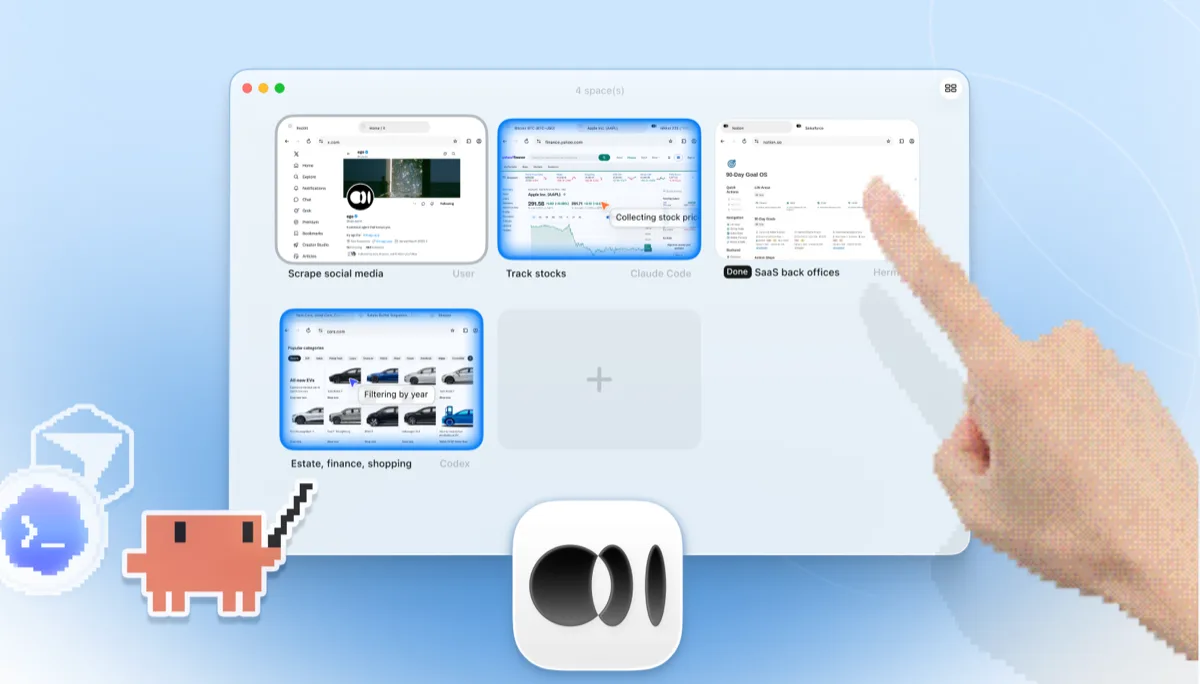
    Vista general de los Spaces de ego lite con cuatro tareas de navegador ejecutándose en paralelo: Claude Code siguiendo la cotización de Apple en Yahoo Finance, Codex filtrando coches por año en cars.com, Hermes terminando una tarea de back-office de un SaaS, un usuario haciendo scraping en X, y una mano pulsando + para abrir otro Space

    The task runs in its own Space, so your tabs stay untouched. Watch live or take over anytime. Results land back in your agent's CLI.

Keep Selenium for cross-browser regression in CI.

Cuándo usar cada herramienta

Elige ego (lite) cuando

  • Your tasks touch logged-in sites: dashboards, admin panels, anything behind SSO or 2FA.
  • Interactive, one-off browser work that never belonged in a regression suite.
  • You want several tasks running in parallel Spaces without standing up Grid.
  • You care about per-task token cost. Snapshot input plus batched JavaScript beats one MCP call per action.

Elige Selenium cuando

  • You need Firefox and Safari coverage. ego lite is Chromium only.
  • Your team writes tests in Java, Python, C#, Ruby, or JavaScript with official WebDriver bindings.
  • You run enterprise regression on Selenium Grid.
  • You want the WebDriver standard, Apache-2.0 governance, and decades of QA answers on Stack Overflow.

Dale a tu agente un navegador real

Gratis, se ejecuta en tu Mac e importa tu perfil de Chrome con un solo clic. Funciona con Claude Code, Codex, Cursor y cualquier agente de CLI que escriba código.

¿Todavía sopesas tus opciones? Mira cómo se compara Selenium con las otras herramientas del mismo espacio.

Preguntas frecuentes

Selenium is the industry's longest-running browser automation project and the reference WebDriver implementation, with bindings for Java, Python, C#, Ruby, and JavaScript plus Grid for distributed cross-browser runs. It is excellent for QA regression. Searches like Selenium vs Playwright or Selenium vs Puppeteer usually compare test frameworks; this page is about what changes when an AI agent, not a script, browses inside a browser you are already signed into.

Yes for agent-driven, logged-in browser work: describe the task, no WebDriver script, no driver binary. No for cross-browser regression suites or Selenium Grid pipelines in CI. Keep Selenium for committed tests; use ego lite for interactive work that never fit a suite.

Selenium was built for deterministic test scripts, not LLM-driven loops. Wrapping WebDriver for an agent means heavy DOM dumps or community MCP servers like mcp-selenium, with no official Selenium MCP from the project. ego lite is built for agents from the start: run /ego-browser and your coding agent controls ego lite with Snapshot input and batched JavaScript.

There is no official Selenium MCP server. Maintainers have noted that interactive LLM sessions saturate context quickly. Community servers like mcp-selenium exist but often re-read a heavy accessibility tree on every page change. ego lite skips MCP entirely: run /ego-browser in Claude Code, Codex, or Cursor.

Not the profile Chrome is already using. Selenium's issue tracker documents that ChromeDriver cannot attach to a live default profile while Chrome is open. ego lite imports a copy of your profile once, and every task starts signed in.

Playwright vs Selenium usually comes down to test engineering. Playwright is a modern framework with auto-waiting and strong debugging. Selenium is the W3C WebDriver standard with five official languages and Grid for cross-browser matrices. Both start from a blank browser. If an agent is doing the browsing, the bigger question is whether it can reuse your logins. See ego lite vs Playwright and ego lite vs Puppeteer.

For test automation, Selenium vs Puppeteer depends on language and browser reach. Puppeteer is a lean Node.js library focused on Chrome. Selenium is cross-browser and multi-language with Grid. For selenium puppeteer searches comparing AI agent paths, both still mean writing and maintaining scripts. ego lite removes that layer for logged-in agent work.

Neither is designed as an agent browser out of the box. Teams usually add Playwright MCP or a community Selenium MCP wrapper, which still means one tool call per action and a fresh or manually configured profile. ego lite is the agent-native path: run /ego-browser and your coding agent controls ego lite with fewer tokens per whole task.

navigator.webdriver is part of the WebDriver standard, so automated fingerprints are expected. ego lite is not a stealth tool. The practical difference is narrower: your coding agent controls ego lite, the Chromium browser you are already signed into, so many login walls never appear in the first place.

Free, local, no account. No ChromeDriver, GeckoDriver, or Grid to install or keep in sync. macOS 12+, Intel and Apple Silicon. Run /ego-browser in Claude Code, Codex, or Cursor.