





ego (lite) n’est qu’un navigateur ; ego est votre agent personnel sur tous vos appareils.
Rejoindre la liste d'attente
ego lite vs Codex browser

La meilleure alternative au Codex browser

Codex browser is @Browser in the ChatGPT desktop app: a local Chromium panel Codex can drive, with its own state separate from your Chrome. The Codex CLI has no browser at all.

Run /ego-browser and Codex controls ego lite, the browser you already use, in the CLI and on desktop. Import your Chrome profile and finish whole tasks 3 to 4x faster than Codex browser.

Utilisé par des développeurs de
GoogleAmazonShopifyTikTokHarvardStanfordUSCUCLA

Pourquoi ego lite est meilleur que Codex browser

You keep Codex. ego lite is which browser it reaches for: your imported Chrome profile with sessions already in place, not a second Chromium you sign into site by site. It works from the CLI where @Browser cannot run, and it beats @Browser on speed, parallelism, tokens, and logins where it can.

De 3 à 4 fois plus rapide sur des tâches réelles

In the Codex CLI there is no browser at all: the skill may appear, then report unavailable, and you verify changes yourself. On desktop, @Browser re-reads the page through domSnapshot() at every step, and the panel sits idle while Codex thinks.

Run /ego-browser and Codex controls ego lite directly. Every page arrives as a Snapshot: a compressed accessibility tree with stable @N refs Codex can act on instantly. Codex spends its time on the task, not waiting on snapshots or handoffs, finishing whole tasks 3 to 4x faster than Codex browser.

Time to finish a task, shorter is better
81.8 sego lite
282.9 sagent browser
Data source - Task: scrape the main posts from the X account from the last 7 days
Multitâche parallèle, exécution plus rapide

The CLI cannot run browser tasks in parallel because it has no browser. On desktop, @Browser is one panel on one task, and browser work draws from the same usage allowance as your coding work.

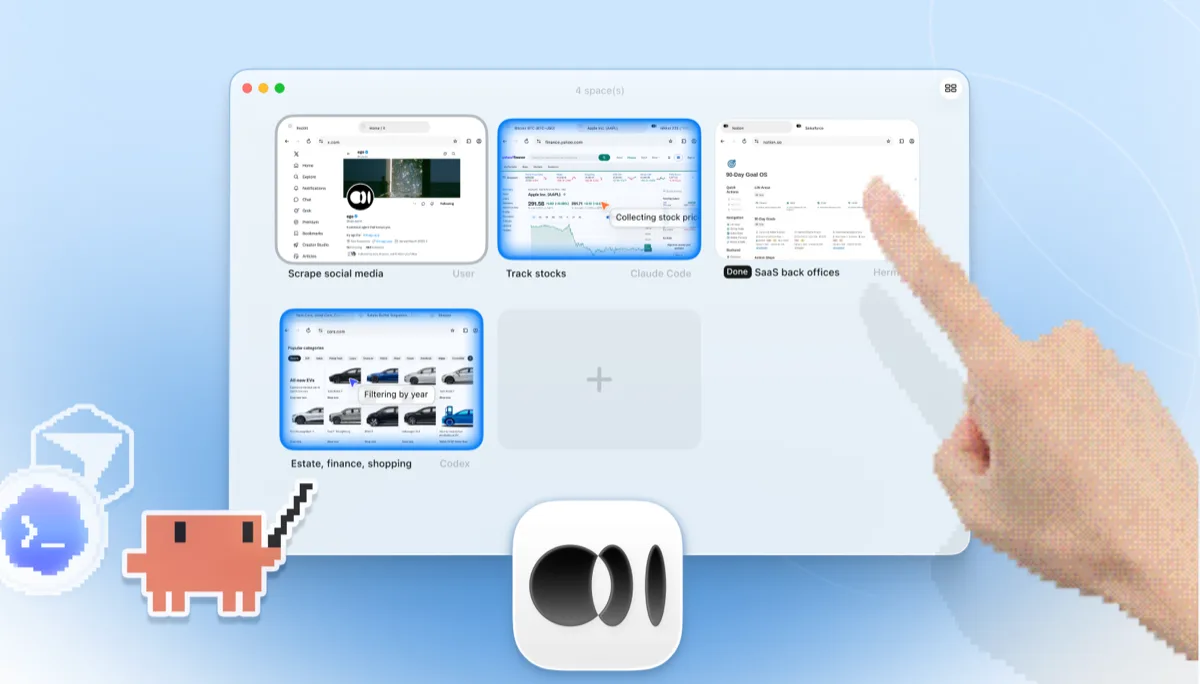
In ego lite there's no cap on how many Spaces you open inside the same browser: each one runs its own task at the same time, controlled by Codex or another coding agent via /ego-browser on its own imported Chrome profile. None of them ever steals the tab you're using, and you can watch or take over any Space anytime.

Fini les allers-retours Moins de jetons consommés

On desktop, every @Browser action is its own round trip through the model: domSnapshot(), click, domSnapshot() again. Each result comes back before the next move is chosen, and that spend comes out of the same allowance as your coding work. In the CLI there is no @Browser, so you never get this loop built in.

Run /ego-browser and Codex batches several actions in a few lines of JavaScript per turn to control ego lite. Stacked with Snapshot input, the same task completes on far fewer tokens overall.

Claude Code · ego lite
>/ego-browser Add the first product to the cart, then check checkout loads
Bash(
ego-browser nodejs <<'EOF' await openOrReuseTab('localhost:3000') await click('.product-card') await click('.add-to-cart') await click('a[href="/checkout"]') cliLog('checkout loaded') EOF
)
Output:
[t=4480ms] checkout loaded
Done. Both steps work.
─── 1 tool call · 1.1k tokens ───
Codex · @Browser
>Add the first product to the cart, then check checkout loads
browser.tabs.new() (@Browser)
Tab
Tab created (about:blank)
1.6k tokens sent so far
Approve localhost for this site, then navigate.
tab.goto (@Browser)("http://localhost:3000")
Result
Navigated to http://localhost:3000
2.8k tokens sent so far
Page is up. Reading the DOM before choosing a target.
tab.playwright.domSnapshot() (@Browser)
DOM snapshot
… +187 lines (ctrl+o to expand)
4.6k tokens sent so far
First product card is .product-card. Clicking it.
tab.playwright.locator(".product-card").click() (@Browser)
Result
Clicked .product-card
6.3k tokens sent so far
Product page rendered. Snapshot again: prior refs are stale.
tab.playwright.domSnapshot() (@Browser)
DOM snapshot
… +203 lines (ctrl+o to expand)
8.4k tokens sent so far
Add to cart is .add-to-cart.
tab.playwright.locator(".add-to-cart").click() (@Browser)
Result
Clicked .add-to-cart
10.2k tokens sent so far
Added. Opening checkout, then confirming the form with a snapshot.
tab.playwright.locator("a[href='/checkout']").click() (@Browser)
Result
Clicked a[href='/checkout']
tab.playwright.domSnapshot() → payment form present
13.6k tokens sent so far
─── 7 tool calls · 13.6k tokens ───
La même tâche, le même modèle. À gauche : un appel JavaScript groupé dans ego lite, 1.1k tokens au total. À droite : le navigateur intégré de Codex, 7 allers-retours, les tokens grimpent à 13.6k.

Le même Chrome, natif pour les agents

In the CLI, Codex never sees your Chrome logins because there is no browser. On desktop, @Browser uses separate state: OpenAI's help center says it does not use your Chrome profile, cookies, tabs, or extensions. You sign into a second browser by hand, one site at a time.

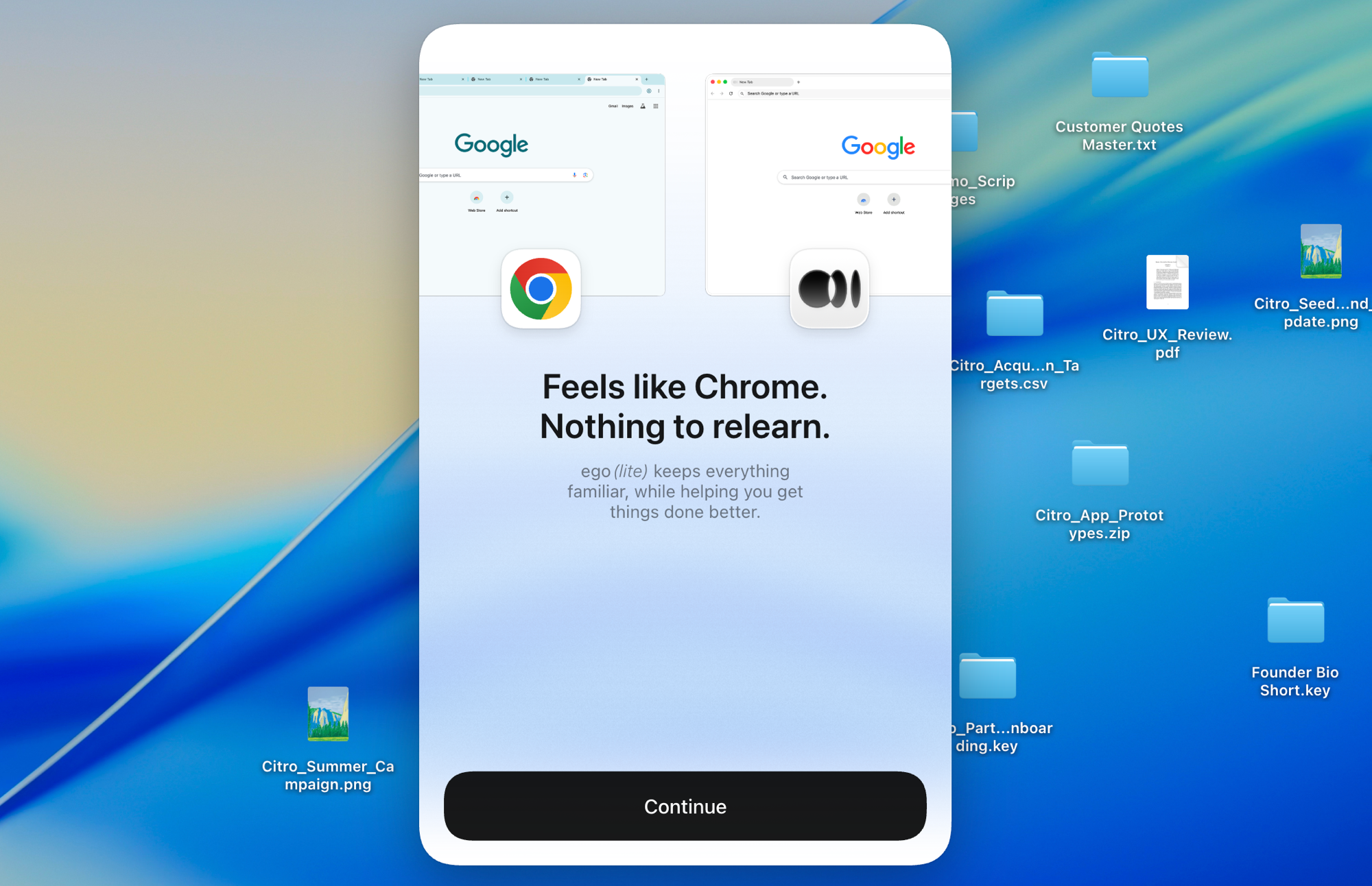
Built on Chromium, ego lite imports your entire Chrome setup in one click. When Codex runs /ego-browser, it controls ego lite with your real sessions already in place, including the 2FA trust you already have, so it doesn't stall on login walls you passed months ago.

Import du profil Chrome dans ego lite : configuration en un clic avec toutes vos connexions

ego lite vs Codex browser

Comparatif des fonctionnalités entre ego lite et Codex browser.
Fonctionnalitéego liteCodex browser
Fonctionne dans la CLI CodexYes. Run /ego-browser and the coding agent controls ego liteNo. Only the desktop app has @Browser
Réutilise vos identifiants Chrome réelsYes, one-click Chrome profile importNo. Separate browser state, signed in by hand per site
Iframes cross-origin et passkeysSnapshot reaches into cross-origin iframes and shadow DOMOpen issues: cross-origin iframe input unsupported; passkeys incomplete
Comment l'agent agit sur une pageCoding agent batches multiple actions in JavaScript per turn via /ego-browserOne tool call per action, result read back each time
Coût en jetons par tâcheLower: Snapshot plus batched actions, measured per taskPlus élevé : chaque étape renvoie du contexte via le modèle
Sur quoi le travail est facturéRien d'extra. Le navigateur est gratuit et localThe same coding allowance as the rest of your Codex work (5-hour window plus a weekly cap)
Isolation des tâches en parallèleUnlimited Spaces in one browser, bounded by your machineUn panneau navigateur intégré par session
Sert aussi de navigateur au quotidienOui. Vous naviguez dans votre Space, les agents travaillent dans le leurNo. A separate panel with separate state
Isolation de vos vrais comptesNo. The coding agent controls ego lite inside your loginsYes, by design: separate state, no path to personal accounts
Compétences réutilisables (bientôt disponible)Distille les exécutions réussies en compétences réutilisables ; jusqu'à 5 fois plus rapide sur des tâches complexes à mesure que l'agent les répète (bêta limitée)Pas d'équivalent intégré pour les tâches navigateur
Prix et disponibilitéFree, no subscription. macOS, Chromium onlyIncluded with ChatGPT plans; Computer Use is region-limited
Dernière mise à jour 30 juil. 2026

Une transition en douceur

You are not switching away from Codex. Run /ego-browser so Codex controls ego lite, a Chromium browser that already holds your sessions, from the CLI or alongside @Browser on desktop.

  1. Télécharger ego (lite)

    Téléchargez ego lite et importez votre profil Chrome en un clic. Identifiants, cookies et extensions suivent automatiquement.

  2. Lancez votre première tâche avec /ego-browser

    Collez dans votre agent

    /ego-browser Ouvrez ego.app et rejoignez la liste d'attente

    Run /ego-browser in Codex and paste one sentence. Works in the CLI; no MCP config, no per-site approval step first.

  3. Regardez-le travailler
    Vue d'ensemble des Spaces ego lite avec quatre tâches de navigateur exécutées côte à côte : Claude Code suivant l'action Apple sur Yahoo Finance, Codex filtrant des voitures par année sur cars.com, Hermes terminant une tâche de back-office SaaS, un utilisateur scrapant X, et une main appuyant sur + pour ouvrir un autre Space

    The task runs in its own Space, so your tabs stay untouched. Take over anytime. Results land back in the Codex CLI.

Keep @Browser on desktop for localhost previews and the annotation loop: select an element, comment, fix exactly that.

Quand utiliser chaque outil

Choisissez ego (lite) si

  • You want browser work from the Codex CLI, where @Browser does not run.
  • Logged-in tasks should start in your real Chrome, not a second browser you authenticate site by site.
  • Even on desktop, whole tasks behind SSO feel slow in @Browser's one-panel, one-action loop.
  • You want parallel Spaces without spending Codex allowance on routine @Browser clicking.

Choisissez Codex browser quand

  • You want zero setup: @Browser is already in a ChatGPT plan you pay for.
  • You're debugging your own frontend on localhost and want CDP access from inside the agent.
  • You want the annotation loop: select an element, comment, fix exactly that.
  • You want the agent to have no path to your real accounts. Separate state is a deliberate safety tradeoff.

Donnez à votre agent un vrai navigateur

Gratuit, fonctionne sur votre Mac, importe votre profil Chrome en un clic. Compatible avec Claude Code, Codex, Cursor et tout agent CLI qui écrit du code.

Vous hésitez encore ? Découvrez comment Codex browser se compare aux autres outils du même espace.

FAQ

Codex browser is OpenAI's built-in browser for Codex, reached with @Browser in the ChatGPT desktop app. It is a local Chromium panel you can watch and take over, with DOM and accessibility-tree reading plus CDP access in Developer mode. For localhost frontend work it is genuinely good, and it is included in ChatGPT plans. It does not use your Chrome profile, and it is not available in the Codex CLI. The Codex Chrome extension is a separate surface covered on its own compare page.

Yes, for both surfaces. In the Codex CLI, ego lite is the Chromium browser Codex lacks. On desktop, it beats @Browser on speed, parallelism, tokens, and logins because Codex controls ego lite with batched JavaScript instead of one domSnapshot round trip per click. Keep @Browser for localhost previews and the annotation loop.

Codex browser use is OpenAI's @Browser feature in the ChatGPT desktop app: Codex can open pages, click, and inspect them in a local Chromium panel. The Codex CLI has no browser. Run /ego-browser and Codex controls ego lite, a Chromium browser with your imported Chrome profile, from the CLI and beats @Browser on whole logged-in tasks.

OpenAI Codex browser is the built-in Chromium panel reached with @Browser in the ChatGPT desktop app. It is local, not cloud, and separate from your Chrome profile. ego lite is not a replacement for Codex itself. It is the Chromium browser Codex controls when you run /ego-browser from the CLI or want your real Chrome sessions on desktop.

In the ChatGPT desktop app, yes, via @Browser for codex web browser tasks. In the Codex CLI, no: only web search snippets, no page control. Codex cloud blocks internet by default in the agent phase. Run /ego-browser so Codex controls ego lite, a Chromium browser, from the CLI.

No. The browser skill may still appear, then report unavailable. Run /ego-browser so Codex controls ego lite, a Chromium browser on your Mac, from the same terminal. On desktop, @Browser exists but uses separate state and a slower one-action loop; ego lite still wins for logged-in whole tasks.

On desktop, invoke @Browser and Codex drives its built-in panel one action at a time: tab.goto, domSnapshot, locator click. From the CLI, install ego lite, import your Chrome profile, and run /ego-browser so Codex controls ego lite against your real sessions with batched JavaScript instead of seven round trips per task.

Yes, into its own browser state, not your Chrome profile. OpenAI's help center points to the Codex Chrome extension when you need existing cookies or sessions. ego lite imports your profile once, so Codex starts inside the logins and 2FA trust you already have.

No. @Browser is an embedded Chromium panel in the desktop app on your machine. ChatGPT's separate cloud browser is a different surface. ego lite is also a local Chromium browser on your Mac: free, no subscription.

Yes. @Browser draws on the same coding allowance as the rest of your Codex work. ego lite adds no meter of its own; you only pay model tokens your agent already spends, and batched JavaScript keeps per-task totals lower than @Browser's one-action loop.

Playwright MCP works in the CLI but needs MCP config and one tool call per action against a blank profile. ego lite needs no MCP: run /ego-browser against your real Chrome profile from Codex, Claude Code, or Cursor. See ego lite vs Playwright MCP.