





ego (lite) n’est qu’un navigateur ; ego est votre agent personnel sur tous vos appareils.
Rejoindre la liste d'attente
ego lite vs extension Chrome Codex

La meilleure alternative à l'extension Chrome Codex

OpenAI's Codex Chrome extension lets Codex take over tabs in the signed-in Chrome you're using, one browser shared between you and the agent. ego lite gives Codex its own Spaces in a separate browser that inherited your logins, so it works in parallel while your tabs stay yours.

Utilisé par des développeurs de
GoogleAmazonShopifyTikTokHarvardStanfordUSCUCLA

Pourquoi ego lite est meilleur que l'extension Chrome Codex

Both exist for the same reason: Codex needs logged-in browser context to be useful on real sites. The extension borrows yours. ego lite imports your Chrome profile once and gives Codex a browser of its own. Run /ego-browser inside Codex and it's connected.

The agent never fights you for your browser again

Because every task gets its own Space (a separate workspace inside one browser), Codex can run several tasks in parallel without ever touching the tabs you're using, and there's no permission prompt each time it opens a new site.

The Codex Chrome extension works differently: it takes over your existing Chrome tabs and acts inside the session you're already using, one task at a time. Because the agent is acting inside your live, logged-in browser, OpenAI has Codex ask for approval before touching each new website, so real tasks pause for permission clicks.

6.48x faster, and it finished the task the extension couldn't

Codex Chrome extension acts one click, one keystroke, one tool call at a time, and on real tasks that adds up: ranking OpenAI's X posts took it 9 minutes 24 seconds. On the Expedia flight-booking task, it never finished at all. A safety review blocked it after 15 minutes.

ego lite reads the page as a compressed Snapshot and batches several actions into a few lines of JavaScript per turn. Same two tasks: 87 seconds, and 166 seconds to completion. That's 6.48x faster on the first, and the only one of the two that finished.

Time to finish the same tasks, shorter is better
Task 1: Rank OpenAI's X posts from the last 7 days
87 sego (lite)
564 sCodex Chrome extension
Task 2: Expedia: search, filter, and fill a flight booking
166 sego (lite)
BlockedCodex Chrome extension, after 900 s

Works with Codex, and with everything else, in parallel

The extension only works with Codex, only in official Chrome (not Arc, Brave, or Edge), and it needs the Codex desktop app running and paired before anything works at all.

ego lite works with any code-writing CLI agent (Codex, Claude Code, Cursor, Gemini CLI) and runs several of their tasks in parallel. Switch agents later, and the browser side stays exactly the same.

Works from Codex's terminal: the plugin doesn't

The Codex Chrome extension only works through the Codex desktop app. OpenAI's own GitHub issues confirm that a terminal-only Codex CLI session can't reach the extension at all. The request fails immediately with the error "Browser is not available: extension."

ego lite works the same whether Codex is running in a terminal or as a desktop app: run /ego-browser, and the agent gets a real browser of its own either way.

ego lite Chrome profile import: the same setup whether Codex runs in a terminal or as a desktop app

ego lite vs extension Chrome Codex

Feature comparison between ego lite and Codex Chrome extension.
Fonctionnalitéego liteCodex Chrome extension
Où travaille l'agentIn its own Space: never the tabs you're usingDans votre Chrome connecté, en prenant le contrôle d'onglets existants
Continuer à travailler pendant l'exécutionYes: parallel Spaces, you browse in yoursNot really: it's driving the browser you're in
Agents pris en chargeCodex, Claude Code, Cursor, Gemini CLI, tout agent CLI qui écrit du codeCodex uniquement
Navigateur requisNone: ego lite is the browser (Chromium, macOS)Chrome officiel uniquement ; ni Arc, ni Brave, ni Edge
InstallationInstallez l'application, lancez /ego-browser dans CodexApplication de bureau Codex, puis installation de l'extension depuis son menu Plugins
Sites déjà connectés (SSO, 2FA)Yes: one-click Chrome profile importYes: it acts in your already-signed-in Chrome
Modèle de permissionsAccordez l'état de connexion une fois via l'import de profil ; observez ou reprenez n'importe quel SpaceDemandes d'approbation par site, listes d'autorisation/blocage par domaine
Extension reliabilityN/A: no native-messaging pairing between an extension and a desktop appOpenAI's own GitHub issues show a recurring pattern of the extension and desktop app disagreeing on connection state, plus native-host registration and handshake timeouts on Windows
Comment l'agent agit sur les pagesSnapshot input plus batched JavaScript: several actions per turnActions de navigateur étape par étape dans vos onglets
Speed on a real task87s vs Codex's 9:24 on the same X-research task; 166s on the same Expedia flight task9:24 on the X-research task; blocked by a safety review after 15 minutes on the Expedia flight task, never finished
PrixGratuit, sans abonnementIncluded with Codex: requires a ChatGPT plan with Codex access
Works from Codex's terminalYes: /ego-browser works the same in a terminal or a desktop appNo: the CLI can't reach the extension backend at all ("Browser is not available: extension")
Dernière mise à jour 04 août 2026

Une transition en douceur

Already running the Codex Chrome extension? You keep Codex and change what it drives. The switch is a few minutes, and nothing has to be uninstalled.

  1. Télécharger ego (lite)

    Download ego lite and import your Chrome profile in one click. The signed-in context the extension borrows from Chrome becomes real profile state in a browser Codex can call its own.

  2. Lancez votre première tâche avec /ego-browser

    Collez dans votre agent

    /ego-browser Open ego.app and join the waitlist

    Lancez /ego-browser dans Codex. Pas de plugin d'application de bureau, pas d'appairage d'extension.

  3. Regardez-le travailler
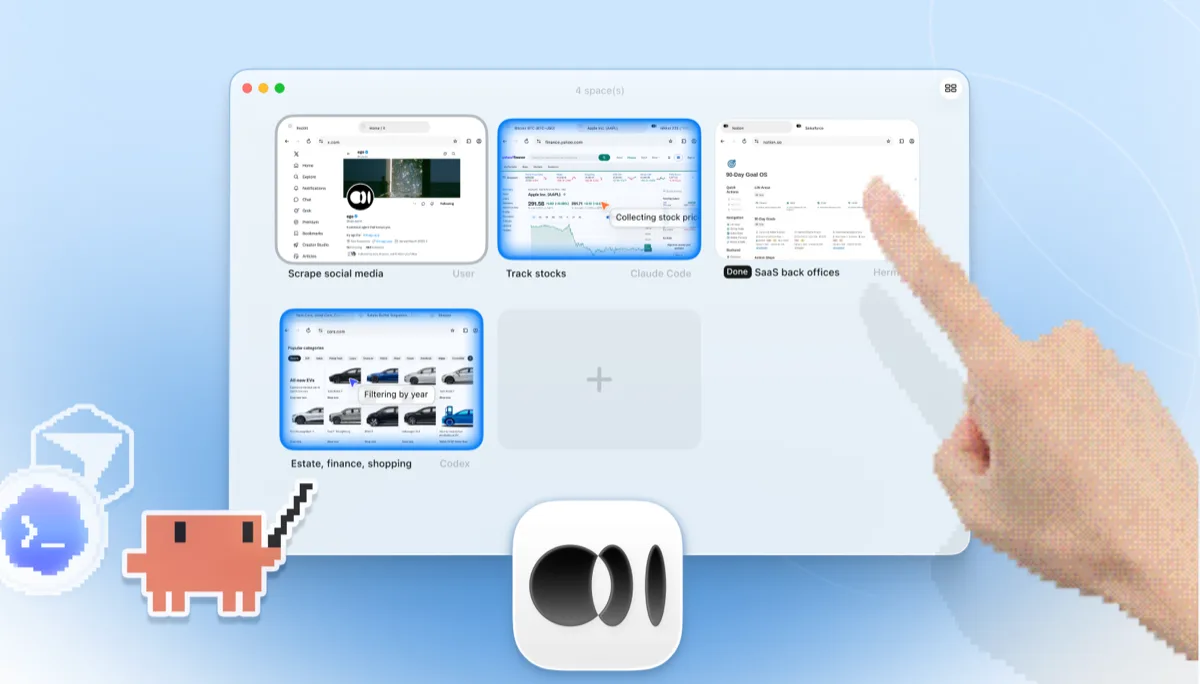
    Vue d'ensemble des Spaces ego lite avec quatre tâches de navigateur exécutées côte à côte : Claude Code suivant l'action Apple sur Yahoo Finance, Codex filtrant des voitures par année sur cars.com, Hermes terminant une tâche de back-office SaaS, un utilisateur scrapant X, et une main appuyant sur + pour ouvrir un autre Space

    Re-run a task you'd normally hand the extension (a dashboard read, a form workflow, a multi-tab test) and keep using your own browser while it executes in its Space.

Gardez l'extension si certains workflows y sont câblés ; ego lite tourne à côté de Chrome, donc rien ne casse pendant que vous comparez.

Quand utiliser chaque outil

Choisissez ego (lite) quand

  • You run Codex from a terminal, where the extension's backend isn't reachable from CLI sessions at all. Run /ego-browser and the agent gets a browser regardless.
  • You want Codex running longer, multi-step tasks in its own Spaces, in parallel, while your tabs stay yours.
  • Vous préférez accorder l'état de connexion une fois via l'import de profil plutôt que cliquer des demandes d'approbation par site en pleine tâche.
  • You use other agents too: the same /ego-browser setup works with Claude Code, Cursor, and Gemini CLI, not just Codex.

Choisir l'extension Chrome Codex quand

  • You're already running the Codex desktop app, and the extension is right there in its Plugins menu, with no extra install.
  • You want a quick action on a page you already have open: handing Codex your live Chrome session is the shortest path.
  • Vous tenez aux garde-fous officiels d'OpenAI : demandes d'approbation par site et listes d'autorisation par domaine autour de chaque action.

Donnez à votre agent un vrai navigateur

Gratuit, fonctionne sur votre Mac, importe votre profil Chrome en un clic. Compatible avec Claude Code, Codex, Cursor et tout agent CLI qui écrit du code.

Still weighing your options? See how Codex Chrome extension compares with the other tools in the same space.

FAQ

The Codex Chrome extension is OpenAI's official way to give Codex a browser, launched in May 2026 and installed through the Codex desktop app's Plugins menu. It lets Codex act in your signed-in Chrome for tasks that need logged-in context (reading dashboards, filling forms, testing sites across tabs) with a genuinely careful permission model: Codex asks before touching each new website, and you manage domain allowlists and blocklists. If you're all-in on Codex and official Chrome, it's a polished, well-scoped tool.

Oui. OpenAI l'a livrée en mai 2026 dans le cadre du système de plugins de l'application de bureau Codex, et elle a été déployée dans l'EEE, au Royaume-Uni et en Suisse en juin 2026. Elle laisse Codex agir dans votre Chrome connecté pour les tâches qui exigent un contexte de session, avec des demandes de permission par site.

Si vous voulez que Codex fasse du travail de navigateur sans occuper le navigateur que vous utilisez, oui. ego lite donne à Codex ses propres Spaces avec vos identifiants importés, exécute les tâches en parallèle, et il est gratuit. L'extension gagne si vous voulez précisément la voie officielle mono-fournisseur dans Chrome, avec les garde-fous d'approbation d'OpenAI.

Install ego lite, import your Chrome profile, then run /ego-browser inside Codex. The agent reads pages as compressed Snapshots and executes batched JavaScript in the browser. No extension, no MCP server, no plugin configuration.

No. As of mid-2026 it supports official Chrome only. ego lite sidesteps the question: it is its own Chromium-based browser on macOS, and your existing Chrome profile imports into it in one click.

No. It's bound to the Codex desktop app. OpenAI's own GitHub issues confirm a terminal-only Codex CLI session can't acquire the extension backend at all, failing with "Browser is not available: extension." ego lite doesn't make that distinction: install ego lite and run /ego-browser inside Codex, terminal or desktop app, and the agent gets a real browser either way.

You're not alone. OpenAI's own GitHub issue tracker has a recurring thread of reports where the extension and the Codex desktop app disagree on whether they're connected, plus native-host registration and handshake timeouts, mostly on Windows. That's the tradeoff of pairing a browser extension to a separate desktop app over native messaging. ego lite doesn't have that pairing step: it is the browser Codex drives directly.

Yes. They don't conflict: the extension lives in Chrome, ego lite is a separate browser. A common split: the extension for quick actions in a page you already have open, ego lite for longer parallel tasks you don't want running in your active window.