





ego (lite) n’est qu’un navigateur ; ego est votre agent personnel sur tous vos appareils.
Rejoindre la liste d'attente
ego lite vs Stagehand

La meilleure alternative à Stagehand

Stagehand is Browserbase's open-source SDK: you write TypeScript or Python, and methods like act, extract, and observe turn plain-language instructions into browser actions.

ego lite is a Stagehand alternative that skips the SDK entirely. Run /ego-browser and your coding agent controls ego lite directly, batching a whole task into one JavaScript call, finishing whole tasks 3 to 4x faster than Stagehand.

Utilisé par des développeurs de
GoogleAmazonShopifyTikTokHarvardStanfordUSCUCLA

Pourquoi ego lite est meilleur que Stagehand

Stagehand means maintaining a TypeScript or Python project, and every uncached action is another model call at runtime. With ego lite you type one sentence in Claude Code, Codex, or Cursor after /ego-browser. No project, no schema, no API key.

De 3 à 4 fois plus rapide sur des tâches réelles

In Stagehand, three clicks in a row can mean three separate trips to the model before the page moves again. Stagehand's own speed guide shows this pattern and suggests calling observe first so later clicks can reuse what it found.

Run /ego-browser and your coding agent controls ego lite directly. Every page arrives as a Snapshot: a compressed accessibility tree with stable @N refs it can act on instantly. Your coding agent spends its time on the task, not restructuring scripts, finishing whole tasks 3 to 4x faster than Stagehand.

Time to finish a task, shorter is better
81.8 sego lite
282.9 sagent browser
Data source - Task: scrape the main posts from the X account from the last 7 days
Multitâche parallèle, exécution plus rapide

Running several Stagehand tasks at once means spinning up and tearing down browser instances in your own code, or moving to Browserbase and hitting session caps of 3, 25, or 100. To see what happened, you open a replay after the run finishes.

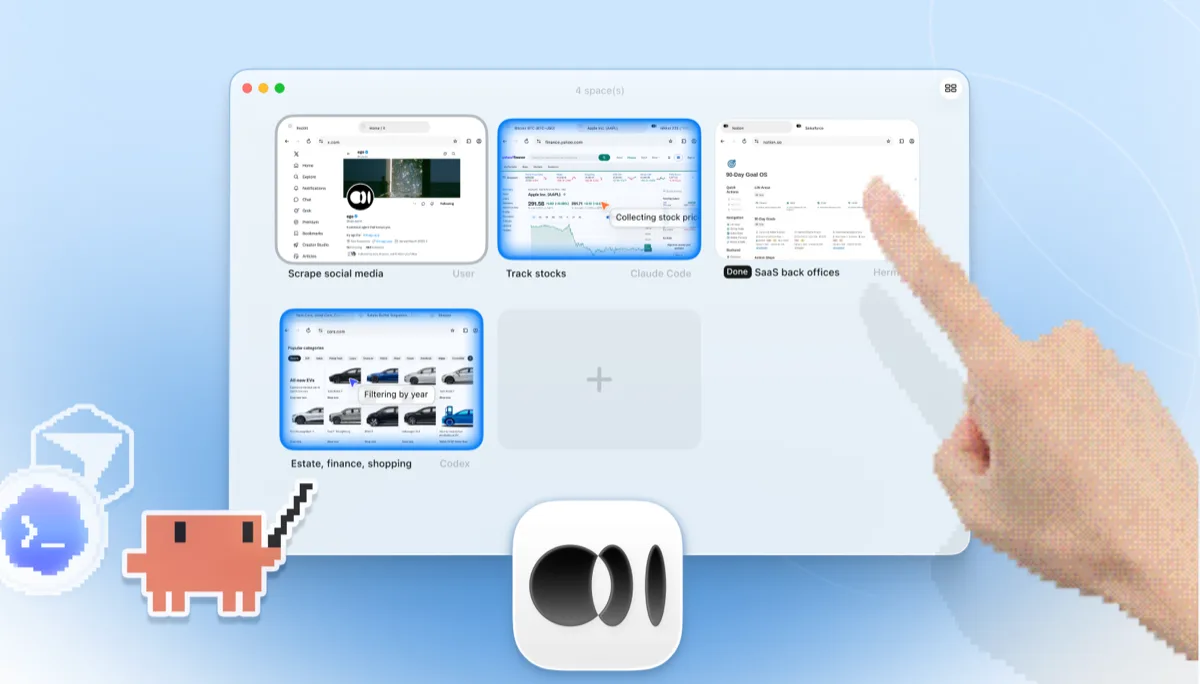
In ego lite there's no cap on how many Spaces you open inside the same browser: each one runs its own task at the same time, controlled by a coding agent via /ego-browser on its own imported Chrome profile. None of them ever steals the tab you're using, and you can watch or take over any Space anytime.

Fini les allers-retours Moins de jetons consommés

Stagehand's action cache helps when you repeat the same flow on the same page. On a new site, or after the DOM shifts, each call asks the model again, and stale caches have to be cleared by hand.

Run /ego-browser and your coding agent batches several actions in a few lines of JavaScript per turn to control ego lite. Stacked with Snapshot input, the same task completes on far fewer tokens overall.

Claude Code · ego lite
>/ego-browser Add the first product to the cart, then check checkout loads
Bash(
ego-browser nodejs <<'EOF' await openOrReuseTab('localhost:3000') await click('.product-card') await click('.add-to-cart') await click('a[href="/checkout"]') cliLog('checkout loaded') EOF
)
Output:
[t=4480ms] checkout loaded
Done. Both steps work.
─── 1 tool call · 1.1k tokens ───
Stagehand · env: "LOCAL"
>$ npx tsx run_task.ts const stagehand = new Stagehand({ env: "LOCAL" }) await stagehand.init()
await page.goto("http://localhost:3000")
// page = stagehand.context.pages()[0]
navigated: http://localhost:3000
1.6k tokens sent so far
await stagehand.act("click the first product card")
// LLM call #1 · model: gpt-5.6-sol
→ { success: true, message: "Action completed successfully",
actions: [{ selector: "/html/body/div[2]/main/div[1]/a",
method: "click", arguments: [] }] }
3.8k tokens sent so far
await stagehand.act("click add to cart")
// LLM call #2 · model: gpt-5.6-sol
→ { success: true, message: "Action completed successfully",
actions: [{ selector: "/html/body/div[2]/main/button[1]",
method: "click", arguments: [] }] }
5.9k tokens sent so far
await stagehand.observe("find the checkout link")
// LLM call #3 · model: gpt-5.6-sol
→ [{ selector: "/html/body/nav/a[href='/checkout']",
description: "Checkout link", method: "click", arguments: [] }]
8.0k tokens sent so far
await stagehand.act(action)
// no LLM: Action from observe()
→ { success: true, message: "Action completed successfully",
actions: [{ method: "click" }] }
navigated: /checkout
9.1k tokens sent so far
await stagehand.extract("is the payment form present?", z.object({ present: z.boolean() }))
// LLM call #4 · model: gpt-5.6-sol
→ { present: true }
11.4k tokens sent so far
await stagehand.extract("list the payment fields", z.object({ fields: z.array(z.string()) }))
// LLM call #5 · model: gpt-5.6-sol
→ { fields: ["card", "expiry", "cvc", "zip"] }
13.6k tokens sent so far
─── 7 model calls · 13.6k tokens ───
The same task, the same model. Left: one batched JavaScript call in ego lite, 1.1k tokens total. Right: a Stagehand script, a model call on nearly every step, tokens climb to 13.6k.

Le même Chrome, natif pour les agents

Staying logged in is the hard part of local Stagehand. Chrome profile support still has an open bug in v3, cookie workarounds often miss the HttpOnly session cookies that matter, and the browse CLI only attaches if you started Chrome with remote debugging yourself.

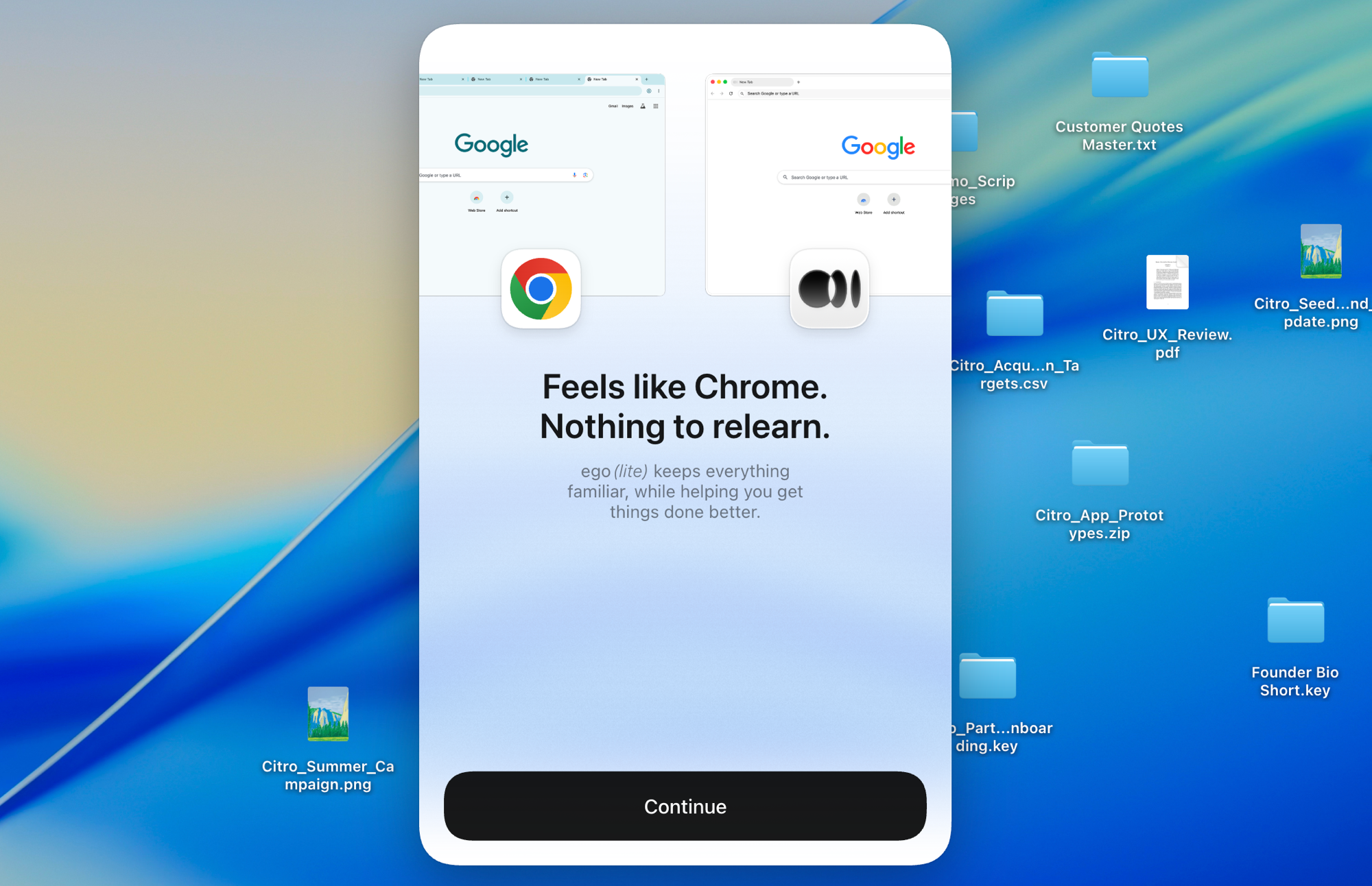
Built on Chromium, ego lite imports your entire Chrome setup in one click. When your coding agent runs /ego-browser, it controls ego lite with your real sessions already in place, so it doesn't stall on SSO, 2FA, or captchas on accounts you already have.

Import du profil Chrome dans ego lite : configuration en un clic avec toutes vos connexions

ego lite vs Stagehand

Comparatif des fonctionnalités entre ego lite et Stagehand.
Fonctionnalitéego liteStagehand
Ce que vous écrivezRien. Une phrase à l'agent que vous utilisez déjàA TypeScript or Python project: SDK, act/extract/observe, keep it working
Comment l'agent agit sur une pageCoding agent batches multiple actions in JavaScript per turn via /ego-browserOne model call per act, extract, or observe that isn't cached; precise locators when you want to skip the model
Coût en jetons par tâcheLower: Snapshot plus batched JavaScript, measured per taskRepeated flows can reuse a cached selector; new pages pay for a fresh model call each time
Réutilise vos identifiants Chrome réelsYes, one-click Chrome profile import; coding agent controls ego lite via /ego-browserNot reliably in local mode: Chrome profile support has an open bug, and browse needs remote debugging
ConfigurationInstall ego lite, run /ego-browser in your agentnpm/pip install, model API key, and a project
Isolation des tâches en parallèleUnlimited Spaces in one browser, bounded by your machineYour code manages instances; Browserbase caps concurrency by plan
Sert aussi de navigateur au quotidienOui. Vous naviguez dans votre Space, les agents travaillent dans le leurNon. Il lance un navigateur d'automatisation propre
Automatisation engagée et reproductibleNo. Tasks are interactiveYes: scripts with git history, review, and a committed cache
Compétences réutilisables (bientôt disponible)Distille les exécutions réussies en compétences réutilisables ; jusqu'à 5 fois plus rapide sur des tâches complexes à mesure que l'agent les répète (bêta limitée)Action caching on repeated flows only
PrixGratuit, sans abonnement, sans compteMIT and free to install; you pay model tokens (plus Browserbase if hosted)
Dernière mise à jour 30 juil. 2026

Une transition en douceur

Already running Stagehand scripts in CI or on a schedule? Keep those. Move one-off and logged-in exploratory work to ego lite in a few minutes.

  1. Télécharger ego (lite)

    Téléchargez ego lite et importez votre profil Chrome en un clic. Identifiants, cookies et extensions suivent automatiquement.

  2. Lancez votre première tâche avec /ego-browser

    Collez dans votre agent

    /ego-browser Ouvrez ego.app et rejoignez la liste d'attente

    Paste one sentence into Claude Code, Codex, or Cursor and hit enter. No SDK, no model API key, no Zod schema.

  3. Regardez-le travailler
    Vue d'ensemble des Spaces ego lite avec quatre tâches de navigateur exécutées côte à côte : Claude Code suivant l'action Apple sur Yahoo Finance, Codex filtrant des voitures par année sur cars.com, Hermes terminant une tâche de back-office SaaS, un utilisateur scrapant X, et une main appuyant sur + pour ouvrir un autre Space

    The task runs in its own Space, so your tabs stay untouched. Watch live or take over anytime. Results land back in your agent's CLI.

Keep Stagehand for committed automation, typed extraction, and deterministic locators.

Quand utiliser chaque outil

Choisissez ego (lite) si

  • You'd rather describe a one-off scrape or form fill than maintain a TypeScript or Python project for it.
  • The work sits behind your own logins and should start signed in.
  • You want parallel Spaces you can watch, without managing browser instances in code.
  • You don't want to add an SDK, model key, and project for something your coding agent can already do.

Choisissez Stagehand quand

  • Automation must live in a repo with review, caching, and the same run months later.
  • You want a deterministic escape hatch: precise locators when a flow must not vary.
  • You need typed extraction with a Zod schema into TypeScript.
  • It must run in CI or across many cloud browsers on Browserbase.

Donnez à votre agent un vrai navigateur

Gratuit, fonctionne sur votre Mac, importe votre profil Chrome en un clic. Compatible avec Claude Code, Codex, Cursor et tout agent CLI qui écrit du code.

Vous hésitez encore ? Découvrez comment Stagehand se compare aux autres outils du même espace.

FAQ

Stagehand is Browserbase's MIT-licensed browser automation SDK for TypeScript and Python. It gives you act, extract, observe, and agent primitives, plus precise locators when you want to skip the model. It runs locally against Chromium, and pairs with Browserbase when you want hosted sessions, caching, and replay. For automation you commit to a repo and run on a schedule, it remains an excellent choice.

For interactive, logged-in browser work, yes: run /ego-browser and describe the task. For committed automation you ship to CI, with typed extraction and deterministic locators, keep Stagehand. Stagehand is for browser work you commit; ego lite is for browser work you do today.

No. Stagehand runs locally against Chromium on its own. Browserbase is optional when you want hosted sessions, server-side caching, and replay. The Browserbase vs Stagehand pairing matters for cloud fleets, not for a local script on your laptop. ego lite has no hosted path: local only, free, no account.

Often yes in production, but for different reasons. Stagehand is the SDK you write act, extract, and observe calls in. Browserbase is where those scripts run when you need cloud scale. For your own agent chores on logged-in sites, you may need neither: run /ego-browser and let Claude Code or Codex drive ego lite directly.

Stagehand is MIT-licensed and free to install. You pay model tokens for every act, extract, or observe call that is not cached, plus Browserbase browser minutes if you host it there. ego lite is free. You only pay the model tokens your coding agent already uses.

Not dependably in local mode today. Pointing Stagehand at your Chrome profile still has an open bug in v3, and cookie workarounds often miss the HttpOnly session cookies that matter. ego lite imports your Chrome profile once, and every task starts signed in.

They aim at different developers. Stagehand is TypeScript-first with act, extract, and observe primitives for hybrid code-plus-AI automation. Browser Use is Python-first and runs a more autonomous agent loop. Both are frameworks you write and fund. ego lite is the Chromium browser your coding agent controls via /ego-browser. See ego lite vs Browser Use for that side.

Stagehand is an SDK: you write act, extract, and observe calls in TypeScript or Python. agent-browser is a CLI your agent shells out to, one command at a time. ego lite is neither. Run /ego-browser and your coding agent controls ego lite with batched JavaScript. See ego lite vs agent-browser.

Not as a native skill. Claude Code would run a Stagehand script you wrote, with model API keys and a project to maintain. ego lite is the shorter path: run /ego-browser in Claude Code, Codex, or Cursor and describe the task. No SDK install, no schema, no separate model billing loop.

When an action is not cached, the model picks the target again each time, so a shifting page can resolve differently. Caches can also go stale after the DOM changes. Use Stagehand's precise locators when a flow must not vary. ego lite is built for interactive work where some variation is acceptable.

Neither. Run /ego-browser in Claude Code, Codex, Cursor, Gemini CLI, or OpenCode. Free on macOS 12+, no account required.