





ego (lite) è solo un browser; ego è il tuo agente personale su tutti i dispositivi.
Iscriviti alla lista d'attesa
ego lite vs estensione Chrome di Codex

La migliore alternativa all'estensione Chrome di Codex

OpenAI's Codex Chrome extension lets Codex take over tabs in the signed-in Chrome you're using, one browser shared between you and the agent. ego lite gives Codex its own Spaces in a separate browser that inherited your logins, so it works in parallel while your tabs stay yours.

Scelto da sviluppatori di
GoogleAmazonShopifyTikTokHarvardStanfordUSCUCLA

Perché ego lite è meglio dell'estensione Chrome di Codex

Both exist for the same reason: Codex needs logged-in browser context to be useful on real sites. The extension borrows yours. ego lite imports your Chrome profile once and gives Codex a browser of its own. Run /ego-browser inside Codex and it's connected.

The agent never fights you for your browser again

Because every task gets its own Space (a separate workspace inside one browser), Codex can run several tasks in parallel without ever touching the tabs you're using, and there's no permission prompt each time it opens a new site.

The Codex Chrome extension works differently: it takes over your existing Chrome tabs and acts inside the session you're already using, one task at a time. Because the agent is acting inside your live, logged-in browser, OpenAI has Codex ask for approval before touching each new website, so real tasks pause for permission clicks.

6.48x faster, and it finished the task the extension couldn't

Codex Chrome extension acts one click, one keystroke, one tool call at a time, and on real tasks that adds up: ranking OpenAI's X posts took it 9 minutes 24 seconds. On the Expedia flight-booking task, it never finished at all. A safety review blocked it after 15 minutes.

ego lite reads the page as a compressed Snapshot and batches several actions into a few lines of JavaScript per turn. Same two tasks: 87 seconds, and 166 seconds to completion. That's 6.48x faster on the first, and the only one of the two that finished.

Time to finish the same tasks, shorter is better
Task 1: Rank OpenAI's X posts from the last 7 days
87 sego (lite)
564 sCodex Chrome extension
Task 2: Expedia: search, filter, and fill a flight booking
166 sego (lite)
BlockedCodex Chrome extension, after 900 s

Works with Codex, and with everything else, in parallel

The extension only works with Codex, only in official Chrome (not Arc, Brave, or Edge), and it needs the Codex desktop app running and paired before anything works at all.

ego lite works with any code-writing CLI agent (Codex, Claude Code, Cursor, Gemini CLI) and runs several of their tasks in parallel. Switch agents later, and the browser side stays exactly the same.

Works from Codex's terminal: the plugin doesn't

The Codex Chrome extension only works through the Codex desktop app. OpenAI's own GitHub issues confirm that a terminal-only Codex CLI session can't reach the extension at all. The request fails immediately with the error "Browser is not available: extension."

ego lite works the same whether Codex is running in a terminal or as a desktop app: run /ego-browser, and the agent gets a real browser of its own either way.

ego lite Chrome profile import: the same setup whether Codex runs in a terminal or as a desktop app

ego lite vs estensione Chrome di Codex

Feature comparison between ego lite and Codex Chrome extension.
Funzionalitàego liteCodex Chrome extension
Dove lavora l'agenteIn its own Space: never the tabs you're usingNel tuo Chrome autenticato, prendendo il controllo delle schede esistenti
Puoi continuare a lavorare nel frattempoYes: parallel Spaces, you browse in yoursNot really: it's driving the browser you're in
Agenti supportatiCodex, Claude Code, Cursor, Gemini CLI, qualsiasi agente CLI che scrive codiceSolo Codex
Browser richiestoNone: ego lite is the browser (Chromium, macOS)Solo il Chrome ufficiale; niente Arc, Brave o Edge
ConfigurazioneInstalli l'app, esegui /ego-browser dentro CodexApp desktop Codex, poi installi l'estensione dal suo menu Plugins
Siti con accesso già effettuato (SSO, 2FA)Yes: one-click Chrome profile importYes: it acts in your already-signed-in Chrome
Modello di permessiConcedi lo stato di accesso una volta con l'importazione del profilo; osserva o prendi il controllo di qualsiasi SpaceRichieste di approvazione per ogni sito, allowlist/blocklist di domini
Extension reliabilityN/A: no native-messaging pairing between an extension and a desktop appOpenAI's own GitHub issues show a recurring pattern of the extension and desktop app disagreeing on connection state, plus native-host registration and handshake timeouts on Windows
Come l'agente agisce sulle pagineSnapshot input plus batched JavaScript: several actions per turnAzioni del browser passo dopo passo nelle tue schede
Speed on a real task87s vs Codex's 9:24 on the same X-research task; 166s on the same Expedia flight task9:24 on the X-research task; blocked by a safety review after 15 minutes on the Expedia flight task, never finished
PrezzoGratis, nessun abbonamentoIncluded with Codex: requires a ChatGPT plan with Codex access
Works from Codex's terminalYes: /ego-browser works the same in a terminal or a desktop appNo: the CLI can't reach the extension backend at all ("Browser is not available: extension")
Ultimo aggiornamento 04 ago 2026

Una transizione senza intoppi

Already running the Codex Chrome extension? You keep Codex and change what it drives. The switch is a few minutes, and nothing has to be uninstalled.

  1. Scarica ego (lite)

    Download ego lite and import your Chrome profile in one click. The signed-in context the extension borrows from Chrome becomes real profile state in a browser Codex can call its own.

  2. Esegui il tuo primo task con /ego-browser

    Incolla nel tuo agente

    /ego-browser Open ego.app and join the waitlist

    Esegui /ego-browser dentro Codex. Nessun plugin dell'app desktop, nessun abbinamento di estensioni.

  3. Guardalo in azione
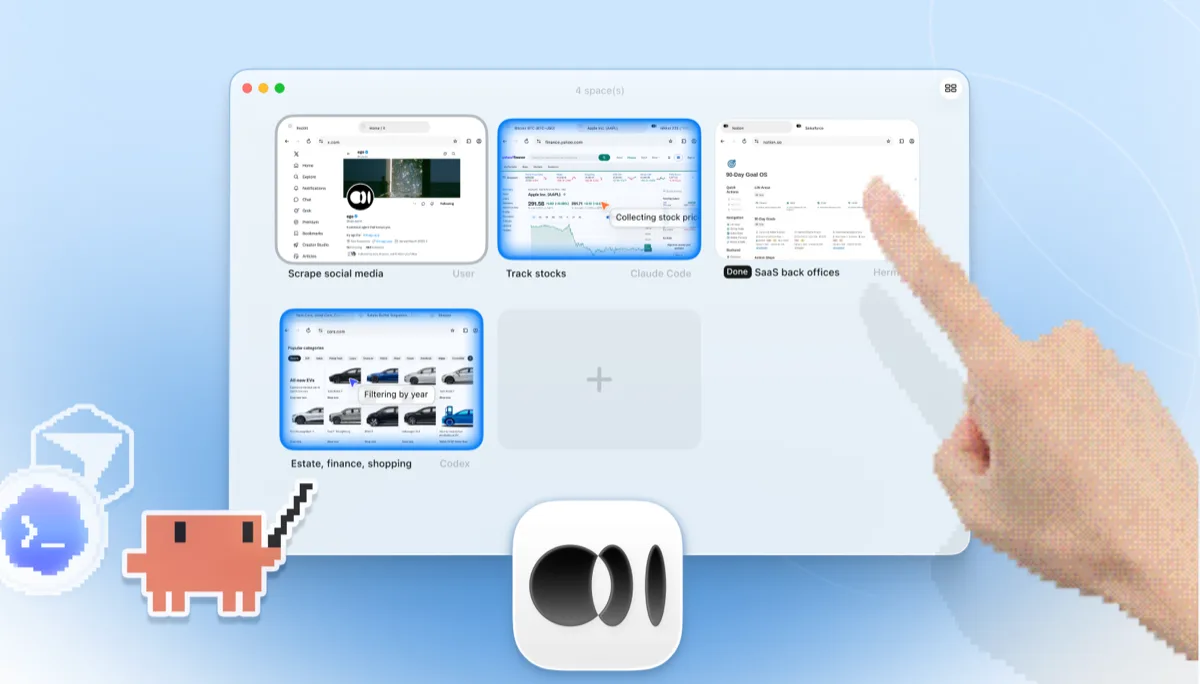
    Panoramica degli Spaces di ego lite con quattro attività di navigazione in esecuzione fianco a fianco: Claude Code che segue il titolo Apple su Yahoo Finance, Codex che filtra le auto per anno su cars.com, Hermes che completa un'attività di back-office SaaS, un utente che effettua scraping su X, e una mano che tocca + per aprire un altro Space

    Re-run a task you'd normally hand the extension (a dashboard read, a form workflow, a multi-tab test) and keep using your own browser while it executes in its Space.

Tieni l'estensione se alcuni flussi ci sono già cablati sopra; ego lite gira accanto a Chrome, quindi nulla si rompe mentre confronti.

Quando usare ogni strumento

Scegli ego (lite) se

  • You run Codex from a terminal, where the extension's backend isn't reachable from CLI sessions at all. Run /ego-browser and the agent gets a browser regardless.
  • You want Codex running longer, multi-step tasks in its own Spaces, in parallel, while your tabs stay yours.
  • Preferisci concedere lo stato di accesso una volta con l'importazione del profilo piuttosto che cliccare richieste di approvazione sito per sito a metà attività.
  • You use other agents too: the same /ego-browser setup works with Claude Code, Cursor, and Gemini CLI, not just Codex.

Scegli l'estensione Chrome di Codex se

  • You're already running the Codex desktop app, and the extension is right there in its Plugins menu, with no extra install.
  • You want a quick action on a page you already have open: handing Codex your live Chrome session is the shortest path.
  • Dai valore alle protezioni ufficiali di OpenAI: richieste di approvazione per ogni sito e allowlist di domini attorno a ogni azione.

Dai al tuo agente un browser vero

Gratis, funziona sul tuo Mac e importa il tuo profilo Chrome con un clic. Funziona con Claude Code, Codex, Cursor e qualsiasi agente CLI che scrive codice.

Still weighing your options? See how Codex Chrome extension compares with the other tools in the same space.

FAQ

The Codex Chrome extension is OpenAI's official way to give Codex a browser, launched in May 2026 and installed through the Codex desktop app's Plugins menu. It lets Codex act in your signed-in Chrome for tasks that need logged-in context (reading dashboards, filling forms, testing sites across tabs) with a genuinely careful permission model: Codex asks before touching each new website, and you manage domain allowlists and blocklists. If you're all-in on Codex and official Chrome, it's a polished, well-scoped tool.

Sì. OpenAI l'ha rilasciata a maggio 2026 come parte del sistema di plugin dell'app desktop di Codex, e a giugno 2026 è arrivata in SEE, Regno Unito e Svizzera. Permette a Codex di agire nel tuo Chrome autenticato per attività che richiedono un contesto con accesso, con richieste di permesso sito per sito.

Se vuoi che Codex faccia lavoro nel browser senza occupare il browser che stai usando, sì. ego lite dà a Codex i suoi Spaces con i tuoi accessi importati, esegue le attività in parallelo ed è gratis. L'estensione vince se vuoi specificamente il percorso ufficiale mono-fornitore dentro Chrome, con le protezioni a richieste di approvazione di OpenAI.

Install ego lite, import your Chrome profile, then run /ego-browser inside Codex. The agent reads pages as compressed Snapshots and executes batched JavaScript in the browser. No extension, no MCP server, no plugin configuration.

No. As of mid-2026 it supports official Chrome only. ego lite sidesteps the question: it is its own Chromium-based browser on macOS, and your existing Chrome profile imports into it in one click.

No. It's bound to the Codex desktop app. OpenAI's own GitHub issues confirm a terminal-only Codex CLI session can't acquire the extension backend at all, failing with "Browser is not available: extension." ego lite doesn't make that distinction: install ego lite and run /ego-browser inside Codex, terminal or desktop app, and the agent gets a real browser either way.

You're not alone. OpenAI's own GitHub issue tracker has a recurring thread of reports where the extension and the Codex desktop app disagree on whether they're connected, plus native-host registration and handshake timeouts, mostly on Windows. That's the tradeoff of pairing a browser extension to a separate desktop app over native messaging. ego lite doesn't have that pairing step: it is the browser Codex drives directly.

Yes. They don't conflict: the extension lives in Chrome, ego lite is a separate browser. A common split: the extension for quick actions in a page you already have open, ego lite for longer parallel tasks you don't want running in your active window.