





ego (lite) è solo un browser; ego è il tuo agente personale su tutti i dispositivi.
Iscriviti alla lista d'attesa
ego lite vs Playwright

La Miglior Alternativa a Playwright

Playwright turns browser behavior into code you maintain. ego (lite) turns the browser into a workspace your coding agent can use.

ego (lite) completed 93.5% of tasks perfectly in our published benchmark of 31 live-site browser automation jobs, the highest perfect-completion rate measured.

Scelto da sviluppatori di
GoogleAmazonShopifyTikTokHarvardStanfordUSCUCLA

Browser automation benchmark: ego lite vs Playwright

This is agent-driven browser automation on live websites, not a scripted test suite you commit to CI. ego lite and Playwright ran the same 31 multi-step tasks end to end: several pages, several decisions, many behind a login. A locator recorded last month often dies on those pages. Both ran the identical set, so the bars below compare the same jobs.

agent: pimodel: ChatGPT 5.6 Solthinking: max31 tasks

Task completion rate

How often the agent finished the job. Stuck at login, skipped a step, or returned the wrong result: that task is a fail. Higher is better.

ego lite93.5%31 tasks benchmarked
playwright-cli71.0%31 tasks benchmarked

Cost per completed task

What one finished job costs in model spend. Failures still get billed, so they push this number up. Lower is better.

ego lite$1.75
playwright-cli$4.82

Model turns per task

How many times the model had to look at the page and choose the next action. Extra looks mean extra tokens, extra waiting, and extra places to stall. Lower is better.

ego lite30.3
playwright-cli42.8

Average task time

How long a job took from start to finish, on average, including time spent waiting on the model. Lower is better.

ego lite6m 38s
playwright-cli10m 48s

We ran the same 31 browser automation tasks with the same model and judge. A failed task still counts against it.

Playwright ran through playwright-cli, the CLI Microsoft ships for coding agents. Not a saved test script.

Check the numbers, or rerun the tasks yourselfThe 31 tasks, grading checklists, and raw results are open source. If a number looks off, open the repo.ego-browser-benchmark-framework

Perché ego lite è meglio di Playwright

The difference is where the workflow lives. Playwright asks you to author and evolve the automation; ego (lite) lets your agent work from the outcome you want, across search, research, data extraction, forms, testing, and everyday web tasks. It can use your authorized browser state and its own Space, so the work stays visible without taking over your tabs.

93.5% of tasks done perfectly. No other tool tops 84%.

A Playwright script survives about as long as the page it was recorded against. Codegen locators capture one DOM snapshot, and a redesign a few months later leaves you patching selectors instead of shipping. Even driven by an agent through Microsoft's own playwright-cli, 29% of those 31 live-site tasks ended short of a perfect score.

In ego lite, your agent reads the page as a compressed Snapshot with stable @N refs and writes the JavaScript itself, so it adapts when the page changes instead of breaking: 93.5% of the same 31 tasks ended perfect, at the fastest average task time of the five tools measured.

Time to finish a task, shorter is better
398 sego (lite)
648 splaywright-cli
Data source - Task: finish an average live-site job
Multitasking parallelo, esecuzione più veloce

Le esecuzioni parallele di test in Playwright sono headless di default. La modalità headed apre una finestra OS separata per ogni worker, senza modo di metterne in pausa una e prendere il controllo, quindi la maggior parte dei team la lascia headless e rivede un trace file in seguito.

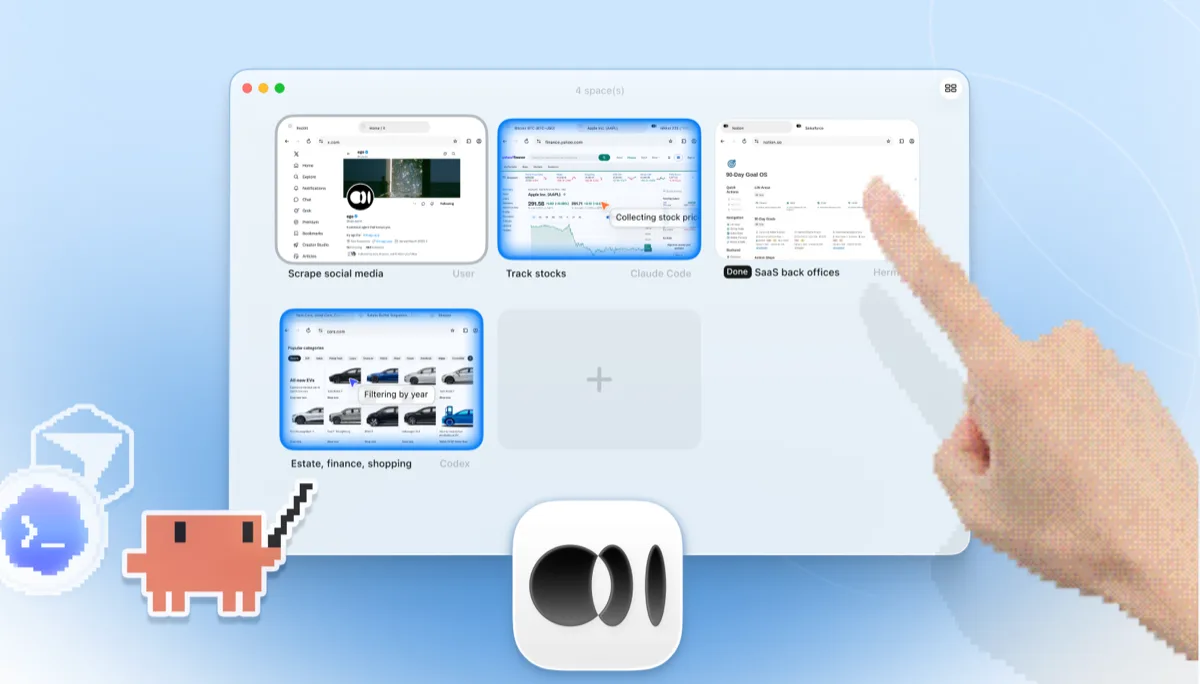
In ego lite non c'è un limite a quanti Spaces puoi aprire: ognuno esegue il proprio task in parallelo, sul proprio profilo Chrome importato, e nessuno di loro ti ruba mai la tab che stai usando. Guarda o prendi il controllo di qualsiasi Space in qualsiasi momento, in diretta.

Basta andirivieni Costi in token più bassi

Pilota Playwright da un agente tramite il playwright-cli di Microsoft, e stai comunque impartendo un comando per ogni azione: snapshot, clicca su un ref, di nuovo snapshot, leggi il risultato, decidi il comando successivo.

In ego lite, l'agente raggruppa diverse azioni in un'unica chiamata JavaScript per turno e legge la pagina come uno Snapshot compresso invece di un dump completo di accessibilità. Messi insieme, questi accorgimenti riducono l'intero task a molti meno token in totale.

Claude Code · ego lite
>/ego-browser Add the first product to the cart, then check checkout loads
Bash(
ego-browser nodejs <<'EOF' await openOrReuseTab('localhost:3000') await click('.product-card') await click('.add-to-cart') await click('a[href="/checkout"]') cliLog('checkout loaded') EOF
)
Output:
[t=4480ms] checkout loaded
Done. Both steps work.
─── 1 tool call · 1.1k tokens ───
Claude Code · playwright-cli
>Add the first product to the cart, then check checkout loads
$playwright-cli open localhost:3000
stdout
Opened http://localhost:3000
1.6k tokens sent so far
Storefront loaded. Snapshotting to find the first product.
$playwright-cli snapshot
Snapshot
… +224 lines (ctrl+o to expand)
3.1k tokens sent so far
First product card is e12. Clicking it.
$playwright-cli click e12
stdout
Clicked e12
4.9k tokens sent so far
Product page is up, refs are stale. Snapshotting again.
$playwright-cli snapshot
Snapshot
… +205 lines (ctrl+o to expand)
6.8k tokens sent so far
Add to cart button is e8.
$playwright-cli click e8
stdout
Clicked e8
9.2k tokens sent so far
Added. Heading to checkout.
$playwright-cli click e21
stdout
Clicked e21
11.2k tokens sent so far
Confirming the checkout page actually rendered.
$playwright-cli snapshot
Snapshot
… +229 lines (ctrl+o to expand)
13.6k tokens sent so far
─── 7 tool calls · 13.6k tokens ───
Lo stesso task, lo stesso modello. Sinistra: una chiamata JavaScript raggruppata in ego lite, 1.1k token totali. Destra: Playwright pilotato tramite playwright-cli, 7 round trip, i token salgono a 13.6k.

Stesso Chrome, nativo per gli agenti

Un nuovo contesto Playwright parte vuoto, quindi un'autenticazione reale significa scrivere lo script del login, salvare lo storageState e sperare che i token sopravvivano alla tua sessione di test. Quando un provider ruota i refresh token, come fa Auth0 sotto MFA, lo stato salvato si rompe comunque.

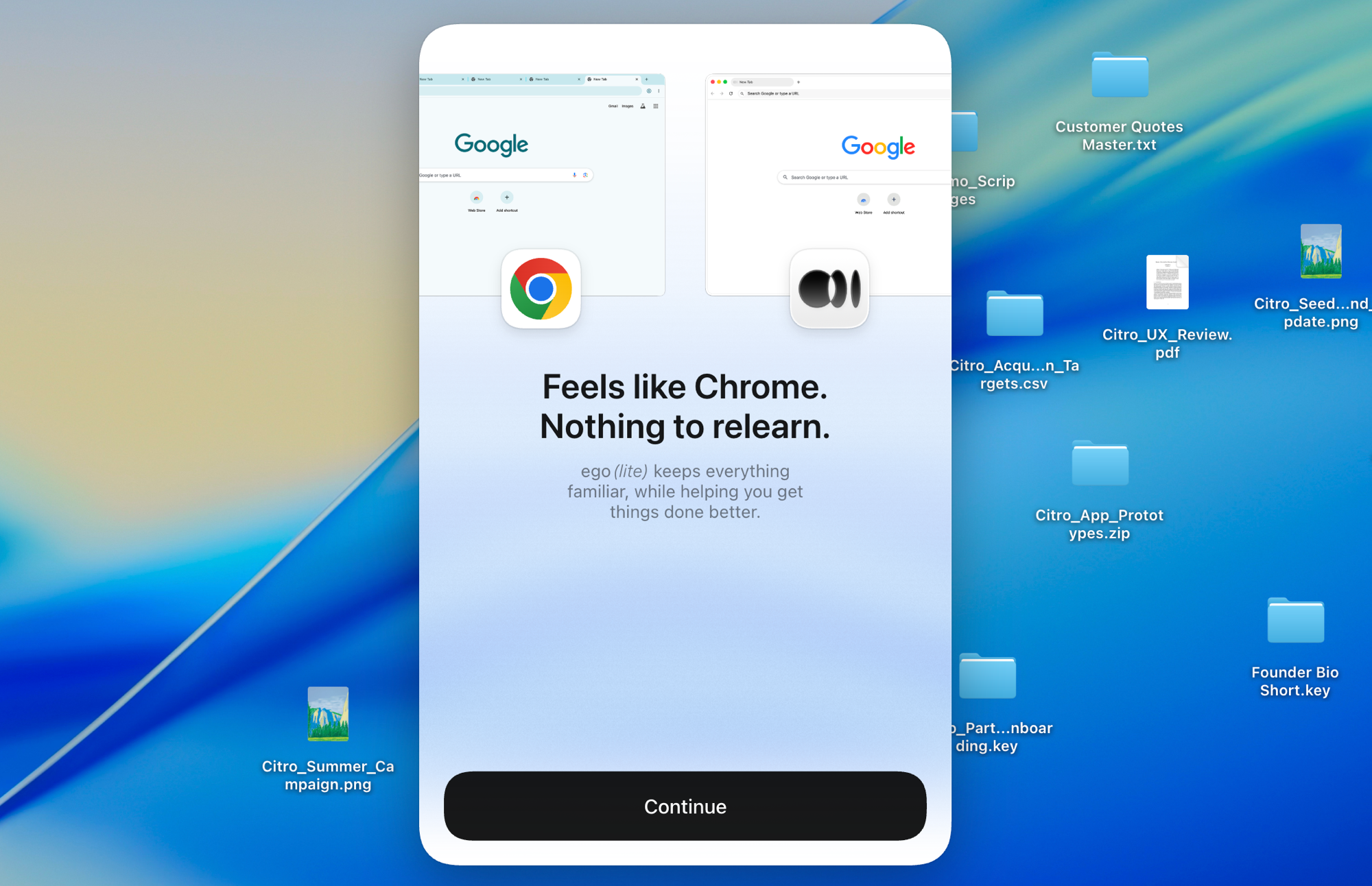
ego lite importa l'intero profilo Chrome con un clic: cookie, sessioni ed estensioni arrivano tutti insieme, così l'agente parte già autenticato ovunque tu lo sia.

Importazione del profilo Chrome in ego lite: configurazione in un clic con tutti i tuoi login, senza bisogno del file storageState

ego lite vs Playwright

Confronto delle funzionalità tra ego lite e Playwright.
Funzionalitàego litePlaywright
Come funziona il lavoroDescrivi il compito: il tuo agente guida il browserScrivi e mantieni script TS/Python/Java/.NET
Gestisce i cambiamenti di paginaL'agente rilegge lo Snapshot e si adattaI locator si rompono: tu aggiorni il codice
Siti con accesso già effettuato (SSO, 2FA)Eredita il tuo vero profilo Chrome e le sessioniContesti vuoti: login via script, gestione di storageState
ConfigurazioneInstalla l'app, esegui /ego-browser nel tuo agenteProgetto Node/Python, installazione dei browser, file di configurazione
Funziona con AI agentCostruito per loro: Claude Code, Codex, Cursor tramite ego-browserTramite codegen, playwright-cli, oppure il server Playwright MCP separato
Browser automation on live sites (31-task suite)93.5% perfect, $1.75 per completed task, 6m 38s average71% perfect, $4.82 per completed task, 10m 48s average (via playwright-cli)
Attività paralleleGli Spaces isolano le attività all'interno di un unico browser visibileWorker e contesti, tipicamente headless
Browser da usare ogni giornoSì, tu navighi nel tuo Space mentre gli agenti lavorano nel loroNo, è una libreria di automazione, non un browser in cui vivi
Suite di test in CINot a test runner; agents handle browser work directlySì, il test runner e l'integrazione CI più solidi in circolazione
Competenze riutilizzabili (in arrivo)Distills successful runs into reusable skills for repeat tasks (limited beta)Nessun equivalente integrato
PrezzoGratis, nessun abbonamentoGratuito, open source
Ultimo aggiornamento 30 ago 2026

Una transizione senza intoppi

You don't port Playwright tests to ego (lite). Keep them. What moves over is browser work you want an agent to handle directly: search, research, extraction, forms, testing, and logged-in workflows outside your CI suite.

  1. Scarica ego (lite)

    Scarica ego lite e importa il tuo profilo Chrome in un clic. Arrivano anche i login che i tuoi contesti di test non hanno mai avuto.

  2. Esegui il tuo primo task con /ego-browser

    Incolla nel tuo agente

    /ego-browser Apri ego.app ed elenca tutti i link nella barra di navigazione

    Esegui /ego-browser in Claude Code, Codex o Cursor. Nessuno scaffold di progetto, nessun playwright.config.

  3. Guardalo in azione
    Panoramica degli Spaces di ego lite con quattro attività di navigazione in esecuzione fianco a fianco: Claude Code che segue il titolo Apple su Yahoo Finance, Codex che filtra le auto per anno su cars.com, Hermes che completa un'attività di back-office SaaS, un utente che effettua scraping su X, e una mano che tocca + per aprire un altro Space

    Affida all'agente un compito per cui normalmente scriveresti uno script, come estrarre numeri da una dashboard con login o percorrere un flusso di checkout, descritto in una frase.

Keep Playwright for deterministic end-to-end suites in CI. ego (lite) covers the agent-driven browser work around them, from investigation and search to live checks and data collection.

Quando usare ogni strumento

Scegli ego (lite) se

  • Il lavoro vive dietro i tuoi login: dashboard, pannelli di amministrazione, SSO, dove scriptare storageState non ne vale la pena.
  • Preferisci descrivere il task a Claude Code, Codex o Cursor piuttosto che creare un progetto di test da zero e mantenere i locator.
  • Vuoi controllare più flussi in parallelo con gli Spaces, mentre continui a navigare nello stesso browser.
  • Ti interessa il costo in token per singolo task: Snapshot in input più JavaScript in batch, combinati insieme, mantengono l'intero task economico.

Scegli Playwright quando

  • Stai costruendo suite di test end-to-end consolidate che devono eseguire in modo deterministico in CI. È il punto di forza principale di Playwright.
  • Ti affidi al suo test runner, all'auto-waiting, al trace viewer e al codegen: strumenti che la maggior parte dei concorrenti non offre ancora.
  • Hai bisogno di copertura su Firefox e WebKit. ego lite funziona solo su Chromium.
  • Il tuo team lavora con TypeScript, Python, Java o .NET e vuole binding di prima classe per ciascuno.

Dai al tuo agente un browser vero

Gratis, funziona sul tuo Mac e importa il tuo profilo Chrome con un clic. Funziona con Claude Code, Codex, Cursor e qualsiasi agente CLI che scrive codice.

Stai ancora valutando le opzioni? Guarda come Playwright si confronta con gli altri strumenti dello stesso ambito.

FAQ

Playwright è il framework di automazione open source di Microsoft per Chromium, Firefox e WebKit, con binding di prima classe per TypeScript, Python, Java e .NET. Il suo test runner, l'auto-waiting, il trace viewer e l'integrazione con la CI sono i più solidi della categoria, e per suite di test end-to-end consolidate e deterministiche è lo strumento da battere. Microsoft ha anche iniziato a distribuire playwright-cli, una CLI companion attenta al consumo di token, creata dal team di Playwright per agenti di coding come Claude Code e Copilot. Questa pagina riguarda il framework principale e i suoi flussi di lavoro basati su script e CLI; Playwright MCP, il server MCP separato pensato per gli agenti, ha una sua pagina di confronto dedicata. Gli sviluppatori che scelgono un approccio guidato da agenti valutano anche Browser Use vs Playwright e Stagehand vs Playwright, dato che tutti e tre compaiono nella maggior parte degli stack di navigazione guidati da LLM.

Per il lavoro nel browser guidato da agenti AI, sì: niente script, login reali, Spaces in parallelo, il che la rende una delle poche alternative a Playwright pensate specificamente per gli agenti, invece che per altro scripting. Per suite di test end-to-end consolidate in CI, no. Il test runner, il tracing e la copertura cross-browser di Playwright sono davvero eccellenti, e conviene continuare a usarli. La distinzione onesta: Playwright per i test che committi, ego lite per i task che deleghi.

We ran the same 31 browser automation tasks on live websites, driven by the same pi agent with the same model (gpt-5.6-sol, thinking effort max) and graded by the same written checklist. Playwright entered through playwright-cli, the companion CLI the Playwright team ships for coding agents, which is the strongest agent-facing way to run it today. ego (lite) finished 93.5% of 31 tasks perfectly at $1.75 per completed task; agent-driven Playwright finished 71.0% across 31 tasks at $4.82. The tasks, the checklists, and the raw results are open source in the ego-browser-benchmark-framework repository on GitHub, so every number can be audited or reproduced.

Tutti e tre sono framework script-first, che tu li cerchi come playwright vs puppeteer o puppeteer vs playwright. Playwright vince per le nuove suite di test: runner più veloce, auto-waiting, TS/Python/Java/.NET, tutti e tre i motori. Puppeteer vince quando lavori solo su Chrome in Node e vuoi un'API leggera a livello DevTools. Selenium vince dove contano lo standard W3C WebDriver, i binding per molti linguaggi o un Grid enterprise già esistente. ego lite ha un ruolo diverso: è un agente AI a navigare invece di uno script, senza codice da mantenere e con il tuo profilo reale già collegato e loggato.

Selenium vs Playwright si riduce a compromessi da entrambe le parti. Playwright: esecuzione più veloce, auto-waiting integrato, un test runner moderno e strumenti come trace viewer e codegen; il compromesso è un ecosistema più giovane. Selenium: lo standard W3C WebDriver, la copertura più ampia di linguaggi e browser legacy, e due decenni di adozione enterprise; il compromesso è codice più verboso e una gestione delle attese più esplicita. Se oggi devi scegliere un framework di test, la maggior parte dei team opta per Playwright. Se il lavoro è guidato da agenti invece che scriptato, guarda come ego lite si confronta con Selenium nella nostra pagina su Selenium.

Both wrap a fresh Playwright browser for agent use, and both still run one command per action in a blank profile: Playwright MCP as MCP tool calls, playwright-cli as CLI invocations. ego lite instead batches multiple actions in JavaScript per turn, reads pages as compressed Snapshots, and starts from your real logged-in Chrome profile. Across those 31 live-site jobs that difference measures out to 93.5% of tasks perfect against 71%, at $1.75 per completed task against $4.82, with playwright-cli as the Playwright entrant. Full breakdown on the ego lite vs Playwright MCP page.

Parzialmente. Puoi salvare lo storageState dopo un login scriptato, oppure avviare un contesto persistente puntato su una directory di profilo Chrome, ma le sessioni scadono, 2FA e SSO interrompono i login scriptati, e un profilo non può essere condiviso con un Chrome già in esecuzione. ego lite importa il tuo profilo una sola volta, e da quel momento l'agente eredita lo stato di login reale.

Sì. Gratis, nessun abbonamento, dati salvati in locale. Il guscio ego-browser a cui si collega il tuo agente è open source con licenza MIT.

CI flake usually comes from shared state, unstable selectors, race conditions, resource pressure, or a test that assumes a fixed delay. Use isolated fixtures, locator-based assertions, waits for meaningful application state, bounded retries for diagnosis, and trace artifacts. ego lite is not a CI test-runner replacement: its visible Spaces help an agent investigate an interactive failure, while Playwright remains the right choice for committed deterministic suites.

No tool can guarantee that, and this page does not provide bypass instructions. A block is an access-control decision: respect the site's terms, robots and rate limits, use an official API or licensed feed, request permission, or stop. ego lite can use your own authorized browser session for content you can already see, but a real Chrome profile, residential IP, stealth plugin, or mouse simulation is not a promise of access and must not be used for ban evasion.

For interactive, agent-driven work, ego lite lets the agent read the current page and choose an action instead of maintaining a generated selector for every one-off task. That reduces script maintenance, but it does not make a changing site magically stable: keep source-linked results, verify important fields, and retain Playwright for assertions and repeatable CI coverage. For Playwright itself, prefer roles, labels, test IDs, and stable application contracts over generated CSS classes.

An agent can turn a plain-English scenario into Playwright code, run the suite, inspect a trace, and propose or apply a fix in a controlled branch. It still needs a clear assertion contract, test data, and human review: an agent can make a test green by weakening an assertion or masking a product bug. ego lite is useful for exploring a flow in a real session; promote verified behavior into committed Playwright tests when it must run in CI.

Treat an iframe as a separate browsing context and wait for the frame or application state that proves it is ready; do not rely on arbitrary sleeps. For Stripe-like third-party checkout, use the provider's supported test mode and stable labels, and keep secrets out of fixtures. An agent can inspect a live frame and recover from a changed layout, but it cannot remove cross-origin restrictions or guarantee that a provider's UI will remain available.