





ego (lite) — это просто браузер, а ego — ваш личный агент на всех устройствах.
Записаться в лист ожидания
ego lite против Codex browser

Лучшая альтернатива Codex browser

Codex browser is @Browser in the ChatGPT desktop app: a local Chromium panel Codex can drive, with its own state separate from your Chrome. The Codex CLI has no browser at all.

Run /ego-browser and Codex controls ego lite, the browser you already use, in the CLI and on desktop. Import your Chrome profile and finish whole tasks 3 to 4x faster than Codex browser.

Нам доверяют разработчики из
GoogleAmazonShopifyTikTokHarvardStanfordUSCUCLA

Почему ego lite лучше Codex browser

You keep Codex. ego lite is which browser it reaches for: your imported Chrome profile with sessions already in place, not a second Chromium you sign into site by site. It works from the CLI where @Browser cannot run, and it beats @Browser on speed, parallelism, tokens, and logins where it can.

В 3-4 раза быстрее на реальных задачах

In the Codex CLI there is no browser at all: the skill may appear, then report unavailable, and you verify changes yourself. On desktop, @Browser re-reads the page through domSnapshot() at every step, and the panel sits idle while Codex thinks.

Run /ego-browser and Codex controls ego lite directly. Every page arrives as a Snapshot: a compressed accessibility tree with stable @N refs Codex can act on instantly. Codex spends its time on the task, not waiting on snapshots or handoffs, finishing whole tasks 3 to 4x faster than Codex browser.

Time to finish a task, shorter is better
81.8 sego lite
282.9 sagent browser
Data source - Task: scrape the main posts from the X account from the last 7 days
Параллельная многозадачность, более быстрое выполнение

The CLI cannot run browser tasks in parallel because it has no browser. On desktop, @Browser is one panel on one task, and browser work draws from the same usage allowance as your coding work.

In ego lite there's no cap on how many Spaces you open inside the same browser: each one runs its own task at the same time, controlled by Codex or another coding agent via /ego-browser on its own imported Chrome profile. None of them ever steals the tab you're using, and you can watch or take over any Space anytime.

Никакой беготни туда-сюда Меньше расходов на токены

On desktop, every @Browser action is its own round trip through the model: domSnapshot(), click, domSnapshot() again. Each result comes back before the next move is chosen, and that spend comes out of the same allowance as your coding work. In the CLI there is no @Browser, so you never get this loop built in.

Run /ego-browser and Codex batches several actions in a few lines of JavaScript per turn to control ego lite. Stacked with Snapshot input, the same task completes on far fewer tokens overall.

Claude Code · ego lite
>/ego-browser Add the first product to the cart, then check checkout loads
Bash(
ego-browser nodejs <<'EOF' await openOrReuseTab('localhost:3000') await click('.product-card') await click('.add-to-cart') await click('a[href="/checkout"]') cliLog('checkout loaded') EOF
)
Output:
[t=4480ms] checkout loaded
Done. Both steps work.
─── 1 tool call · 1.1k tokens ───
Codex · @Browser
>Add the first product to the cart, then check checkout loads
browser.tabs.new() (@Browser)
Tab
Tab created (about:blank)
1.6k tokens sent so far
Approve localhost for this site, then navigate.
tab.goto (@Browser)("http://localhost:3000")
Result
Navigated to http://localhost:3000
2.8k tokens sent so far
Page is up. Reading the DOM before choosing a target.
tab.playwright.domSnapshot() (@Browser)
DOM snapshot
… +187 lines (ctrl+o to expand)
4.6k tokens sent so far
First product card is .product-card. Clicking it.
tab.playwright.locator(".product-card").click() (@Browser)
Result
Clicked .product-card
6.3k tokens sent so far
Product page rendered. Snapshot again: prior refs are stale.
tab.playwright.domSnapshot() (@Browser)
DOM snapshot
… +203 lines (ctrl+o to expand)
8.4k tokens sent so far
Add to cart is .add-to-cart.
tab.playwright.locator(".add-to-cart").click() (@Browser)
Result
Clicked .add-to-cart
10.2k tokens sent so far
Added. Opening checkout, then confirming the form with a snapshot.
tab.playwright.locator("a[href='/checkout']").click() (@Browser)
Result
Clicked a[href='/checkout']
tab.playwright.domSnapshot() → payment form present
13.6k tokens sent so far
─── 7 tool calls · 13.6k tokens ───
Одна и та же задача, одна и та же модель. Слева: один пакетный вызов JavaScript в ego lite, всего 1.1k токенов. Справа: встроенный браузер Codex, 7 раунд-трипов, токены доходят до 13.6k.

Тот же Chrome, нативно для агентов

In the CLI, Codex never sees your Chrome logins because there is no browser. On desktop, @Browser uses separate state: OpenAI's help center says it does not use your Chrome profile, cookies, tabs, or extensions. You sign into a second browser by hand, one site at a time.

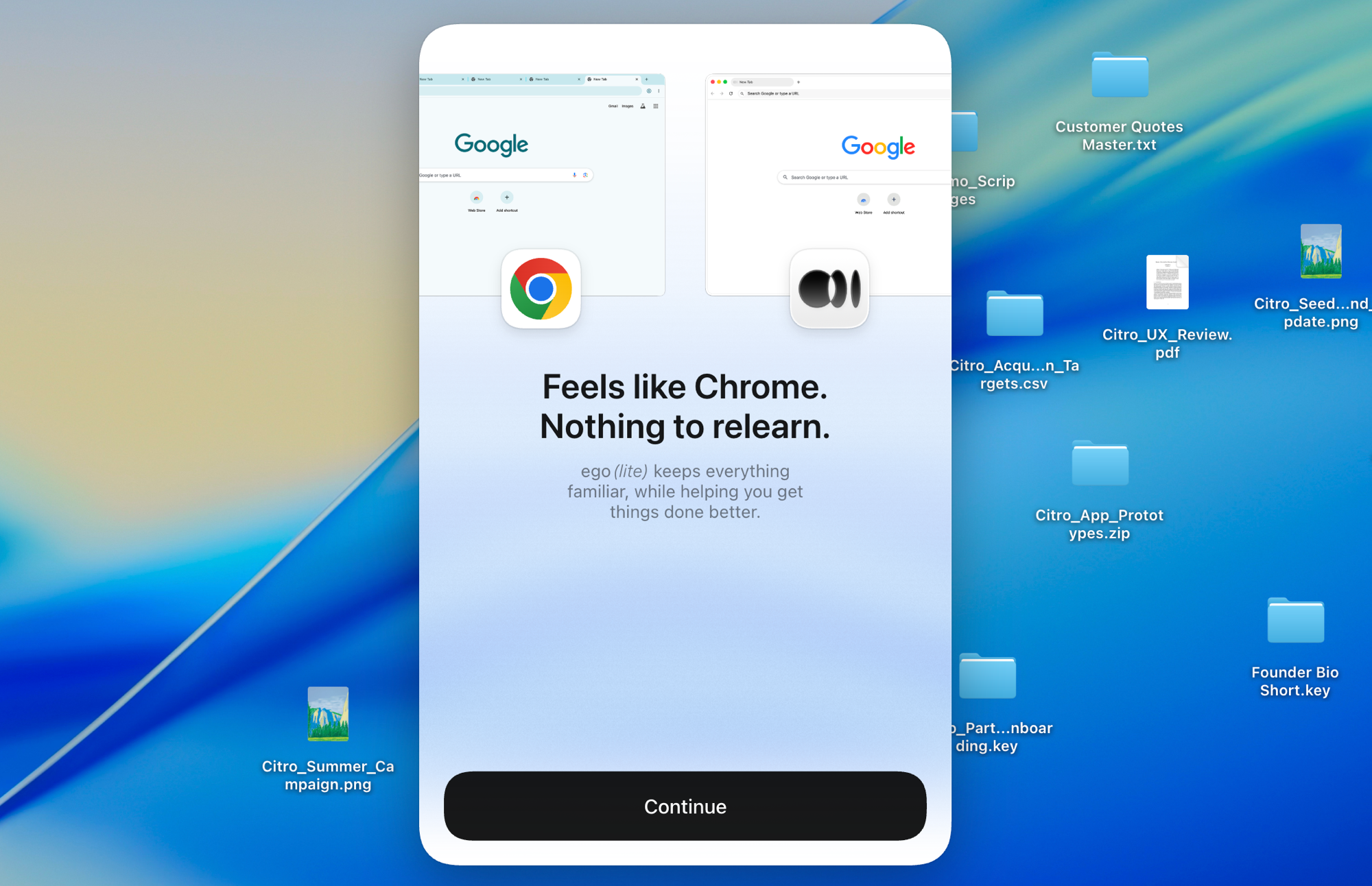
Built on Chromium, ego lite imports your entire Chrome setup in one click. When Codex runs /ego-browser, it controls ego lite with your real sessions already in place, including the 2FA trust you already have, so it doesn't stall on login walls you passed months ago.

Импорт профиля Chrome в ego lite: настройка в один клик со всеми вашими логинами

ego lite против Codex browser

Сравнение возможностей ego lite и Codex browser.
Функцияego liteCodex browser
Работает в Codex CLIYes. Run /ego-browser and the coding agent controls ego liteNo. Only the desktop app has @Browser
Использует ваши настоящие логины ChromeYes, one-click Chrome profile importNo. Separate browser state, signed in by hand per site
Кросс-ориджин iframe и passkeySnapshot reaches into cross-origin iframes and shadow DOMOpen issues: cross-origin iframe input unsupported; passkeys incomplete
Как агент действует на страницеCoding agent batches multiple actions in JavaScript per turn via /ego-browserOne tool call per action, result read back each time
Расход токенов на задачуLower: Snapshot plus batched actions, measured per taskВыше: каждый шаг возвращает контекст через модель
За что выставляется счётНичего лишнего. Браузер бесплатный и локальныйThe same coding allowance as the rest of your Codex work (5-hour window plus a weekly cap)
Изоляция параллельных задачUnlimited Spaces in one browser, bounded by your machineОдна встроенная панель браузера на сессию
Одновременно служит вашим повседневным браузеромДа. Вы работаете в своем Space, агенты в своихNo. A separate panel with separate state
Изоляция от ваших настоящих аккаунтовNo. The coding agent controls ego lite inside your loginsYes, by design: separate state, no path to personal accounts
Многоразовые навыки (скоро)Превращает успешные запуски в многоразовые навыки; до 5 раз быстрее на сложных задачах по мере их повторения агентом (ограниченная бета)Нет встроенного аналога для браузерных задач
Цена и доступностьFree, no subscription. macOS, Chromium onlyIncluded with ChatGPT plans; Computer Use is region-limited
Последнее обновление 30 июл. 2026 г.

Сделайте переход незаметным

You are not switching away from Codex. Run /ego-browser so Codex controls ego lite, a Chromium browser that already holds your sessions, from the CLI or alongside @Browser on desktop.

  1. Скачать ego (lite)

    Скачайте ego lite и импортируйте профиль Chrome в один клик. Логины, куки и расширения переносятся вместе с ним.

  2. Запустите свою первую задачу с /ego-browser

    Вставьте в своего агента

    /ego-browser Откройте ego.app и запишитесь в лист ожидания

    Run /ego-browser in Codex and paste one sentence. Works in the CLI; no MCP config, no per-site approval step first.

  3. Посмотрите, как это работает
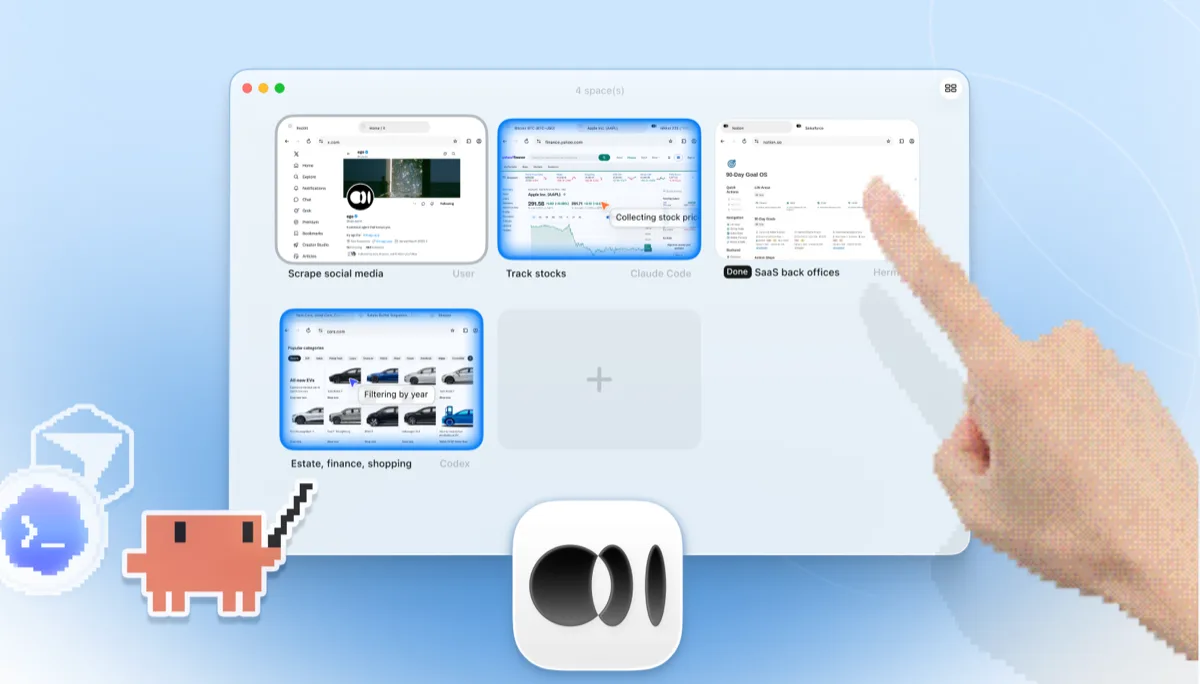
    Обзор Spaces в ego lite с четырьмя браузерными задачами, выполняющимися бок о бок: Claude Code отслеживает акции Apple на Yahoo Finance, Codex фильтрует автомобили по году на cars.com, Hermes завершает офисную задачу SaaS, пользователь собирает данные с X, и рука нажимает + для открытия ещё одного Space

    The task runs in its own Space, so your tabs stay untouched. Take over anytime. Results land back in the Codex CLI.

Keep @Browser on desktop for localhost previews and the annotation loop: select an element, comment, fix exactly that.

Когда использовать каждый инструмент

Выбирайте ego (lite), если

  • You want browser work from the Codex CLI, where @Browser does not run.
  • Logged-in tasks should start in your real Chrome, not a second browser you authenticate site by site.
  • Even on desktop, whole tasks behind SSO feel slow in @Browser's one-panel, one-action loop.
  • You want parallel Spaces without spending Codex allowance on routine @Browser clicking.

Выбирайте Codex browser, когда

  • You want zero setup: @Browser is already in a ChatGPT plan you pay for.
  • You're debugging your own frontend on localhost and want CDP access from inside the agent.
  • You want the annotation loop: select an element, comment, fix exactly that.
  • You want the agent to have no path to your real accounts. Separate state is a deliberate safety tradeoff.

Дайте своему агенту настоящий браузер

Бесплатно, работает на вашем Mac, импортирует профиль Chrome в один клик. Работает с Claude Code, Codex, Cursor и любым CLI-агентом, который пишет код.

Всё ещё сравниваете варианты? Посмотрите, как Codex browser соотносится с другими инструментами в этой нише.

Частые вопросы

Codex browser is OpenAI's built-in browser for Codex, reached with @Browser in the ChatGPT desktop app. It is a local Chromium panel you can watch and take over, with DOM and accessibility-tree reading plus CDP access in Developer mode. For localhost frontend work it is genuinely good, and it is included in ChatGPT plans. It does not use your Chrome profile, and it is not available in the Codex CLI. The Codex Chrome extension is a separate surface covered on its own compare page.

Yes, for both surfaces. In the Codex CLI, ego lite is the Chromium browser Codex lacks. On desktop, it beats @Browser on speed, parallelism, tokens, and logins because Codex controls ego lite with batched JavaScript instead of one domSnapshot round trip per click. Keep @Browser for localhost previews and the annotation loop.

Codex browser use is OpenAI's @Browser feature in the ChatGPT desktop app: Codex can open pages, click, and inspect them in a local Chromium panel. The Codex CLI has no browser. Run /ego-browser and Codex controls ego lite, a Chromium browser with your imported Chrome profile, from the CLI and beats @Browser on whole logged-in tasks.

OpenAI Codex browser is the built-in Chromium panel reached with @Browser in the ChatGPT desktop app. It is local, not cloud, and separate from your Chrome profile. ego lite is not a replacement for Codex itself. It is the Chromium browser Codex controls when you run /ego-browser from the CLI or want your real Chrome sessions on desktop.

In the ChatGPT desktop app, yes, via @Browser for codex web browser tasks. In the Codex CLI, no: only web search snippets, no page control. Codex cloud blocks internet by default in the agent phase. Run /ego-browser so Codex controls ego lite, a Chromium browser, from the CLI.

No. The browser skill may still appear, then report unavailable. Run /ego-browser so Codex controls ego lite, a Chromium browser on your Mac, from the same terminal. On desktop, @Browser exists but uses separate state and a slower one-action loop; ego lite still wins for logged-in whole tasks.

On desktop, invoke @Browser and Codex drives its built-in panel one action at a time: tab.goto, domSnapshot, locator click. From the CLI, install ego lite, import your Chrome profile, and run /ego-browser so Codex controls ego lite against your real sessions with batched JavaScript instead of seven round trips per task.

Yes, into its own browser state, not your Chrome profile. OpenAI's help center points to the Codex Chrome extension when you need existing cookies or sessions. ego lite imports your profile once, so Codex starts inside the logins and 2FA trust you already have.

No. @Browser is an embedded Chromium panel in the desktop app on your machine. ChatGPT's separate cloud browser is a different surface. ego lite is also a local Chromium browser on your Mac: free, no subscription.

Yes. @Browser draws on the same coding allowance as the rest of your Codex work. ego lite adds no meter of its own; you only pay model tokens your agent already spends, and batched JavaScript keeps per-task totals lower than @Browser's one-action loop.

Playwright MCP works in the CLI but needs MCP config and one tool call per action against a blank profile. ego lite needs no MCP: run /ego-browser against your real Chrome profile from Codex, Claude Code, or Cursor. See ego lite vs Playwright MCP.