





ego (lite) 只是一個瀏覽器,ego 則是你跨裝置的個人 Agent。
加入候補名單
ego lite 對比 Stagehand

最好用的 Stagehand 替代品

Stagehand is Browserbase's open-source SDK: you write TypeScript or Python, and methods like act, extract, and observe turn plain-language instructions into browser actions.

ego lite is a Stagehand alternative that skips the SDK entirely. Run /ego-browser and your coding agent controls ego lite directly, batching a whole task into one JavaScript call, finishing whole tasks 3 to 4x faster than Stagehand.

獲得來自以下單位開發者的信賴
GoogleAmazonShopifyTikTokHarvardStanfordUSCUCLA

為什麼 ego lite 比 Stagehand 更好

Stagehand means maintaining a TypeScript or Python project, and every uncached action is another model call at runtime. With ego lite you type one sentence in Claude Code, Codex, or Cursor after /ego-browser. No project, no schema, no API key.

在實際任務中快 3 到 4 倍

In Stagehand, three clicks in a row can mean three separate trips to the model before the page moves again. Stagehand's own speed guide shows this pattern and suggests calling observe first so later clicks can reuse what it found.

Run /ego-browser and your coding agent controls ego lite directly. Every page arrives as a Snapshot: a compressed accessibility tree with stable @N refs it can act on instantly. Your coding agent spends its time on the task, not restructuring scripts, finishing whole tasks 3 to 4x faster than Stagehand.

Time to finish a task, shorter is better
81.8 sego lite
282.9 sagent browser
Data source - Task: scrape the main posts from the X account from the last 7 days
平行多工,執行更快

Running several Stagehand tasks at once means spinning up and tearing down browser instances in your own code, or moving to Browserbase and hitting session caps of 3, 25, or 100. To see what happened, you open a replay after the run finishes.

In ego lite there's no cap on how many Spaces you open inside the same browser: each one runs its own task at the same time, controlled by a coding agent via /ego-browser on its own imported Chrome profile. None of them ever steals the tab you're using, and you can watch or take over any Space anytime.

不再來回往返 消耗更少 tokens

Stagehand's action cache helps when you repeat the same flow on the same page. On a new site, or after the DOM shifts, each call asks the model again, and stale caches have to be cleared by hand.

Run /ego-browser and your coding agent batches several actions in a few lines of JavaScript per turn to control ego lite. Stacked with Snapshot input, the same task completes on far fewer tokens overall.

Claude Code · ego lite
>/ego-browser Add the first product to the cart, then check checkout loads
Bash(
ego-browser nodejs <<'EOF' await openOrReuseTab('localhost:3000') await click('.product-card') await click('.add-to-cart') await click('a[href="/checkout"]') cliLog('checkout loaded') EOF
)
Output:
[t=4480ms] checkout loaded
Done. Both steps work.
─── 1 tool call · 1.1k tokens ───
Stagehand · env: "LOCAL"
>$ npx tsx run_task.ts const stagehand = new Stagehand({ env: "LOCAL" }) await stagehand.init()
await page.goto("http://localhost:3000")
// page = stagehand.context.pages()[0]
navigated: http://localhost:3000
1.6k tokens sent so far
await stagehand.act("click the first product card")
// LLM call #1 · model: gpt-5.6-sol
→ { success: true, message: "Action completed successfully",
actions: [{ selector: "/html/body/div[2]/main/div[1]/a",
method: "click", arguments: [] }] }
3.8k tokens sent so far
await stagehand.act("click add to cart")
// LLM call #2 · model: gpt-5.6-sol
→ { success: true, message: "Action completed successfully",
actions: [{ selector: "/html/body/div[2]/main/button[1]",
method: "click", arguments: [] }] }
5.9k tokens sent so far
await stagehand.observe("find the checkout link")
// LLM call #3 · model: gpt-5.6-sol
→ [{ selector: "/html/body/nav/a[href='/checkout']",
description: "Checkout link", method: "click", arguments: [] }]
8.0k tokens sent so far
await stagehand.act(action)
// no LLM: Action from observe()
→ { success: true, message: "Action completed successfully",
actions: [{ method: "click" }] }
navigated: /checkout
9.1k tokens sent so far
await stagehand.extract("is the payment form present?", z.object({ present: z.boolean() }))
// LLM call #4 · model: gpt-5.6-sol
→ { present: true }
11.4k tokens sent so far
await stagehand.extract("list the payment fields", z.object({ fields: z.array(z.string()) }))
// LLM call #5 · model: gpt-5.6-sol
→ { fields: ["card", "expiry", "cvc", "zip"] }
13.6k tokens sent so far
─── 7 model calls · 13.6k tokens ───
The same task, the same model. Left: one batched JavaScript call in ego lite, 1.1k tokens total. Right: a Stagehand script, a model call on nearly every step, tokens climb to 13.6k.

同一個 Chrome,AI Agent 原生體驗

Staying logged in is the hard part of local Stagehand. Chrome profile support still has an open bug in v3, cookie workarounds often miss the HttpOnly session cookies that matter, and the browse CLI only attaches if you started Chrome with remote debugging yourself.

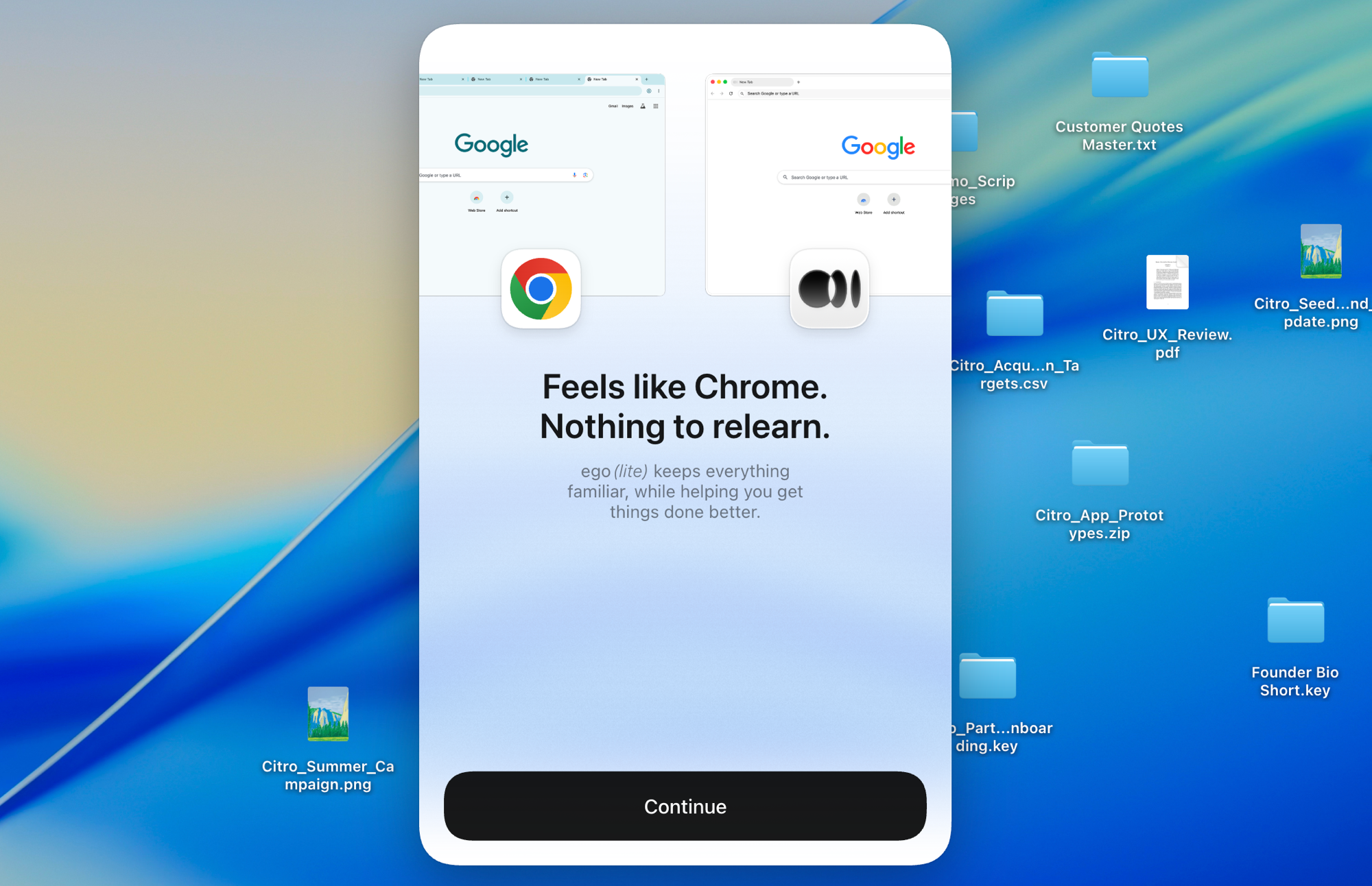
Built on Chromium, ego lite imports your entire Chrome setup in one click. When your coding agent runs /ego-browser, it controls ego lite with your real sessions already in place, so it doesn't stall on SSO, 2FA, or captchas on accounts you already have.

ego lite Chrome 個人設定檔匯入:一鍵設定,帶入你所有的登入狀態

ego lite 對比 Stagehand

ego lite 與 Stagehand 的功能比較。
功能ego liteStagehand
你寫什麼什麼都不用。對你已經在用的 AI Agent 說一句話A TypeScript or Python project: SDK, act/extract/observe, keep it working
AI Agent 如何在頁面上執行動作Coding agent batches multiple actions in JavaScript per turn via /ego-browserOne model call per act, extract, or observe that isn't cached; precise locators when you want to skip the model
每項任務的 Token 成本Lower: Snapshot plus batched JavaScript, measured per taskRepeated flows can reuse a cached selector; new pages pay for a fresh model call each time
沿用你真實的 Chrome 登入狀態Yes, one-click Chrome profile import; coding agent controls ego lite via /ego-browserNot reliably in local mode: Chrome profile support has an open bug, and browse needs remote debugging
設定Install ego lite, run /ego-browser in your agentnpm/pip install, model API key, and a project
平行任務隔離Unlimited Spaces in one browser, bounded by your machineYour code manages instances; Browserbase caps concurrency by plan
同時可作為你日常使用的瀏覽器可以,你在自己的 Space 裡瀏覽,Agent 在它們自己的 Space 裡工作不能。它啟動的是乾淨的自動化瀏覽器
可提交、可重複的自動化No. Tasks are interactiveYes: scripts with git history, review, and a committed cache
可重複使用的 skills(即將推出)將成功的執行過程萃取成可重複使用的 skills;隨著 AI Agent 重複執行,複雜任務最多可加快 5 倍(限量 beta)Action caching on repeated flows only
價格免費,無訂閱,無帳號MIT and free to install; you pay model tokens (plus Browserbase if hosted)
最後更新 2026年7月30日

讓轉換無縫接軌

Already running Stagehand scripts in CI or on a schedule? Keep those. Move one-off and logged-in exploratory work to ego lite in a few minutes.

  1. 下載 ego (lite)

    下載 ego lite,一鍵匯入你的 Chrome 設定檔,登入狀態、Cookie 和擴充功能全部一併帶入。

  2. 用 /ego-browser 執行你的第一個任務

    貼到你的 Agent 裡

    /ego-browser 前往 ego.app 並加入候補名單

    Paste one sentence into Claude Code, Codex, or Cursor and hit enter. No SDK, no model API key, no Zod schema.

  3. 看它實際運作
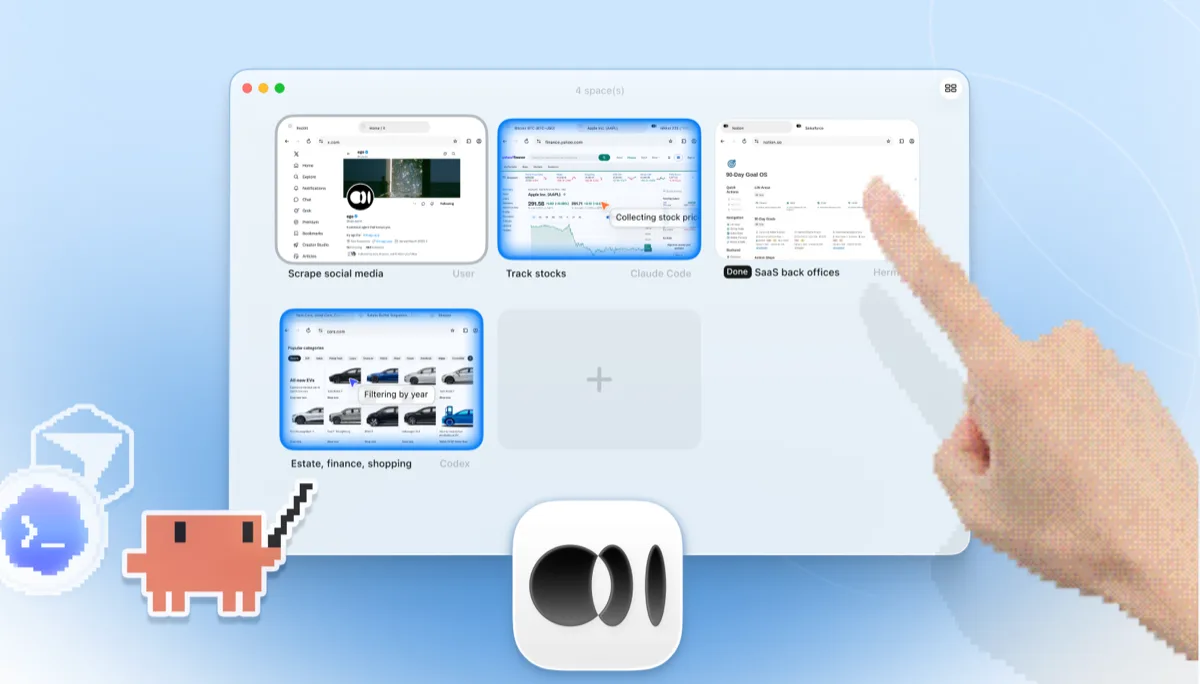
    ego lite 的 Space 總覽,四項瀏覽器任務並排執行:Claude Code 在 Yahoo Finance 追蹤蘋果股價、Codex 在 cars.com 依年份篩選車款、Hermes 完成一項 SaaS 後台任務、一位使用者在擷取 X 上的資料,還有一隻手正點擊 + 開啟另一個 Space

    The task runs in its own Space, so your tabs stay untouched. Watch live or take over anytime. Results land back in your agent's CLI.

Keep Stagehand for committed automation, typed extraction, and deterministic locators.

何時該用哪個工具

適合選擇 ego (lite) 的情況

  • You'd rather describe a one-off scrape or form fill than maintain a TypeScript or Python project for it.
  • The work sits behind your own logins and should start signed in.
  • You want parallel Spaces you can watch, without managing browser instances in code.
  • You don't want to add an SDK, model key, and project for something your coding agent can already do.

選擇 Stagehand 的情境

  • Automation must live in a repo with review, caching, and the same run months later.
  • You want a deterministic escape hatch: precise locators when a flow must not vary.
  • You need typed extraction with a Zod schema into TypeScript.
  • It must run in CI or across many cloud browsers on Browserbase.

給你的 AI Agent 一個真實瀏覽器

免費,在你的 Mac 上執行,一鍵匯入你的 Chrome 個人設定檔。適用於 Claude Code、Codex、Cursor,以及任何會寫程式碼的 CLI AI Agent。

還在權衡?看看 Stagehand 和同賽道其他工具怎麼比。

FAQ

Stagehand is Browserbase's MIT-licensed browser automation SDK for TypeScript and Python. It gives you act, extract, observe, and agent primitives, plus precise locators when you want to skip the model. It runs locally against Chromium, and pairs with Browserbase when you want hosted sessions, caching, and replay. For automation you commit to a repo and run on a schedule, it remains an excellent choice.

For interactive, logged-in browser work, yes: run /ego-browser and describe the task. For committed automation you ship to CI, with typed extraction and deterministic locators, keep Stagehand. Stagehand is for browser work you commit; ego lite is for browser work you do today.

No. Stagehand runs locally against Chromium on its own. Browserbase is optional when you want hosted sessions, server-side caching, and replay. The Browserbase vs Stagehand pairing matters for cloud fleets, not for a local script on your laptop. ego lite has no hosted path: local only, free, no account.

Often yes in production, but for different reasons. Stagehand is the SDK you write act, extract, and observe calls in. Browserbase is where those scripts run when you need cloud scale. For your own agent chores on logged-in sites, you may need neither: run /ego-browser and let Claude Code or Codex drive ego lite directly.

Stagehand is MIT-licensed and free to install. You pay model tokens for every act, extract, or observe call that is not cached, plus Browserbase browser minutes if you host it there. ego lite is free. You only pay the model tokens your coding agent already uses.

Not dependably in local mode today. Pointing Stagehand at your Chrome profile still has an open bug in v3, and cookie workarounds often miss the HttpOnly session cookies that matter. ego lite imports your Chrome profile once, and every task starts signed in.

They aim at different developers. Stagehand is TypeScript-first with act, extract, and observe primitives for hybrid code-plus-AI automation. Browser Use is Python-first and runs a more autonomous agent loop. Both are frameworks you write and fund. ego lite is the Chromium browser your coding agent controls via /ego-browser. See ego lite vs Browser Use for that side.

Stagehand is an SDK: you write act, extract, and observe calls in TypeScript or Python. agent-browser is a CLI your agent shells out to, one command at a time. ego lite is neither. Run /ego-browser and your coding agent controls ego lite with batched JavaScript. See ego lite vs agent-browser.

Not as a native skill. Claude Code would run a Stagehand script you wrote, with model API keys and a project to maintain. ego lite is the shorter path: run /ego-browser in Claude Code, Codex, or Cursor and describe the task. No SDK install, no schema, no separate model billing loop.

When an action is not cached, the model picks the target again each time, so a shifting page can resolve differently. Caches can also go stale after the DOM changes. Use Stagehand's precise locators when a flow must not vary. ego lite is built for interactive work where some variation is acceptable.

Neither. Run /ego-browser in Claude Code, Codex, Cursor, Gemini CLI, or OpenCode. Free on macOS 12+, no account required.