











ego (lite) is just a browser, ego is your personal agent across devices.
Join waitlist
YouTube scraping for public data

Free YouTube scraper with your AI agent

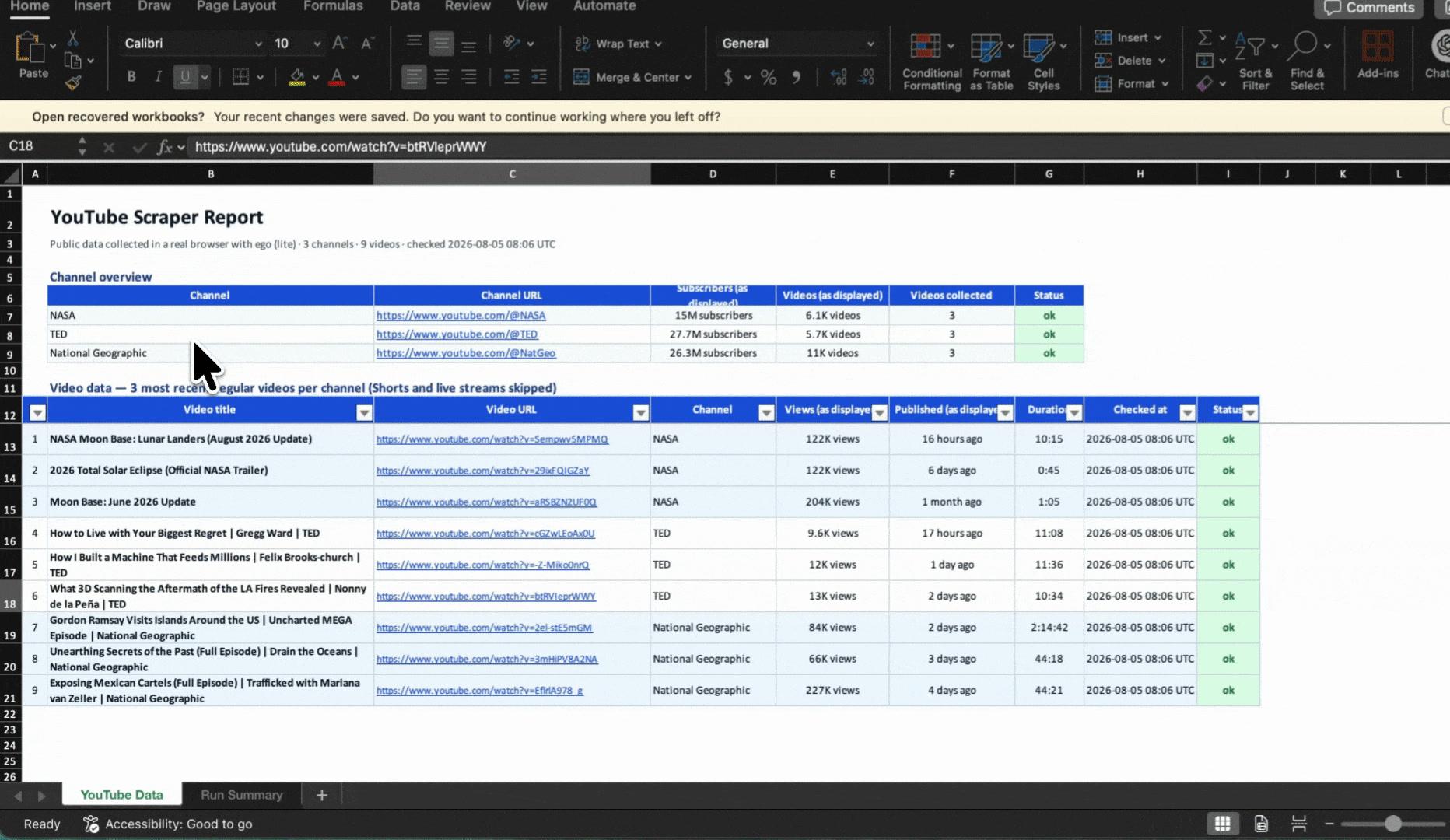
Use ego (lite) as a free YouTube scraper for public video, channel, and playlist data. Send YouTube URLs to Codex, Claude Code, or another AI agent, and it opens each page in a visible browser Space and returns a CSV or Markdown report with the displayed fields, source URLs, access status, and the time each page was checked.

Download for Mac(yes, free)

Trusted by developers from

OpenAIAnthropicGoogleMetaNVIDIACursorPerplexity
SpaceXTeslaNotionFigmaStripeNetflixAirbnb

How to scrape YouTube videos, channels, and playlists

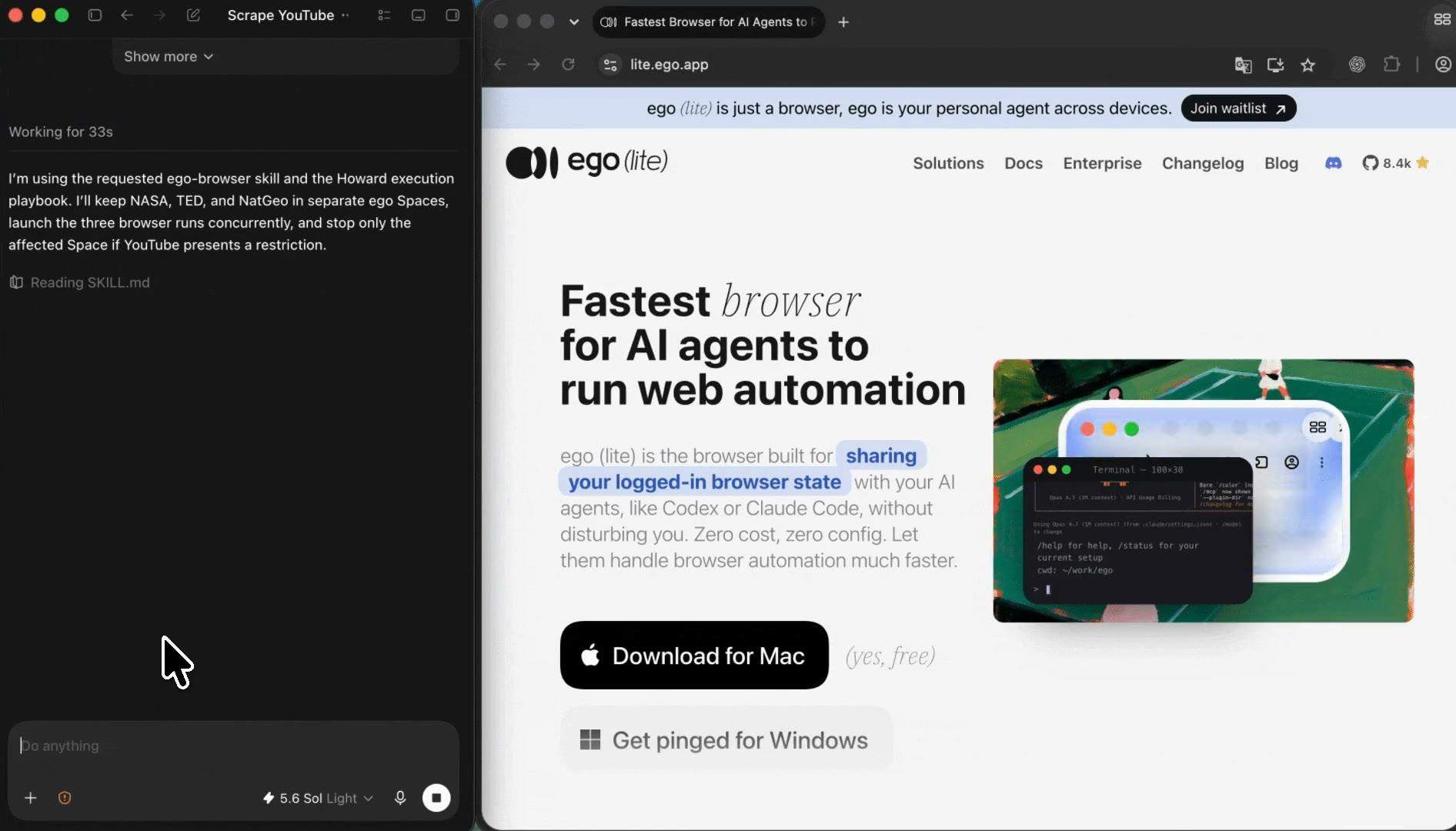
To scrape YouTube video data, give your Agent public video URLs, a channel videos page, or a playlist URL, plus the fields you need. The Agent works in a visible browser, keeps each source in its own ego (lite) Space, and records only the values the current session actually displays.

1

Install ego (lite) and choose your browser context

Download ego (lite), then import only the Chrome context you are authorized to use. Public YouTube pages usually load without signing in, but YouTube still decides what a region, consent choice, age gate, or session can see. The Agent works inside those rules instead of around them.
2

Scrape videos, channels, and playlists with one prompt

Paste public video URLs, a channel videos page, or a playlist URL into one prompt for Codex or Claude Code. Tell the Agent which fields to collect, such as the title, channel, displayed view count, publish date, and duration. Then choose the output format and tell it to stop when YouTube asks for sign-in, consent, or another human decision.

3

Collect YouTube data without copying it by hand

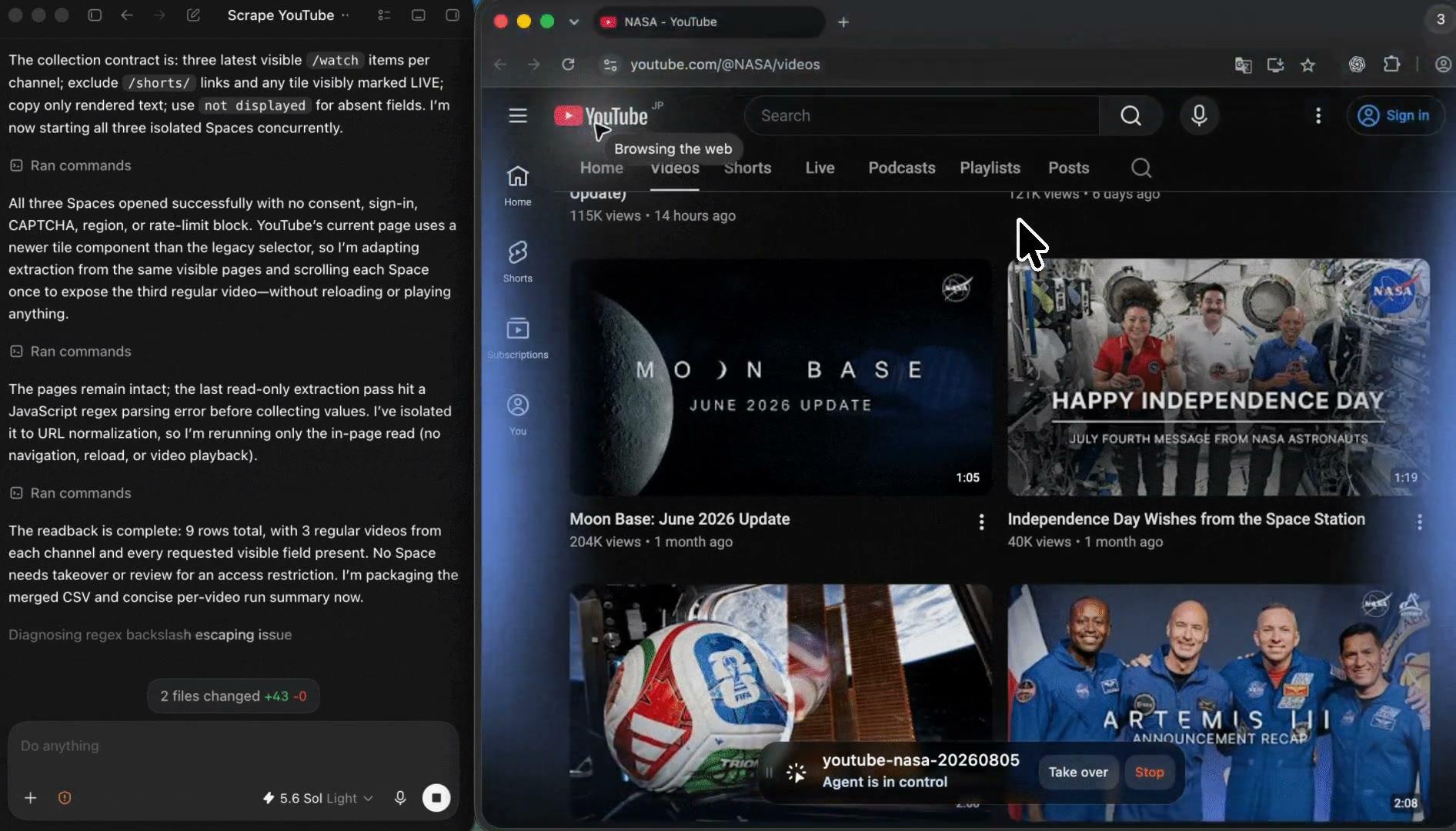
Your Agent opens each video, channel, or playlist in its own ego (lite) Space and captures the title, displayed view count, publish date, and other fields you requested. Every result stays connected to the page it came from, so the final report is easy to verify.

4

Multitask while YouTube scraping runs in parallel

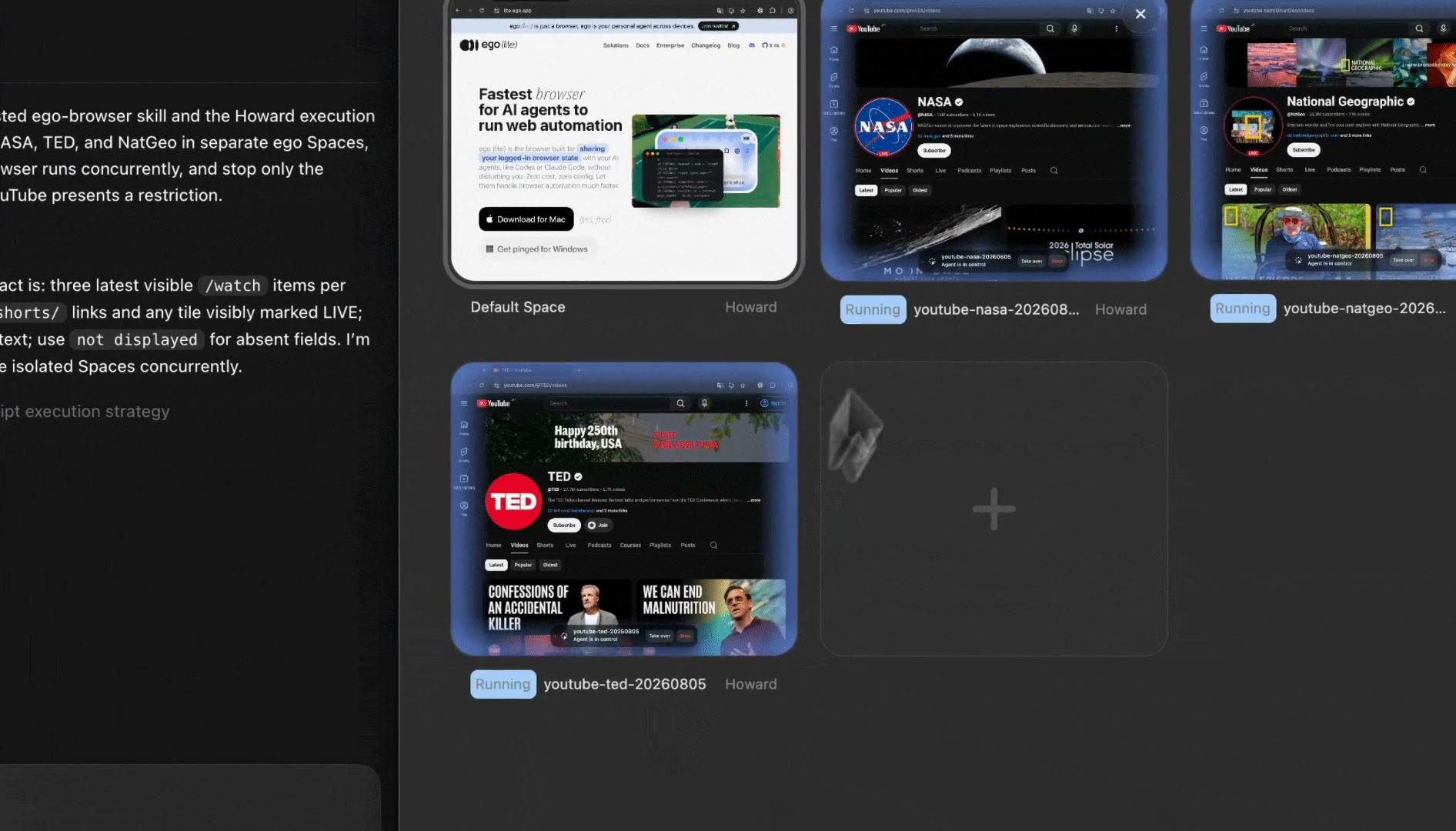
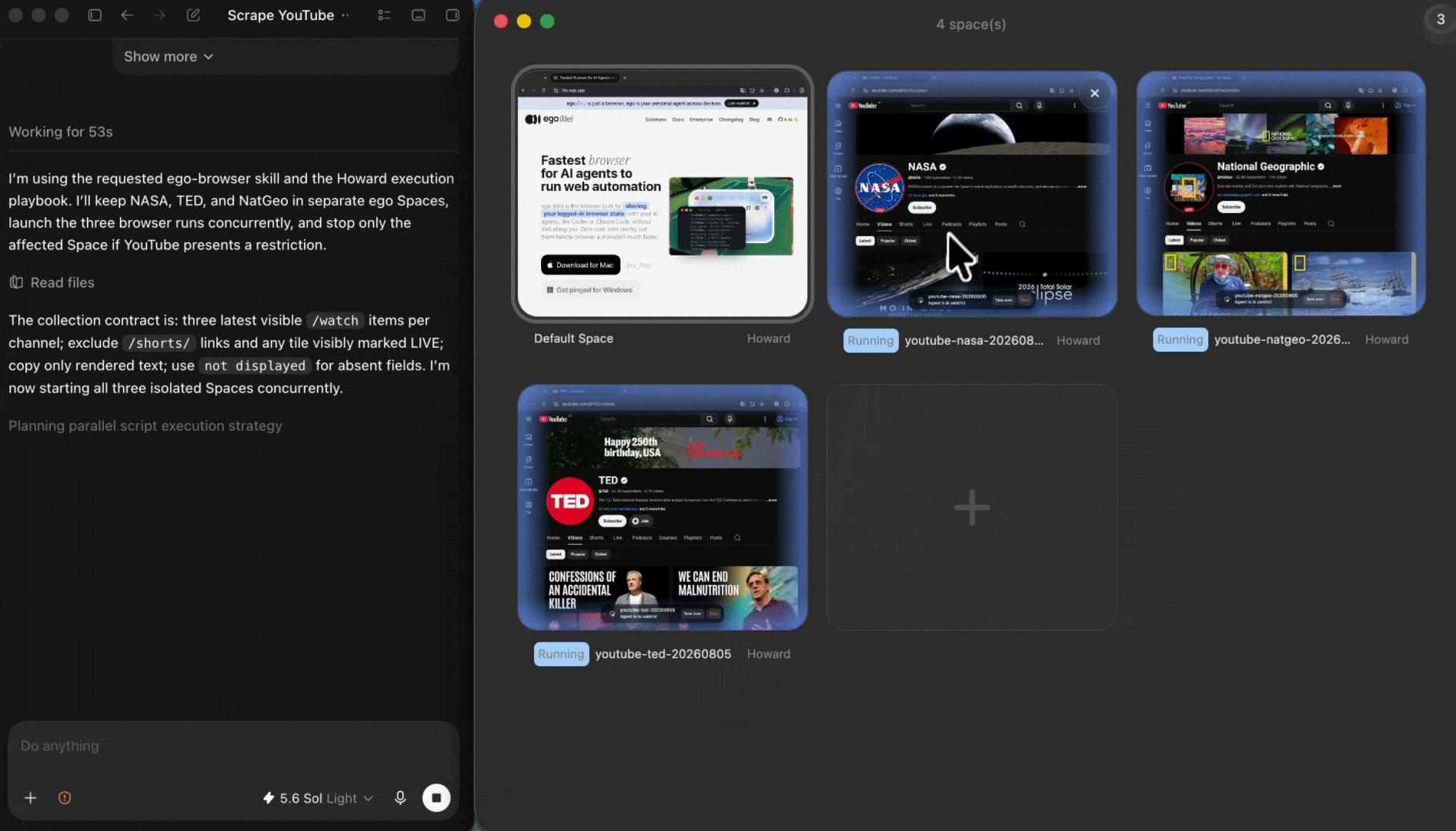
Give each channel, playlist, or video list its own Space and let your Agent run them side by side. Keep working in your own tabs while the collections continue, then open any Space to check progress, pause a task, or take over when YouTube needs you.

5

Review the source-linked YouTube scraper report

Open the finished CSV or Markdown report to compare every value with its source URL and check time. Fields are copied exactly as the page displayed them, unavailable fields stay marked instead of guessed, and you can rerun the same list later to compare checked-at times.

Why use ego (lite) as a YouTube scraper?

Most YouTube scrapers are credit-metered APIs or no-code crawlers running in someone else's cloud. ego (lite) gives the coding Agent you already use a real browser on your Mac, with visible Spaces, a browser context you control, and a report that keeps every source and access status. The workflow is free, with no tokens or per-row charges.

Finish YouTube scraping tasks with less waiting

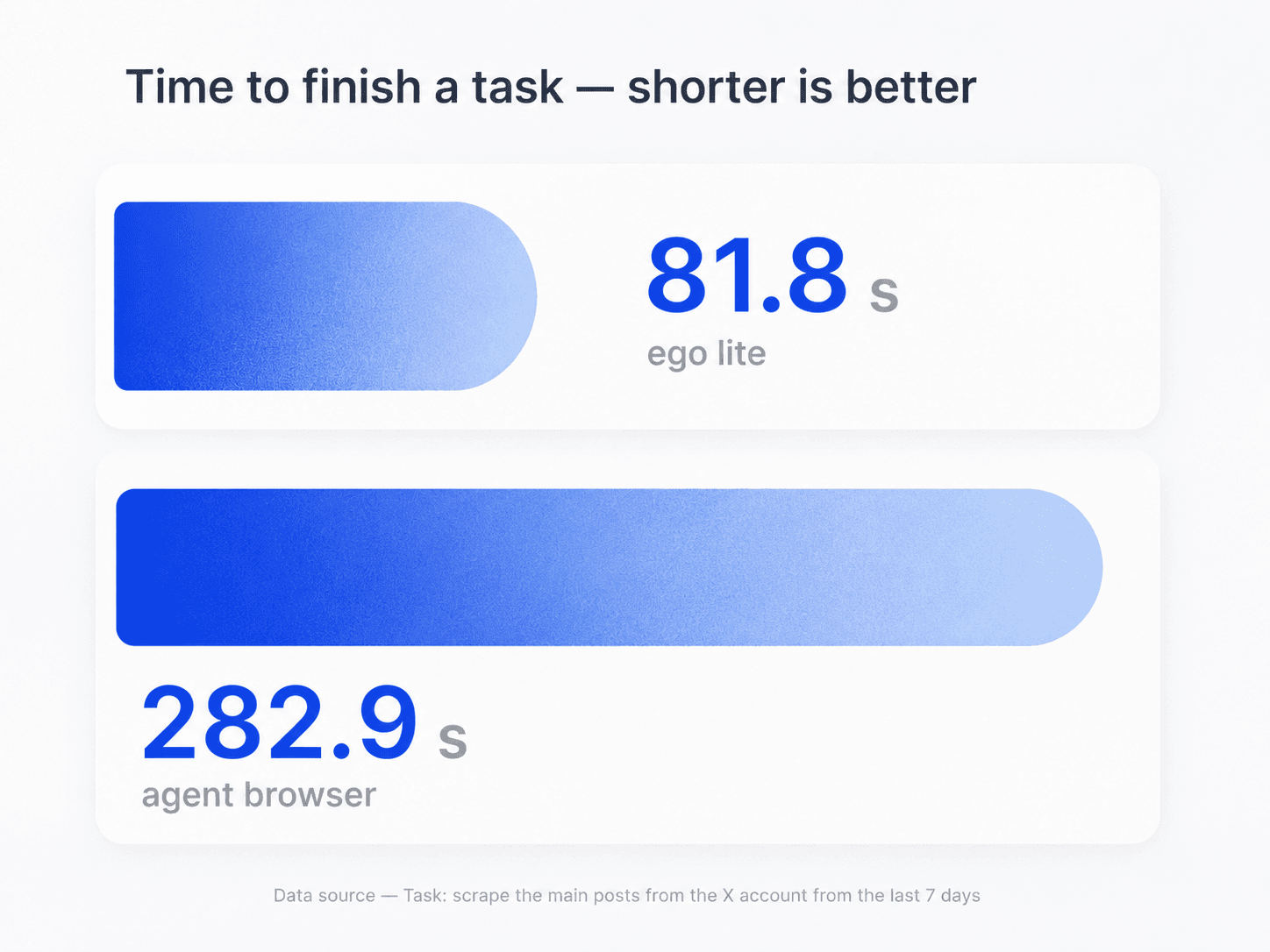
ego (lite) helps your Agent complete browser work faster, so a list of videos or channels takes less time to check. In the task shown here, ego (lite) finished in 81.8 seconds, compared with 282.9 seconds for an agent browser. Actual timing varies by website, workflow, and network conditions.

Task-time comparison for ego (lite) and an agent browser during browser data collection

Scrape several channels or lists in parallel

Give each channel, playlist, or video list its own ego (lite) Space. The Agent works through independent sources side by side without mixing browser state, and you can return to the exact page a value came from whenever a row needs a second look.

Parallel ego (lite) Spaces for separate YouTube channel and playlist scraping tasks

Watch the run and take over when YouTube needs you

Open any Space to see which video or channel the Agent is reading. When YouTube asks for sign-in, consent, age verification, or shows a CAPTCHA, the Agent stops, records the status, and hands you the browser. You decide whether to complete the step yourself, and nothing is bypassed.

Use the browser context you authorize

Import the Chrome context you choose instead of pasting URLs into an unknown cloud scraper. The Agent sees the same content you see when you open the page yourself. YouTube's sign-in, age, region, and membership rules still decide what the session displays.

ego (lite) Chrome context import for an authorized YouTube browser session

What this YouTube scraper can and cannot do

ego (lite) reads what YouTube pages display in the browser context you choose. It is built for bounded, reviewable lists rather than mass crawling. For large programmatic pipelines, the official YouTube Data API remains the right tool.

What your Agent can record

Public values visible in the current browser session.

  • Visible video fields: title, channel, displayed view count, publish or relative date, duration, likes, and description text the page shows
  • Visible channel fields: displayed subscriber count, video count, About text, and the video list the channel page shows
  • The visible video list of a playlist page, processed one video at a time
  • Source URL, checked-at time, access status, and limitations for every row

What stays out of scope

No bypasses, no downloads, no engagement, no mass crawls.

  • Private videos, YouTube Studio analytics, watch time, revenue, or any metric the public page does not display
  • Bypassing sign-in, consent, age gates, region blocks, members-only access, CAPTCHAs, or rate limits, as well as rotating proxies or evading bot detection
  • Downloading video or audio files, or ripping streams in any form
  • Playing, liking, commenting, subscribing, or any other engagement action
  • Unbounded crawls of thousands of URLs; use the official YouTube Data API for large-scale pipelines

Read YouTube's Terms of Service

Scrape YouTube data you can still verify next month

Give your Agent the video, channel, or playlist URLs and the fields you need. ego (lite) turns YouTube scraping into a source-linked report that keeps displayed values, access status, and checked-at time in the same row. You can rerun the report and compare the results later.

Try the free YouTube scraper

YouTube scraper FAQ: videos, channels, and playlists

A YouTube scraper is a tool or workflow that collects selected information from YouTube pages into a structured result, such as a CSV of video titles, view counts, and publish dates. With ego (lite), the scraper is your own AI agent working in a visible browser: it opens each public video, channel, or playlist page in a separate Space and records the fields the page displays, together with the source URL, checked-at time, and access status.

Give Codex or Claude Code the prompt on this page plus your video, channel, or playlist URLs and the fields you need. The Agent opens each source in a separate ego (lite) Space, copies the values the page visibly displays, and returns CSV or Markdown rows with a status for every source. If YouTube asks for sign-in, consent, or another human decision, it stops in that Space and lets you review or take over.

Yes. Point the Agent at a public channel videos page and it records the channel fields the page displays, including the subscriber count, video count, and About text. It also captures the visible video list with titles, URLs, and displayed view counts. Values are copied exactly as YouTube shows them (including rounded counts like “1.2M”), and anything the page does not display stays marked as not displayed.

Yes. Used as a YouTube playlist scraper, the Agent opens the playlist page, lists the videos it can see, and then records the requested fields one video at a time in separate Spaces. Long playlists take proportionally long because each video is a real page visit, and the run summary shows the status of every entry instead of silently skipping failures.

No. ego (lite) is an Agent-driven browser workflow, not a hosted API endpoint. There are no API keys, credits, or JSON quotas. If you need thousands of rows per day inside a server-side pipeline, the official YouTube Data API or a dedicated service is the better fit. This workflow is for bounded lists where you want the run observable and every row source-linked.

YouTube's Terms of Service restrict automated access, and rules differ by jurisdiction and use, so review them before you run any collection. This workflow is deliberately conservative: it reads only public values your own browser session already displays, respects sign-in walls, region blocks, CAPTCHAs, and rate limits instead of bypassing them, and keeps a source trail for review. None of this page is legal advice.

Only the comments the page visibly loads in your session, for a small, bounded list of videos. The Agent can record visible comment text with its video source, but it will not paginate through thousands of comments or reconstruct threads the page never displayed. For large comment datasets, the official YouTube Data API is the appropriate tool.

No. The output is text and metadata: titles, URLs, displayed counts, dates, statuses, and check times. The workflow does not download video or audio files, and it is not a tool for saving copies of media.

Yes, through the dedicated transcript workflow. The Agent opens YouTube's own “Show transcript” panel and saves what it displays, with the caption language and auto-generated label preserved. See the YouTube transcript extractor page for the full prompt and its boundaries. Videos without captions stay marked instead of being transcribed from audio.

ego (lite) is free to download for Mac, and the Agent doing the work is your own Codex or Claude Code. There are no scraping credits, per-row charges, or sign-up walls in this workflow. What it can record is limited by what your browser session can see, not by a meter.

Scraper APIs and no-code crawlers run in someone else's cloud, meter output by credits, and often sell proxy rotation and bot-detection handling. ego (lite) runs in a visible browser on your Mac with the agent you already use: the scope stays bounded by your input list, nothing is bypassed, and every row keeps its source URL, checked-at time, and access status so results stay reviewable.

The Agent stops in that Space and records the visible restriction instead of solving or bypassing it. You can inspect the browser state, complete an authorized step yourself if appropriate, or end the run. The report keeps the source, time, and blocked status so a limited result is never mistaken for a complete one.