





ego (lite)는 그저 브라우저일 뿐이고, ego는 여러 기기를 넘나드는 나만의 에이전트입니다.
대기자 명단 등록
ego lite vs Stagehand

최고의 Stagehand 대안

Stagehand is Browserbase's open-source SDK: you write TypeScript or Python, and methods like act, extract, and observe turn plain-language instructions into browser actions.

ego lite is a Stagehand alternative that skips the SDK entirely. Run /ego-browser and your coding agent controls ego lite directly, batching a whole task into one JavaScript call, finishing whole tasks 3 to 4x faster than Stagehand.

다음 소속 개발자들이 신뢰합니다
GoogleAmazonShopifyTikTokHarvardStanfordUSCUCLA

ego lite가 Stagehand보다 나은 이유

Stagehand means maintaining a TypeScript or Python project, and every uncached action is another model call at runtime. With ego lite you type one sentence in Claude Code, Codex, or Cursor after /ego-browser. No project, no schema, no API key.

실제 작업에서 3~4배 빠름

In Stagehand, three clicks in a row can mean three separate trips to the model before the page moves again. Stagehand's own speed guide shows this pattern and suggests calling observe first so later clicks can reuse what it found.

Run /ego-browser and your coding agent controls ego lite directly. Every page arrives as a Snapshot: a compressed accessibility tree with stable @N refs it can act on instantly. Your coding agent spends its time on the task, not restructuring scripts, finishing whole tasks 3 to 4x faster than Stagehand.

Time to finish a task, shorter is better
81.8 sego lite
282.9 sagent browser
Data source - Task: scrape the main posts from the X account from the last 7 days
병렬 멀티태스킹으로 더 빠르게 실행

Running several Stagehand tasks at once means spinning up and tearing down browser instances in your own code, or moving to Browserbase and hitting session caps of 3, 25, or 100. To see what happened, you open a replay after the run finishes.

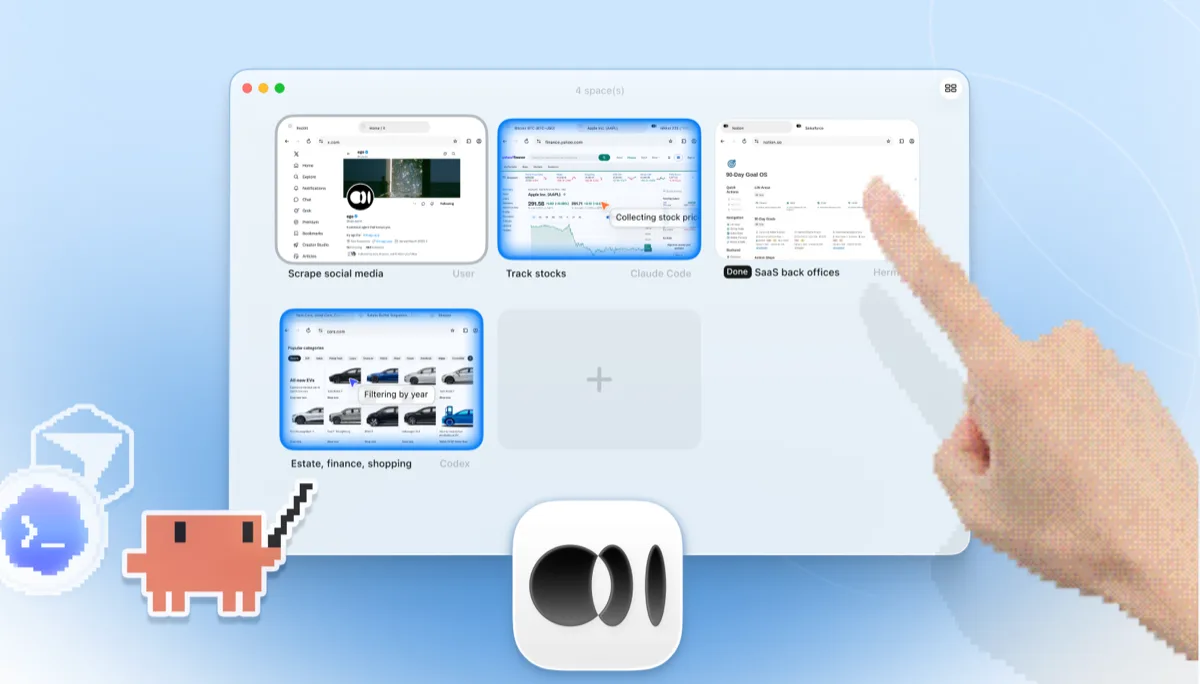
In ego lite there's no cap on how many Spaces you open inside the same browser: each one runs its own task at the same time, controlled by a coding agent via /ego-browser on its own imported Chrome profile. None of them ever steals the tab you're using, and you can watch or take over any Space anytime.

불필요한 왕복 없이 토큰 비용은 더 적게

Stagehand's action cache helps when you repeat the same flow on the same page. On a new site, or after the DOM shifts, each call asks the model again, and stale caches have to be cleared by hand.

Run /ego-browser and your coding agent batches several actions in a few lines of JavaScript per turn to control ego lite. Stacked with Snapshot input, the same task completes on far fewer tokens overall.

Claude Code · ego lite
>/ego-browser Add the first product to the cart, then check checkout loads
Bash(
ego-browser nodejs <<'EOF' await openOrReuseTab('localhost:3000') await click('.product-card') await click('.add-to-cart') await click('a[href="/checkout"]') cliLog('checkout loaded') EOF
)
Output:
[t=4480ms] checkout loaded
Done. Both steps work.
─── 1 tool call · 1.1k tokens ───
Stagehand · env: "LOCAL"
>$ npx tsx run_task.ts const stagehand = new Stagehand({ env: "LOCAL" }) await stagehand.init()
await page.goto("http://localhost:3000")
// page = stagehand.context.pages()[0]
navigated: http://localhost:3000
1.6k tokens sent so far
await stagehand.act("click the first product card")
// LLM call #1 · model: gpt-5.6-sol
→ { success: true, message: "Action completed successfully",
actions: [{ selector: "/html/body/div[2]/main/div[1]/a",
method: "click", arguments: [] }] }
3.8k tokens sent so far
await stagehand.act("click add to cart")
// LLM call #2 · model: gpt-5.6-sol
→ { success: true, message: "Action completed successfully",
actions: [{ selector: "/html/body/div[2]/main/button[1]",
method: "click", arguments: [] }] }
5.9k tokens sent so far
await stagehand.observe("find the checkout link")
// LLM call #3 · model: gpt-5.6-sol
→ [{ selector: "/html/body/nav/a[href='/checkout']",
description: "Checkout link", method: "click", arguments: [] }]
8.0k tokens sent so far
await stagehand.act(action)
// no LLM: Action from observe()
→ { success: true, message: "Action completed successfully",
actions: [{ method: "click" }] }
navigated: /checkout
9.1k tokens sent so far
await stagehand.extract("is the payment form present?", z.object({ present: z.boolean() }))
// LLM call #4 · model: gpt-5.6-sol
→ { present: true }
11.4k tokens sent so far
await stagehand.extract("list the payment fields", z.object({ fields: z.array(z.string()) }))
// LLM call #5 · model: gpt-5.6-sol
→ { fields: ["card", "expiry", "cvc", "zip"] }
13.6k tokens sent so far
─── 7 model calls · 13.6k tokens ───
The same task, the same model. Left: one batched JavaScript call in ego lite, 1.1k tokens total. Right: a Stagehand script, a model call on nearly every step, tokens climb to 13.6k.

같은 Chrome, 에이전트 네이티브

Staying logged in is the hard part of local Stagehand. Chrome profile support still has an open bug in v3, cookie workarounds often miss the HttpOnly session cookies that matter, and the browse CLI only attaches if you started Chrome with remote debugging yourself.

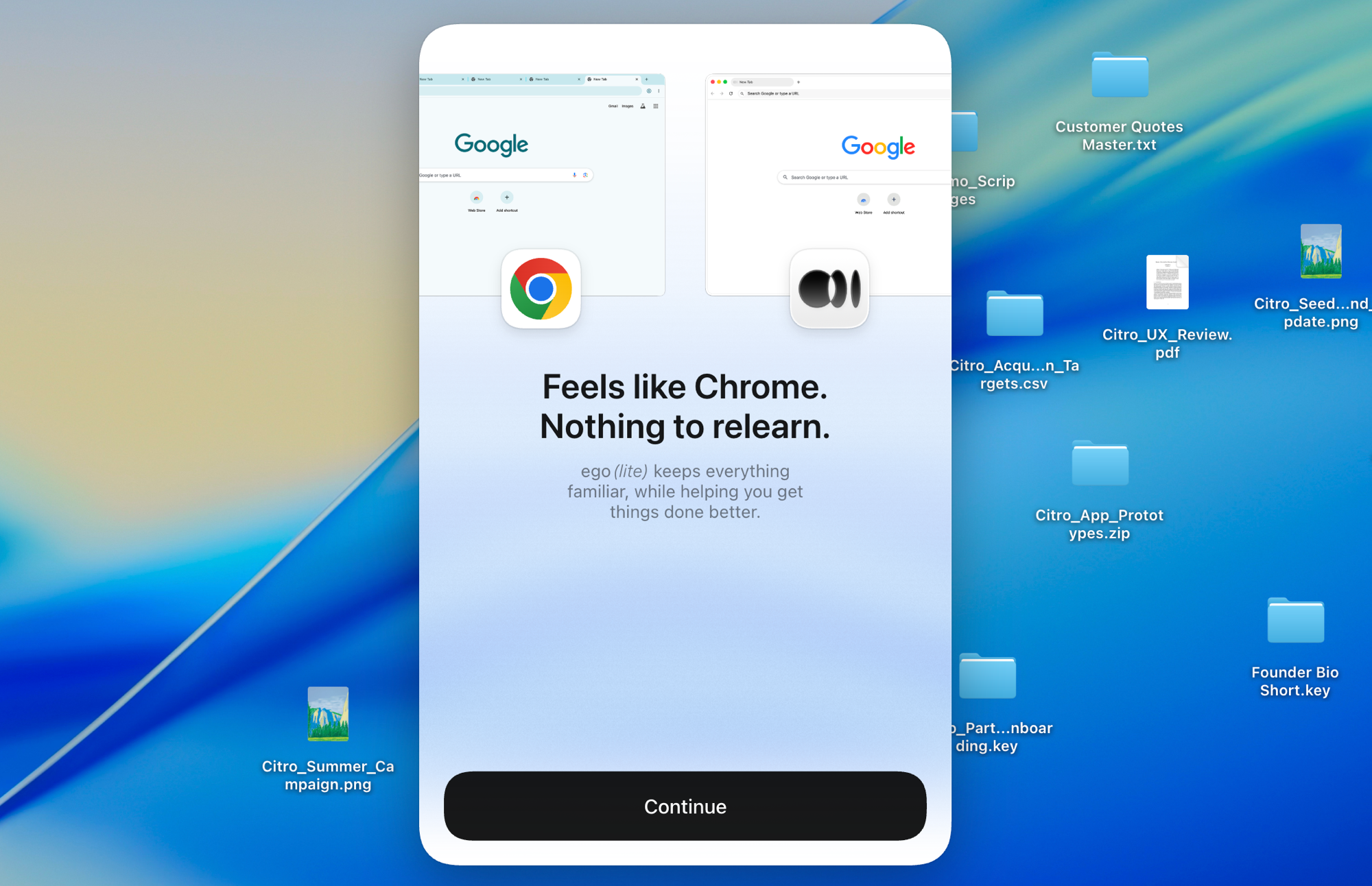
Built on Chromium, ego lite imports your entire Chrome setup in one click. When your coding agent runs /ego-browser, it controls ego lite with your real sessions already in place, so it doesn't stall on SSO, 2FA, or captchas on accounts you already have.

ego lite Chrome 프로필 가져오기: 로그인 정보까지 클릭 한 번으로 설정 완료

ego lite vs Stagehand

ego lite와 Stagehand의 기능 비교.
기능ego liteStagehand
무엇을 쓰는지아무것도 없음. 이미 쓰는 에이전트에게 한 문장A TypeScript or Python project: SDK, act/extract/observe, keep it working
에이전트가 페이지에서 동작하는 방식Coding agent batches multiple actions in JavaScript per turn via /ego-browserOne model call per act, extract, or observe that isn't cached; precise locators when you want to skip the model
작업당 토큰 비용Lower: Snapshot plus batched JavaScript, measured per taskRepeated flows can reuse a cached selector; new pages pay for a fresh model call each time
실제 Chrome 로그인 정보를 그대로 재사용Yes, one-click Chrome profile import; coding agent controls ego lite via /ego-browserNot reliably in local mode: Chrome profile support has an open bug, and browse needs remote debugging
설정Install ego lite, run /ego-browser in your agentnpm/pip install, model API key, and a project
병렬 작업 분리Unlimited Spaces in one browser, bounded by your machineYour code manages instances; Browserbase caps concurrency by plan
일상적으로 쓰는 브라우저 역할도 겸함네. 사용자는 자신의 Space에서 브라우징하고, 에이전트는 각자의 Space에서 작업해요아니요. 깨끗한 자동화 브라우저를 띄움
커밋 가능하고 반복 가능한 자동화No. Tasks are interactiveYes: scripts with git history, review, and a committed cache
재사용 가능한 스킬 (출시 예정)성공한 실행을 재사용 가능한 스킬로 압축하며, 에이전트가 이를 반복할수록 복잡한 작업에서 최대 5배 빠름 (제한적 베타)Action caching on repeated flows only
가격무료, 구독 없음, 계정 없음MIT and free to install; you pay model tokens (plus Browserbase if hosted)
마지막 업데이트 2026년 7월 30일

매끄럽게 전환해 보세요

Already running Stagehand scripts in CI or on a schedule? Keep those. Move one-off and logged-in exploratory work to ego lite in a few minutes.

  1. ego (lite) 다운로드

    ego lite를 다운로드하고 클릭 한 번으로 Chrome 프로필을 가져오세요. 로그인 정보, 쿠키, 확장 프로그램까지 그대로 따라옵니다.

  2. /ego-browser로 첫 작업을 실행해보세요

    에이전트에 붙여넣기

    /ego-browser ego.app에 접속해 대기 명단에 등록하세요

    Paste one sentence into Claude Code, Codex, or Cursor and hit enter. No SDK, no model API key, no Zod schema.

  3. 작동하는 모습을 확인하세요
    네 개의 브라우저 작업이 나란히 실행되는 ego lite Spaces 개요: Yahoo Finance에서 Apple 주가를 추적하는 Claude Code, cars.com에서 연식별로 차량을 필터링하는 Codex, SaaS 백오피스 작업을 마무리하는 Hermes, X를 스크래핑하는 사용자, 그리고 손가락으로 +를 눌러 새 Space를 여는 모습

    The task runs in its own Space, so your tabs stay untouched. Watch live or take over anytime. Results land back in your agent's CLI.

Keep Stagehand for committed automation, typed extraction, and deterministic locators.

각 도구를 언제 사용해야 할까요

ego (lite)를 선택해야 할 때

  • You'd rather describe a one-off scrape or form fill than maintain a TypeScript or Python project for it.
  • The work sits behind your own logins and should start signed in.
  • You want parallel Spaces you can watch, without managing browser instances in code.
  • You don't want to add an SDK, model key, and project for something your coding agent can already do.

Stagehand를 선택해야 할 때

  • Automation must live in a repo with review, caching, and the same run months later.
  • You want a deterministic escape hatch: precise locators when a flow must not vary.
  • You need typed extraction with a Zod schema into TypeScript.
  • It must run in CI or across many cloud browsers on Browserbase.

AI 에이전트에게 진짜 브라우저를 선사하세요

무료이며 Mac에서 실행되고, 클릭 한 번으로 Chrome 프로필을 가져옵니다. Claude Code, Codex, Cursor 등 코드를 작성하는 모든 CLI 에이전트와 함께 사용할 수 있습니다.

아직 저울질 중이신가요? Stagehand가 같은 분야의 다른 도구와 어떻게 다른지 보세요.

자주 묻는 질문

Stagehand is Browserbase's MIT-licensed browser automation SDK for TypeScript and Python. It gives you act, extract, observe, and agent primitives, plus precise locators when you want to skip the model. It runs locally against Chromium, and pairs with Browserbase when you want hosted sessions, caching, and replay. For automation you commit to a repo and run on a schedule, it remains an excellent choice.

For interactive, logged-in browser work, yes: run /ego-browser and describe the task. For committed automation you ship to CI, with typed extraction and deterministic locators, keep Stagehand. Stagehand is for browser work you commit; ego lite is for browser work you do today.

No. Stagehand runs locally against Chromium on its own. Browserbase is optional when you want hosted sessions, server-side caching, and replay. The Browserbase vs Stagehand pairing matters for cloud fleets, not for a local script on your laptop. ego lite has no hosted path: local only, free, no account.

Often yes in production, but for different reasons. Stagehand is the SDK you write act, extract, and observe calls in. Browserbase is where those scripts run when you need cloud scale. For your own agent chores on logged-in sites, you may need neither: run /ego-browser and let Claude Code or Codex drive ego lite directly.

Stagehand is MIT-licensed and free to install. You pay model tokens for every act, extract, or observe call that is not cached, plus Browserbase browser minutes if you host it there. ego lite is free. You only pay the model tokens your coding agent already uses.

Not dependably in local mode today. Pointing Stagehand at your Chrome profile still has an open bug in v3, and cookie workarounds often miss the HttpOnly session cookies that matter. ego lite imports your Chrome profile once, and every task starts signed in.

They aim at different developers. Stagehand is TypeScript-first with act, extract, and observe primitives for hybrid code-plus-AI automation. Browser Use is Python-first and runs a more autonomous agent loop. Both are frameworks you write and fund. ego lite is the Chromium browser your coding agent controls via /ego-browser. See ego lite vs Browser Use for that side.

Stagehand is an SDK: you write act, extract, and observe calls in TypeScript or Python. agent-browser is a CLI your agent shells out to, one command at a time. ego lite is neither. Run /ego-browser and your coding agent controls ego lite with batched JavaScript. See ego lite vs agent-browser.

Not as a native skill. Claude Code would run a Stagehand script you wrote, with model API keys and a project to maintain. ego lite is the shorter path: run /ego-browser in Claude Code, Codex, or Cursor and describe the task. No SDK install, no schema, no separate model billing loop.

When an action is not cached, the model picks the target again each time, so a shifting page can resolve differently. Caches can also go stale after the DOM changes. Use Stagehand's precise locators when a flow must not vary. ego lite is built for interactive work where some variation is acceptable.

Neither. Run /ego-browser in Claude Code, Codex, Cursor, Gemini CLI, or OpenCode. Free on macOS 12+, no account required.